
Enter a cage's inside dimensions to check its base space, height, and main standing surface for one or two chinchillas.
Table of contents
How to use our Chinchilla Cage Size and Floor Space Calculator
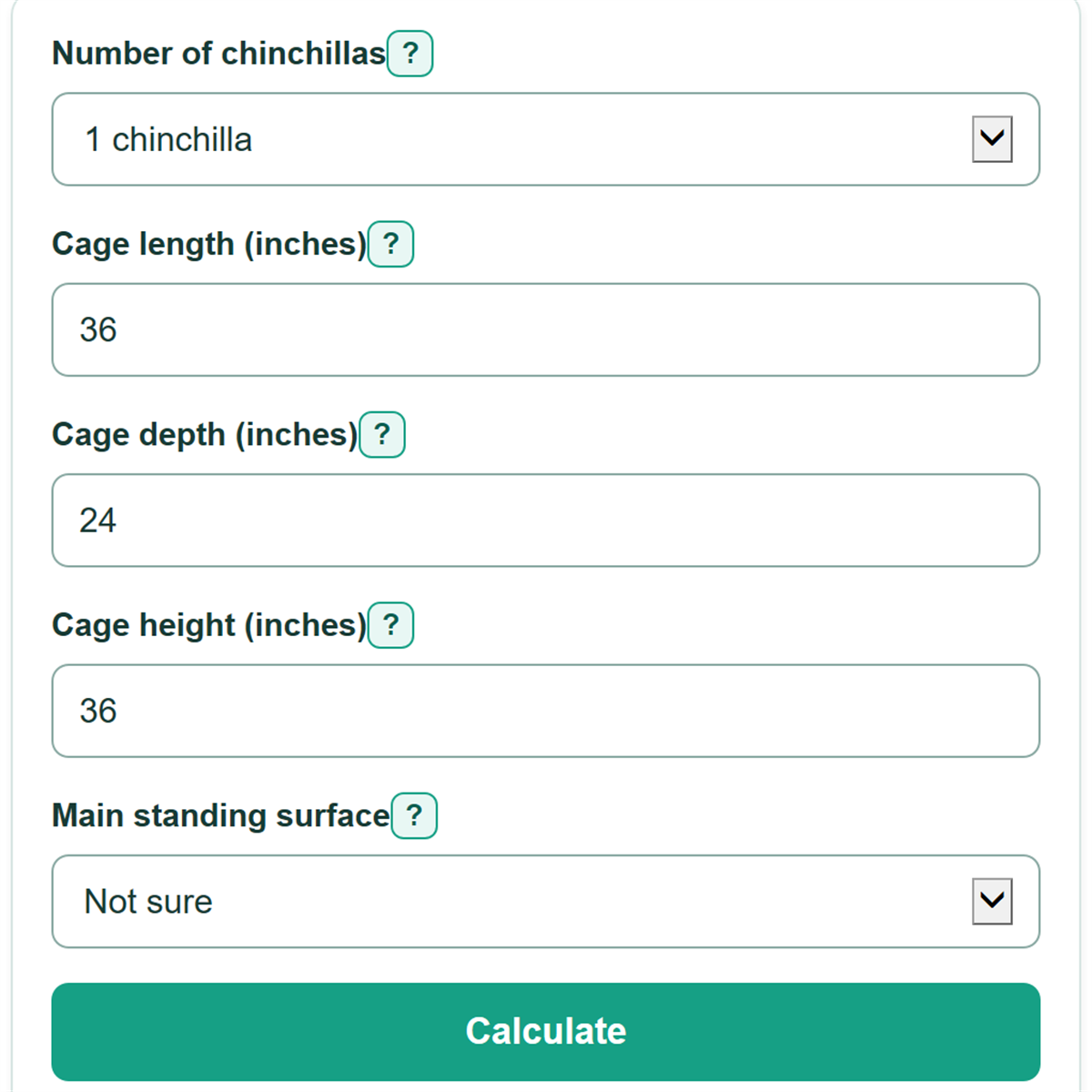
- Choose the number of chinchillas that will live in the cage.
- Enter the usable inside Cage length, Cage depth, and Cage height in inches from a listing, manual, or tape measure.
- Choose the Main standing surface that the chinchilla regularly stands on.
- Select Calculate, then read Cage dimension check and Standing-surface check as separate results.
- Sanity-check the result by confirming that the entered dimensions are inside cage measurements, not shipping-box or stand dimensions, and that both horizontal sides meet the listed benchmark.
Definitions
Entered cage floor area: The base footprint in square feet, calculated from Cage length times Cage depth. It does not include shelves.
Entered enclosure volume: The inside space in cubic feet, calculated from length times depth times height. It is supporting information, not a pass rule.
Required base floor area: The 6 square foot footprint made by a 36 by 24 inch base.
Required cage height: The height used for the selected Number of chinchillas: 36 inches for one or 60 inches for two under the cited VCA housing benchmark. [1]
Standing surface: The cage base or surface where the chinchilla regularly stands. Solid flooring or wire with a solid cover receives a basic pass in this check.
Common mistakes and quick fixes
Mistake: Using the shipping carton dimensions for Cage length, Cage depth, or Cage height.
Fix: Use the usable inside dimensions of the assembled cage.
Mistake: Assuming a large Entered cage floor area makes up for a narrow Cage depth.
Fix: Check Cage dimension check because each horizontal side must meet the benchmark separately.
Mistake: Counting shelves as part of Entered cage floor area.
Fix: Enter only the base Cage length and Cage depth; shelves are not added to the footprint.
Mistake: Choosing Solid surface when the Main standing surface includes uncovered wire.
Fix: Choose Mixed or partly uncovered, or Uncovered wire, so Standing-surface check gives the needed follow-up.
Mistake: Selecting 1 chinchilla for a cage intended for a pair.
Fix: Choose 2 chinchillas so Required cage height uses the pair benchmark.
Limitations & Key Assumptions / Boundary Conditions
- This is a planning check against one source-labeled VCA benchmark: 36 by 24 by 36 inches for one chinchilla and 36 by 24 by 60 inches for two. Other sources may use different guidance.
- Only one or two chinchillas are supported. Do not use the result to size a cage for more animals.
- The calculator checks inside dimensions only. It does not assess bar spacing, door security, cage material, shelf design, cleaning, room temperature, exercise, hiding places, or compatibility between animals.
- Floor area is the base footprint only. Shelves and ledges are not added, and enclosure volume cannot make up for a short base side or insufficient height.
- A basic Standing-surface check is not a complete safety assessment. Uncovered, mixed, or unknown wire surfaces need closer inspection and discussion with an exotic-animal veterinarian.
Methodology
Dimension check
The calculator uses the VCA housing dimensions as its displayed benchmark: a 36 by 24 inch base for one or two chinchillas, with a 36 inch height for one and a 60 inch height for two. [1]
It puts the two entered horizontal measurements in order before checking them. This means a retailer can call a side width instead of depth without changing the result.
floor area (sq ft) = Cage length (inches) x Cage depth (inches) / 144
volume (cu ft) = Cage length (inches) x Cage depth (inches) x Cage height (inches) / 1,728
dimension pass = longer horizontal side >= 36 and shorter horizontal side >= 24 and height >= required height
Worked example
For one chinchilla, a 36 by 24 by 36 inch cage has 6 square feet of base floor area and 18 cubic feet of volume. Each required dimension is met, so the Cage dimension check passes.
Standing-surface check
Solid surface and Wire with a solid cover receive a basic pass. Not sure, Uncovered wire, and Mixed or partly uncovered receive a follow-up. VCA notes that wire flooring can contribute to foot trauma and advises covering at least part of a wire floor with solid, cleanable material. [1]
Calculation choices
Floor area and volume are shown as supporting measurements. They do not replace the separate checks of both horizontal sides and height.