
Calculate daily dairy income over feed cost and feed efficiency using your milk, milk-price, feed-cost, and dry-matter records.
Milk made per lactating cow divided by dry matter intake.
Calculation details
Table of contents
How to use our Dairy Income Over Feed Cost and Feed Efficiency Calculator
- Choose "Lactating cows only" for a per-cow feeding check, or choose "Whole-herd planning" when you also have milk-shipment and dry-cow feed records.
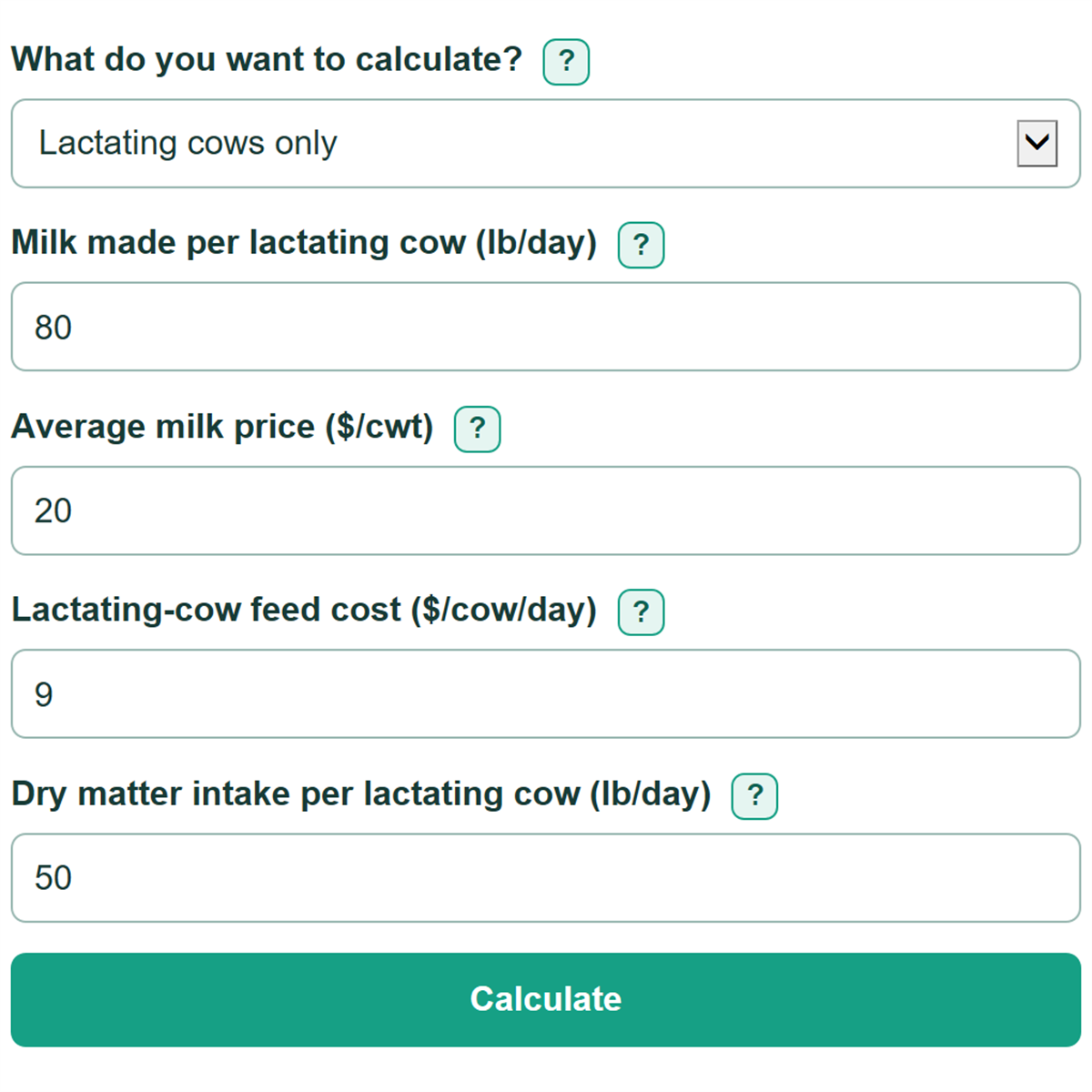
- Enter records from the same day or matching reporting period for Milk made per lactating cow (lb/day), Average milk price ($/cwt), Lactating-cow feed cost ($/cow/day), and Dry matter intake per lactating cow (lb/day).
- For whole-herd planning, also enter Lactating cows (count), Milk shipped (lb/day), Dry cows (count), and Dry-cow feed cost ($/cow/day).
- Click Calculate. Check that milk made and dry matter intake describe the same lactating-cow group, and that milk shipped and cow counts match the feed costs included.
Definitions
Income over feed cost (IOFC): Milk revenue minus the feed cost included in the chosen scope. It is a feeding margin, not net profit.
Feed efficiency: Pounds of milk made per pound of dry matter eaten. This calculator uses milk made divided by dry matter intake.
Dry matter intake: The pounds of feed eaten after water is removed from the feed.
cwt: A US hundredweight. One cwt equals 100 lb.
Milk made: Average milk produced by lactating cows. It is used for the per-cow milk revenue and feed-efficiency calculations.
Milk shipped: Milk actually sold and shipped. It is used for whole-herd milk-shipment revenue and can differ from milk made.
Common mistakes and quick fixes
Mistake: Entering Milk shipped (lb/day) as Milk made per lactating cow (lb/day).
Fix: Use milk made per average lactating cow for feed efficiency. Use milk shipped only in whole-herd planning.
Mistake: Using a milk price in dollars per pound for Average milk price ($/cwt).
Fix: Enter the blended settlement price in dollars per cwt. One cwt equals 100 lb.
Mistake: Entering wet feed weight for Dry matter intake per lactating cow (lb/day).
Fix: Use dry matter intake after feed water is removed, including the effect of refusals if your record does.
Mistake: Mixing a monthly Lactating-cow feed cost ($/cow/day) with a daily milk record.
Fix: Convert the feed cost to a daily per-cow amount, or use records averaged over the same period.
Mistake: Leaving Dry cows (count) out of whole-herd planning even though their feed is included in farm feed records.
Fix: Enter the dry-cow count and Dry-cow feed cost ($/cow/day) when you want their daily feed cost included.
Limitations & Key Assumptions / Boundary Conditions
- Income over feed cost excludes labor, veterinary care, breeding, repairs, fuel, interest, depreciation, manure handling, and other non-feed costs. It is not net farm profit.
- Use records from the same day or a matching average period. A milk price, milk amount, feed cost, and dry matter intake from different periods can produce a misleading comparison.
- Feed efficiency is a lactating-cow production measure. It uses milk made and dry matter intake for the entered lactating-cow population, even in whole-herd planning.
- Whole-herd planning treats entered dry cows as having feed cost and no milk revenue. Include other nonlactating groups only if their count and feed cost fit that assumption.
- Milk shipped may be lower than milk made because milk can be withheld or discarded. The calculator does not estimate the reason for a difference.
- Results depend on the accuracy of ration cost, dry matter percentage, feed-delivery, and refusal records.
Methodology
Calculation method
Milk price is entered in dollars per cwt, and one cwt is 100 lb. For lactating cows, the calculator first finds daily milk revenue per cow, then subtracts daily feed cost. Feed efficiency uses milk made, not milk shipped.
Lactating-cow milk revenue = (milk made per lactating cow / 100) * average milk price
Lactating-cow income over feed cost = lactating-cow milk revenue - lactating-cow feed cost
Feed efficiency = milk made per lactating cow / dry matter intake per lactating cow
Whole-herd planning
Whole-herd planning uses milk shipped for revenue. It adds lactating-cow feed cost and dry-cow feed cost, then subtracts that combined feed cost from shipment revenue. The daily herd margin is also divided by lactating cows to show a per-lactating-cow comparison value.
Whole-herd milk-shipment revenue = (milk shipped / 100) * average milk price
Whole-herd feed cost = (lactating cows * lactating-cow feed cost) + (dry cows * dry-cow feed cost)
Whole-herd income over feed cost = whole-herd milk-shipment revenue - whole-herd feed cost
Worked example
With 80 lb of milk made per lactating cow, a milk price of $20/cwt, and a lactating-cow feed cost of $9/day, milk revenue is $16/day and income over feed cost is $7/cow/day. With 50 lb of dry matter intake, feed efficiency is 1.6 lb milk per lb dry matter. In whole-herd planning, 7,600 lb shipped at $20/cwt produces $1,520/day of milk-shipment revenue; 100 lactating cows at $9/day plus 20 dry cows at $4/day produces $980/day of feed cost, leaving $540/day.