
Estimate whether your hay supply covers the feeding period, how many bales to buy, and the delivered cost after losses.
Table of contents
How to use our Hay Inventory, Bale Waste and Winter Feed Cost Calculator
- Enter Animals to feed, Daily hay per animal, and the planned Feeding period.
- Enter Bales on hand and Average bale weight from a scale ticket, seller record, or weighed sample.
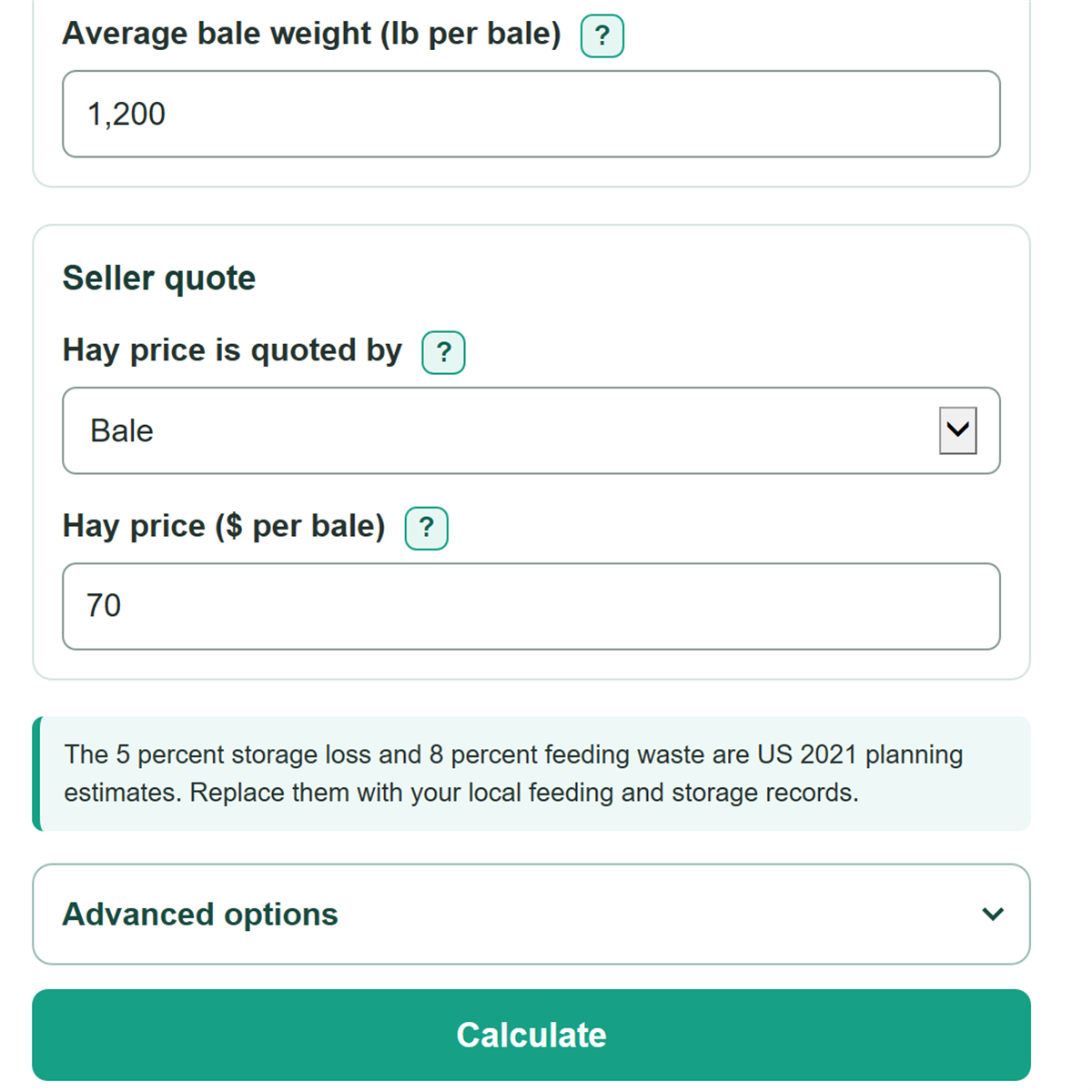
- Choose how the seller quotes hay under Hay price is quoted by, then enter the matching Hay price.
- Open Advanced options to review Storage loss (percent), Feeding setup, and Feeding waste (percent); add delivery or tax only when they apply.
- Check that Feeding days covered by current inventory is close to your records and that the bale weight matches the hay you actually have or plan to buy.
Definitions
As-fed hay: The actual weight of hay fed, including its moisture. This calculator uses an as-fed daily amount rather than a dry-matter ration calculation.
Storage loss: Hay lost or spoiled while stored before it reaches the feeder.
Feeding waste: Hay that is offered but not eaten because it is refused, trampled, blown away, or otherwise lost at feeding.
Usable hay on hand: Current bale weight after the entered storage loss and feeding waste are applied.
Minimum raw hay shortfall: The unrounded pounds of raw hay needed to cover a shortage after both losses.
Short ton: A US ton equal to 2,000 lb.
Estimated delivered hay purchase cost: Hay purchase cost plus any entered flat delivery charge and sales tax on the hay purchase.
Common mistakes and quick fixes
Mistake: Using bale shape to guess Average bale weight.
Fix: Use a scale ticket, seller record, or an average from sample bales. Round, square, and similarly sized bales can weigh very differently.
Mistake: Entering hay offered at the feeder as Daily hay per animal while also adding a high Feeding waste (percent).
Fix: Enter the amount each animal needs to consume before losses, then use feeding waste only for hay that is refused, trampled, or otherwise lost.
Mistake: Treating Storage loss (percent) and Feeding waste (percent) as one combined percent.
Fix: Keep them separate. Storage loss happens before feeding, and feeding waste applies to hay that reaches the feeding setup.
Mistake: Entering a per-bale quote after selecting Short ton under Hay price is quoted by.
Fix: Match the selection to the seller quote before entering Hay price. The calculator keeps bale and ton prices as different values.
Mistake: Adding Flat delivery charge ($ per order) when no bales need to be purchased.
Fix: Leave it blank unless a new order is needed. The calculator applies this charge only when Bales to buy is greater than zero.
Mistake: Reading a negative Usable inventory balance as an error.
Fix: A negative balance is a shortfall in usable hay. Use Minimum raw hay shortfall and Bales to buy to plan the purchase.
Limitations & Key Assumptions / Boundary Conditions
- The calculation assumes every animal has the same Daily hay per animal. Run separate plans for groups with different needs.
- It uses an as-fed hay amount supplied by you. It does not calculate a ration from body weight, forage test results, hay dry matter, pasture intake, supplements, or production stage.
- All bales on hand and purchased bales are assumed to have the entered Average bale weight and the same loss percentages.
- Storage loss and feeding waste are planning assumptions. Replace the defaults with farm records when possible because storage conditions, weather, feeder design, and animal behavior can change losses.
- Purchases are rounded up to whole bales, so Planned hay purchase can exceed the Minimum raw hay shortfall.
- Delivery is treated as one flat order charge and tax is applied only to hay purchase cost. Labor, equipment, feeder, barn, and financing costs are excluded.
- Check local tax treatment and seller quote terms before buying hay.
Methodology
Calculation steps
The calculator first finds the share of raw hay expected to remain after storage and feeding losses. The default 5 percent storage loss and 8 percent feeding-waste starting value are planning estimates; the feeding setup can suggest a different waste starting value. University of Maryland Extension discusses a 5 percent protected-storage example and feeder-related waste ranges. [1]
usable_fraction = (1 - storage_loss / 100) * (1 - feeding_waste / 100)
Losses are applied one after the other. They are not added together.
daily_herd_need_lb = animals_to_feed * daily_hay_per_animal_lb
season_need_lb = daily_herd_need_lb * feeding_period_days
raw_hay_needed_lb = season_need_lb / usable_fraction
usable_hay_on_hand_lb = bales_on_hand * average_bale_weight_lb * usable_fraction
usable_inventory_balance_lb = usable_hay_on_hand_lb - season_need_lb
If the balance is negative, the calculator converts that usable shortage back to raw hay and rounds the purchase up to a whole bale.
minimum_raw_hay_shortfall_lb = -usable_inventory_balance_lb / usable_fraction
bales_to_buy = ceil(minimum_raw_hay_shortfall_lb / average_bale_weight_lb)
Planned purchase weight is divided by 2,000 to show US short tons. Cost uses either whole purchased bales times the per-bale quote or purchased short tons times the per-ton quote. Delivery is added only when bales are purchased, and tax is calculated on hay purchase cost only.
Worked example
For 20 animals eating 25 lb per day for 120 days, season consumption is 60,000 lb. With 5 percent storage loss and 8 percent feeding waste, the usable fraction is 0.95 * 0.92 = 0.874.
raw_hay_needed_lb = 60000 / 0.874 = 68649.89 lb
With 40 bales at 1,200 lb each, usable inventory is 40 * 1,200 * 0.874 = 41,952 lb. The usable shortfall is 18,048 lb, which requires 20,649.89 lb of raw hay. Rounding up requires 18 bales, or 10.8 short tons.