
Estimate standing-tree board feet under three log rules and apply a matching $ per MBF quote for a planning value.
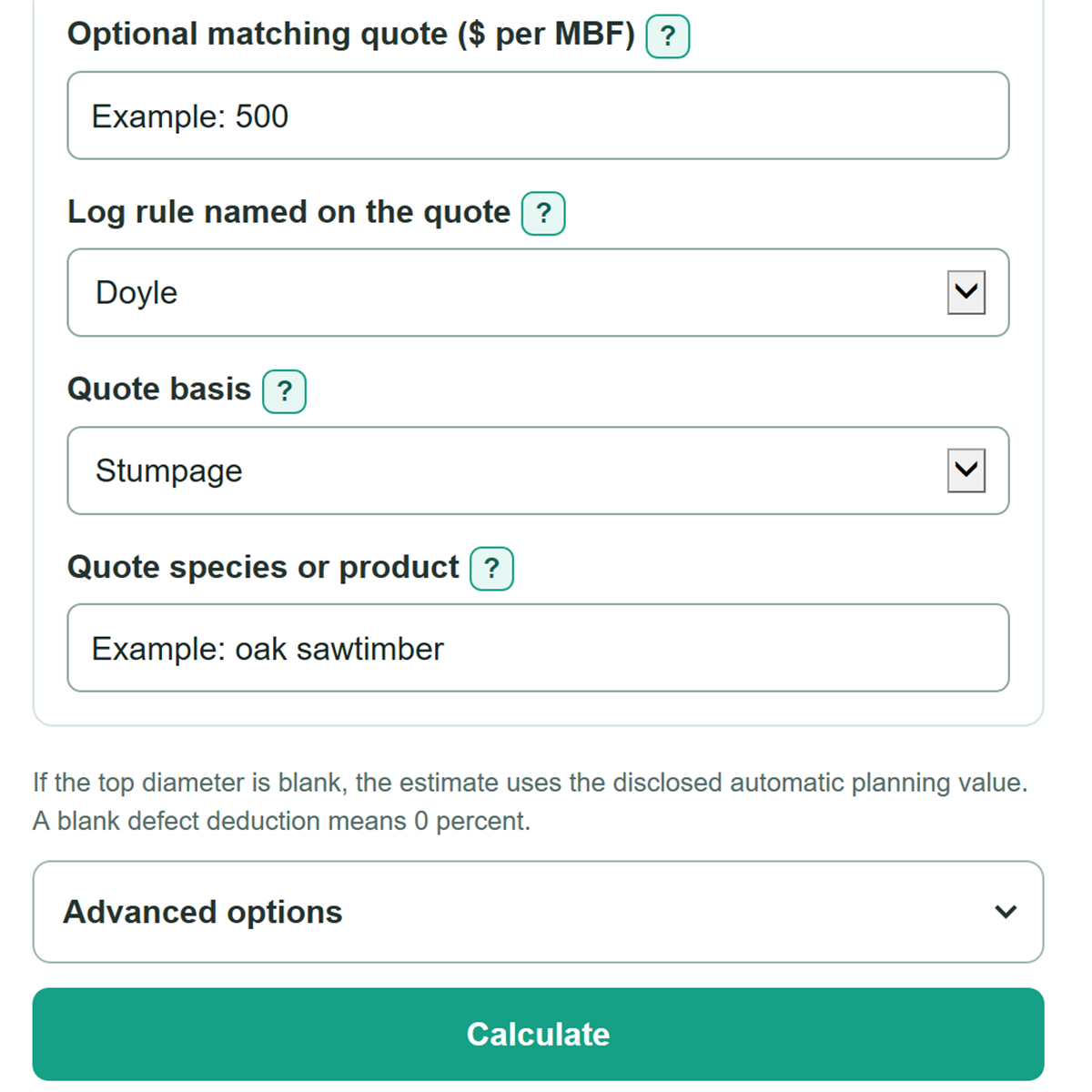
Optional matching quote
If the top diameter is blank, the estimate uses the disclosed automatic planning value. A blank defect deduction means 0 percent.
Advanced options
Table of contents
How to use our Doyle, Scribner, and International Timber Calculator
- Enter DBH at 4.5 ft above ground (inches), the trunk diameter measured on the standing tree at breast height.
- Choose how you will enter height, then enter Merchantable height (16-ft logs) or merchantable feet and the Number of trees with these measurements.
- For a value estimate, enter the Optional matching quote ($ per MBF), then copy its rule, basis, and species or product wording into the quote fields.
- Open Advanced options only if you know the buyer or cruise top diameter or want to apply a Defect deduction (percent).
- Check that the quote-based value uses the same named rule as your quote, and compare the three board-foot results before using any one of them for a decision.
Definitions
DBH: Diameter at breast height, measured on a standing tree 4.5 feet above ground.
Merchantable height: The usable sawlog length of the trunk. It can be entered as 16-foot log sections or as feet.
DIB: Diameter inside bark. It is the wood diameter after excluding bark.
Board foot (BF): A lumber-volume unit used for timber scaling.
MBF: One thousand board feet. A quote in $/MBF is multiplied by board feet divided by 1,000.
Doyle, Scribner, and International 1/4: Different log rules used to estimate board-foot volume. The same tree can have a different result under each rule.
Defect deduction: A percentage removed from gross scaled volume as a planning adjustment for issues such as rot, sweep, crook, or damage.
Stumpage: The price for standing timber paid to the landowner. Delivered pricing is for timber at a later transaction point.
Common mistakes and quick fixes
Mistake: Entering trunk circumference in DBH at 4.5 ft above ground (inches) .
Fix: Enter diameter, not the distance around the trunk. Measure at 4.5 feet above ground.
Mistake: Using the tree's total height as Merchantable height (16-ft logs) .
Fix: Enter only the usable sawlog portion of the trunk, stopping at the applicable merchantable top.
Mistake: Selecting Doyle under Log rule named on the quote when the buyer quote says Scribner or International 1/4.
Fix: Select the exact rule printed on the same quote line as the price.
Mistake: Entering a price in Optional matching quote ($ per MBF) without filling in Quote species or product .
Fix: Copy the species or product wording from the same bid, contract, or report line as the price.
Mistake: Treating a Delivered Quote basis as if it were stumpage paid for standing timber.
Fix: Keep delivered and stumpage quotes separate because they describe different transaction points.
Mistake: Setting Top diameter inside bark override (inches) larger than DBH.
Fix: Use a top diameter no greater than the entered DBH, or leave the override blank to use the calculator's planning check.
Limitations & Key Assumptions / Boundary Conditions
- This is a simplified standing-tree estimate using a straight-line taper from DBH to the selected top diameter. Real stems do not all taper in a straight line.
- The calculator applies log-rule equations to modeled stem segments. It is not a certified timber cruise, mill scale, grade determination, or recovery estimate.
- DBH is used as the modeled starting diameter even though DBH is not a cut log's small-end DIB.
- The automatic top diameter is a planning check: 8 inches or 50% of DBH, whichever is larger, limited to no more than DBH. Replace it with the buyer or cruise specification when known.
- A single DBH and merchantable height should describe a similar tree class. Calculate separate classes when trees differ substantially in size, height, species, product, or defect.
- Estimated value is gross defect-adjusted volume times the entered $/MBF quote. It excludes road work, harvest costs, consulting fees, hauling, taxes, and other costs unless they are already part of the quote.
- Use a $/MBF quote only with the same log rule, species or product, and quote basis. This calculator does not convert tons to MBF.
Methodology
Calculation method
The calculator first converts merchantable height to feet, then splits the stem into 16-foot segments. A final segment can be shorter than 16 feet.
merchantable_height_feet = height_amount * 16 for 16-ft logs; otherwise height_amount
If no custom top DIB is entered, the planning top is the larger of 8 inches or half of DBH, limited so it cannot exceed DBH.
top_dib_used = min(dbh_in, max(8, dbh_in * 0.5))
For each segment, the model estimates small-end DIB with a straight-line taper from DBH to the top DIB.
segment_small_end_dib = dbh_in - (dbh_in - top_dib_used) * segment_end_feet / merchantable_height_feet
Each segment is estimated with the stated Doyle, Scribner, and International 1/4 equations. Negative segment estimates are set to zero because negative board feet are not meaningful.
doyle_segment_bf = max(0, dib - 4)^2 * segment_length_feet / 16
scribner_segment_bf = max(0, 0.79 * dib^2 - 2 * dib - 4) * segment_length_feet / 16
international_segment_bf = max(0, 0.04976191 * dib^2 * length + 0.006220239 * dib * length^2 - 0.1854762 * dib * length + 0.0002591767 * length^3 - 0.01159226 * length^2 - 0.04222222 * length)
Per-tree segment totals are added, multiplied by the number of trees, and then reduced by any entered defect deduction.
net_bf = gross_bf * (1 - defect_percent / 100)
When a complete quote is entered, the calculator uses only the net volume under the selected quote rule.
estimated_quote_value = quote_matched_net_bf / 1000 * quote_price_per_mbf
Worked example
With a 20-inch DBH, 2 merchantable 16-foot logs, 10 trees, a 10-inch top DIB, and a 10% defect deduction, the simplified Doyle estimate is 1,413 BF. A matching Doyle stumpage quote of $500 per MBF gives an estimated value of $706.50.
Calculation choices
The same defect percentage is applied to all three rule totals so their comparison stays consistent. Values remain unrounded during calculation and are rounded only when displayed.