
Calculate required steam trap capacity from a known condensate load or heat duty, then check it against the lowest available pressure difference.
Advanced options
Choose a published trap capacity at least this high at the minimum pressure difference shown below, subject to the manufacturer's application limits.
Use this pressure difference to find the applicable manufacturer capacity-chart value.
This is the selected operating-case load before the safety factor is applied.
Table of contents
How to use our Steam Trap Condensate Load and Required Capacity Calculator
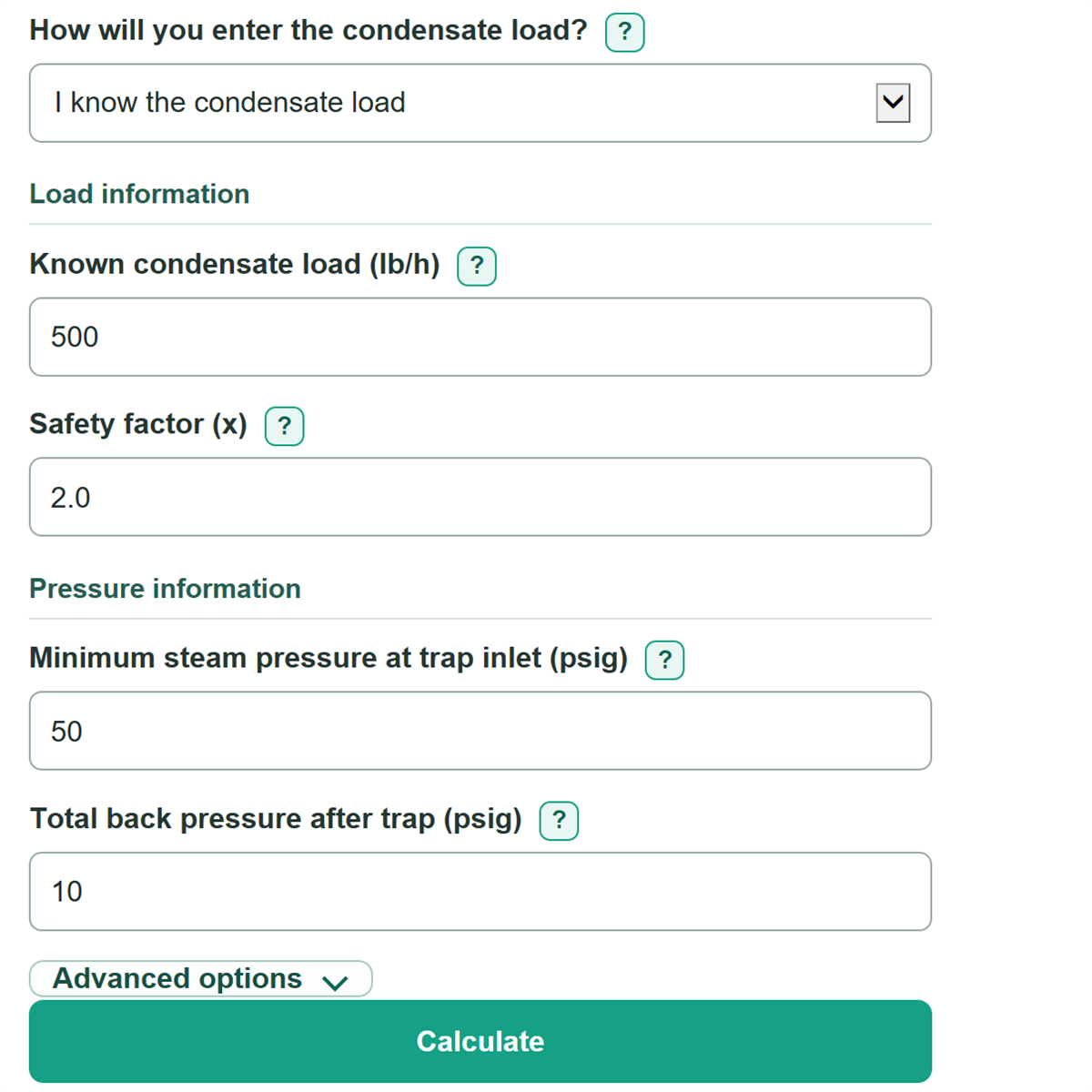
- Choose how you will enter the condensate load: use Known condensate load (lb/h) if you have a governing load, or use heat duty if you have equipment data.
- Enter the Safety factor (x) selected for the operating case, then enter the lowest expected inlet pressure and total back pressure.
- Click Calculate to see the required capacity in lb/h and the minimum available pressure difference in psid.
- For a candidate check, open Advanced options and enter both Candidate trap capacity (lb/h) and Pressure difference for candidate rating (psid) from the same manufacturer chart condition.
- Sanity-check that the candidate chart pressure exactly matches the calculated minimum available pressure difference; a different chart row cannot be compared directly.
Definitions
Condensate load (lb/h): The mass of steam condensate produced each hour for the operating case being sized.
Governing condensate load (lb/h): The selected known load, or the load calculated from equipment heat duty before the safety factor is applied.
Latent heat (Btu/lb): Heat released when one pound of steam condenses at the applicable steam condition.
Safety factor (x): A user-selected multiplier applied to the governing condensate load to set required trap capacity.
psig: Pounds per square inch gauge, measured relative to atmospheric pressure.
psid: Pounds per square inch difference. In this calculator, it is trap-inlet gauge pressure minus total back pressure.
Candidate capacity ratio: Candidate published capacity divided by required trap capacity. A ratio of 1 matches the requirement.
Common mistakes and quick fixes
Mistake: Entering supply pressure instead of the lowest pressure at the equipment or trap inlet in Minimum steam pressure at trap inlet (psig).
Fix: Use the lowest expected steam-space or trap-inlet gauge pressure, especially downstream of a modulating control valve.
Mistake: Treating Total back pressure after trap (psig) as zero without checking the condensate return system.
Fix: Include return-header pressure and known downstream pressure effects.
Mistake: Adding unrelated startup and running cases into Known condensate load (lb/h).
Fix: Enter the single governing case unless an engineering analysis shows the loads occur at the same time.
Mistake: Using a candidate rating from one chart pressure with a different Pressure difference for candidate rating (psid).
Fix: Copy the capacity from the manufacturer chart at the exact calculated minimum pressure difference.
Mistake: Choosing a trap by connection size instead of Required trap capacity.
Fix: Select a model whose published capacity meets or exceeds the required lb/h at the applicable psid.
Mistake: Entering malformed commas such as 1,01 in Equipment heat duty (Btu/h) or another numeric field.
Fix: Use commas only in groups of three digits, such as 950,000, and use a decimal point for decimals.
Limitations & Key Assumptions / Boundary Conditions
- This is a preliminary capacity screen. Final trap selection also needs the manufacturer chart and the trap's application, operating-pressure, temperature, materials, discharge, and air-handling limits.
- The pressure difference uses the entered minimum trap-inlet pressure minus entered total back pressure. Incorrect pressure measurements or uncounted downstream effects change the answer.
- Heat-duty mode assumes all entered heat duty is supplied by condensing steam and uses the latent heat value you enter. It does not calculate steam properties.
- The safety factor is fully user selected. The calculator adds no hidden startup allowance and does not decide which operating case governs.
- A candidate comparison is valid only when the published candidate capacity and its chart pressure difference are entered as a complete pair and that chart pressure exactly matches the calculated psid.
- A zero governing load produces zero required capacity, but no candidate capacity ratio is shown because dividing by zero is undefined.
Methodology
Calculation method
In known-load mode, the entered governing load is used directly. In heat-duty mode, the load is found by dividing equipment heat duty by steam latent heat. This follows the basic heat-balance relationship used for condensate-load calculations. [1]
Governing condensate load (lb/h) = equipment heat duty (Btu/h) / steam latent heat (Btu/lb)
The required trap capacity is the governing condensate load multiplied by the entered safety factor. No extra multiplier is added.
Required trap capacity (lb/h) = governing condensate load (lb/h) x safety factor
The minimum pressure difference is found by subtracting total downstream back pressure from the minimum gauge pressure at the trap inlet. A positive result is required because the trap needs higher inlet pressure than downstream pressure.
Minimum available pressure difference (psid) = minimum steam pressure at trap inlet (psig) - total back pressure after trap (psig)
If both candidate fields are complete and the chart pressure exactly matches the calculated psid, the calculator compares the published capacity with the required capacity.
Candidate capacity margin (lb/h) = candidate trap capacity (lb/h) - required trap capacity (lb/h)
Candidate capacity ratio = candidate trap capacity (lb/h) / required trap capacity (lb/h)
Worked example
A known condensate load of 500 lb/h with a 2.0 safety factor requires 1,000 lb/h of trap capacity. With 50 psig at the trap inlet and 10 psig total back pressure, the available pressure difference is 40 psid. A candidate rated at 1,200 lb/h at 40 psid has a 200 lb/h margin and a 1.2 capacity ratio.