
Estimate liquid flow from an orifice plate pressure difference or calculate the pressure difference needed for a target liquid flow.
Advanced options
Table of contents
How to use our Orifice Plate Flow Rate and Differential Pressure Calculator
- Choose whether to calculate flow from a measured pressure difference or pressure difference from a target flow.
- For Pipe diameter entered as, choose Actual inside diameter, then enter the Pipe inside diameter and Orifice bore diameter from verified meter records.
- Enter Measured pressure difference or Target liquid flow, plus Fluid density and Discharge coefficient for the actual liquid and meter.
- Click Calculate and check that Pipe ID entry check confirms the actual inside diameter before using the primary answer.
- Sanity-check the result against the transmitter range, expected process flow, and the units shown; a large mismatch can mean the wrong DP, density, bore, or coefficient was entered.
Definitions
Differential pressure (DP): The pressure difference between the upstream and downstream pressure taps across the plate. This calculator uses inH2O.
Actual inside diameter: The measured or specified open diameter inside the pipe. It is not the nominal pipe size or outside diameter.
Orifice bore diameter: The diameter of the round opening in the orifice plate.
Fluid density: Mass per unit volume of the flowing liquid, entered in lb/ft3. The default 62.366 lb/ft3 is a fresh-water planning value at 60 F and should be replaced when needed. [2]
Discharge coefficient: A dimensionless correction for real flow contraction and losses at the plate. The calculator uses the value you enter.
Bore-to-pipe diameter ratio: Bore diameter divided by actual pipe inside diameter. It is also called beta ratio, written as β.
Mass flow: The estimated mass of liquid passing the plate each hour, shown in lb/h.
Common mistakes and quick fixes
Mistake: Entering nominal pipe size or outside diameter as Pipe inside diameter.
Fix: Choose Actual inside diameter under Pipe diameter entered as and copy the actual open ID from a meter sheet, piping record, or verified measurement.
Mistake: Entering line pressure in Measured pressure difference.
Fix: Enter only the pressure difference between the configured upstream and downstream taps, in inH2O.
Mistake: Entering an Orifice bore diameter that equals or exceeds Pipe inside diameter.
Fix: Check the plate stamp or certificate and enter a bore that is smaller than the actual pipe ID.
Mistake: Leaving the fresh-water value in Fluid density for a different liquid or temperature.
Fix: Replace Fluid density with an approved value for the actual fluid, temperature, pressure, and composition.
Mistake: Treating the example Discharge coefficient as a universal value.
Fix: Use the coefficient from the approved meter calculation, calibration record, or manufacturer documentation.
Mistake: Reading Estimated liquid flow rate as a certified meter result.
Fix: Treat it as a simplified incompressible estimate and use an approved meter calculation when a certified or ISO-based result is needed.
Limitations & Key Assumptions / Boundary Conditions
- This is a simplified steady, incompressible liquid calculation using a user-entered Discharge coefficient. It does not calculate an ISO 5167 coefficient from Reynolds number, pressure-tap type, or viscosity.
- Do not use it for gas, steam, flashing liquid, two-phase flow, slurry, or conditions where density changes materially through the plate.
- Pipe inside diameter must be the actual open ID. Nominal size, outside diameter, and pipe schedule alone are not valid substitutes.
- Measured pressure difference is the tap-to-tap DP, not necessarily the permanent pressure loss of the system.
- Results can differ from field performance because of tap arrangement, plate condition, installation geometry, upstream disturbances, pulsating flow, instrument error, and an incorrect density or discharge coefficient.
- The displayed precision is formatting only. It does not make the entered dimensions, density, DP reading, or coefficient more accurate.
Methodology
Calculation method
Dwyer Series OP manual: liquid flow and beta-ratio correction describes the matching incompressible relationship. This calculator retains your supplied discharge coefficient; it does not reproduce the manual's coefficient correlation or certify a particular installation.
The calculator converts the entered US units to SI units, calculates the circular bore area and beta ratio, then applies a simplified incompressible orifice equation. The inch, pound, and US-gallon conversions use standard SI conversion relationships. [1]
β (bore-to-pipe ratio) = d / D
A (bore area in m2) = πd2 / 4
Q (flow in m3/s) = Cd x A x sqrt(2 x ΔP / ρ) / sqrt(1 - β4)
In these formulas, d is bore diameter, D is actual pipe inside diameter, Cd is Discharge coefficient, ΔP is pressure difference, and ρ is fluid density. The flow result is converted to gal/min. In reverse mode, the same equation is rearranged to solve for pressure difference.
ΔP (required pressure) = ρ x (Q x sqrt(1 - β4) / (Cd x A))2 / 2
Mass flow and example
Estimated liquid mass flow equals the active liquid volume flow times entered density, then converts to lb/h.
Mass flow (lb/h) = Q (m3/s) x ρ (kg/m3) x 3600 / 0.45359237
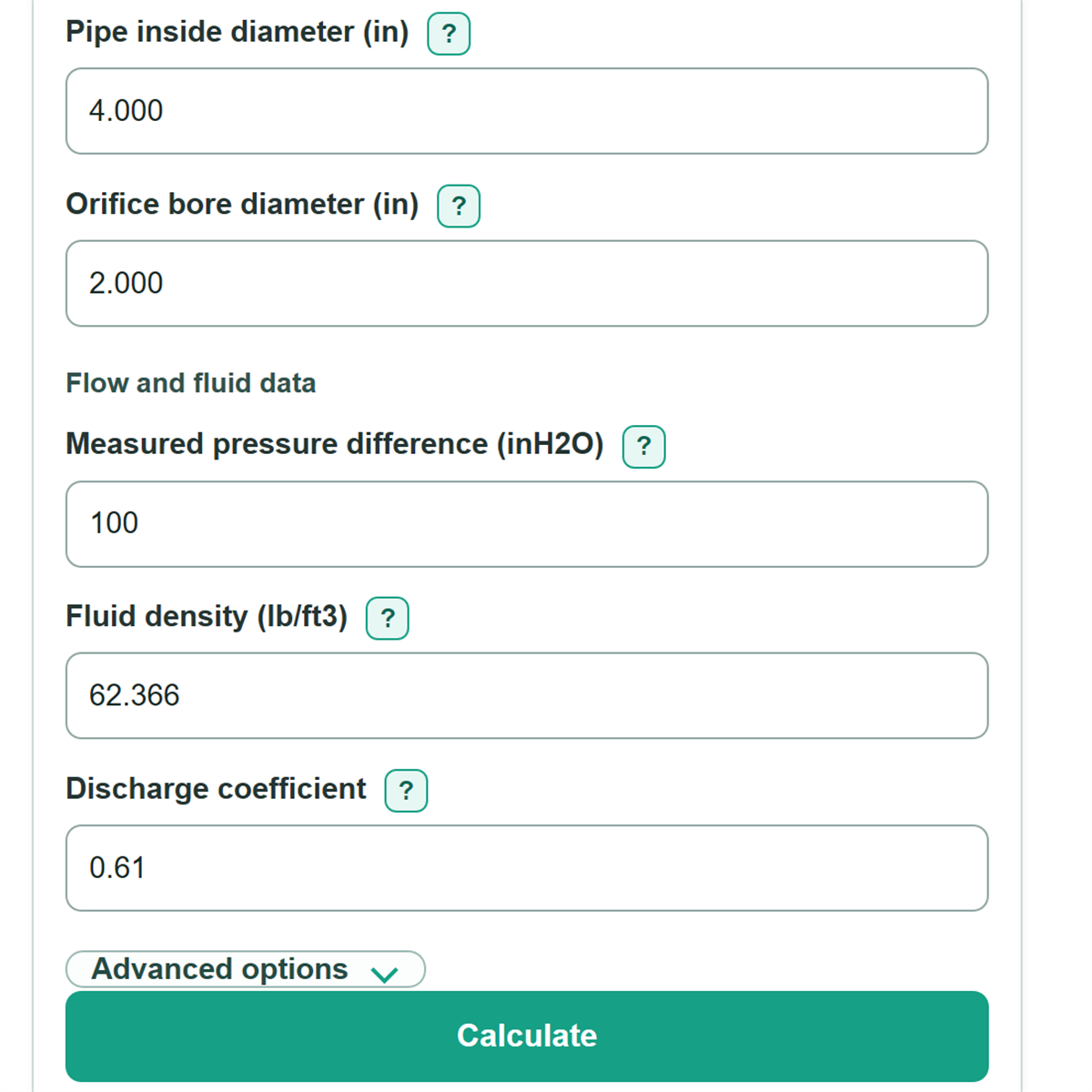
For a 4.000 in actual pipe ID, 2.000 in bore, 100 inH2O DP, density of 62.366 lb/ft3, and coefficient of 0.61, beta ratio is 0.5 and estimated liquid flow is about 142.9 gal/min. Reversing the calculation for 100 gal/min gives about 49.0 inH2O. The calculator stops if the bore is not smaller than the pipe ID or if a required value is zero, negative, or invalid.