
Estimate a centrifugal pump VFD's annual utility savings and simple payback using measured power or motor nameplate information.
Table of contents
How to use our Pump VFD Energy Savings and Payback Calculator
- Choose Measured power if you have typical pump kW from a meter or trend; otherwise choose Motor nameplate estimate and enter the motor values.
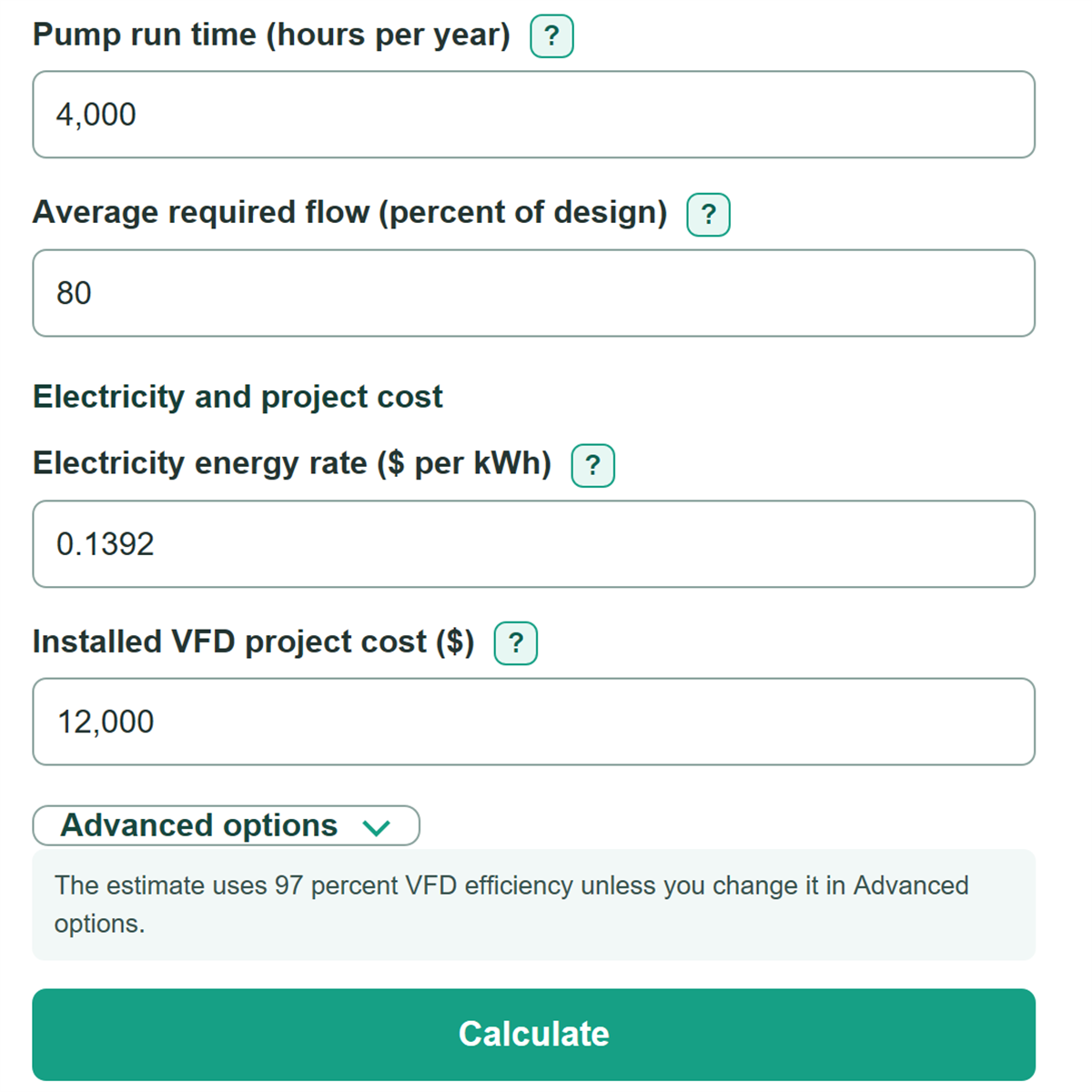
- Enter Pump run time (hours per year), Average required flow (percent of design), and your bill's Electricity energy rate ($ per kWh).
- Enter the full Installed VFD project cost ($), including installation, controls, and commissioning.
- Open Advanced options only if needed. Enter both demand-charge fields if your bill has demand charges, and replace VFD efficiency (percent) if a manufacturer value is available.
- Check that the estimated VFD electricity use is lower than baseline pump electricity use and that the flow assumption fits actual pump operation before using the payback for a project decision.
Definitions
Baseline power source: The method used to find the existing pump's electrical input power: measured kW or a motor-nameplate estimate.
kW: Kilowatt, a measure of electrical power at a moment in time.
kWh: Kilowatt-hour, a measure of electricity used over time. A 10 kW pump running for 100 hours uses 1,000 kWh.
Average required flow (percent of design): The typical flow needed, compared with the pump's design flow. The calculator uses it as an approximate speed percentage for its screening model.
VFD efficiency: The share of electricity reaching the motor after losses in the variable frequency drive.
Demand charge: A utility charge based on billed peak power, usually stated in $ per kW-month. It is separate from the energy charge in $ per kWh.
Simple payback time: Installed project cost divided by estimated annual utility savings, expressed in months. It does not include financing, maintenance, taxes, or future rate changes.
Common mistakes and quick fixes
Mistake: Entering motor HP into Measured pump power (kW).
Fix: Use actual electrical kW from a meter or trend, or switch Baseline power source to the nameplate method.
Mistake: Typing 13.92 into Electricity energy rate ($ per kWh) when the bill shows 13.92 cents per kWh.
Fix: Enter 0.1392 because this field uses dollars per kWh.
Mistake: Using a one-week schedule as Pump run time (hours per year).
Fix: Add expected operating hours across the full year before entering the value.
Mistake: Treating Average required flow (percent of design) as a guaranteed speed setting.
Fix: Use a typical flow from a trend or flow meter and review whether static lift or fixed pressure affects the pump.
Mistake: Adding a demand charge into Electricity energy rate ($ per kWh).
Fix: Keep the energy rate separate and enter both Demand charge ($ per kW-month) and Expected billing-demand reduction (kW) only when applicable.
Mistake: Leaving out installation work from Installed VFD project cost ($).
Fix: Include the drive, electrical work, controls, engineering, commissioning, and subtract confirmed incentives.
Limitations & Key Assumptions / Boundary Conditions
- This is a screening estimate for a variable-torque centrifugal pump. It treats Average required flow (percent of design) as approximately equal to speed percent and uses a cube-law power relationship.
- Static lift, fixed-pressure requirements, system curves, minimum-flow bypasses, control limits, and pump efficiency changes can make actual VFD savings smaller or larger than this estimate.
- Measured pump power improves the baseline estimate, but it does not confirm the reduced-speed power or the actual annual operating profile.
- Motor nameplate mode estimates electrical input from rated HP and motor efficiency. Rated HP is not the same as actual operating kW.
- Demand-charge savings are included only when both demand inputs are entered. The calculation does not model demand ratchets, coincident-peak rules, or whether the pump sets the billed monthly peak.
- Fixed customer, meter, and service charges are excluded. Simple payback is not ROI, net present value, or a guarantee of project savings.
Methodology
Calculation method
The calculator uses the measured pump kW when Measured power is selected. In Motor nameplate estimate mode, it converts rated motor HP to an estimated electrical input using 0.746 kW per HP and motor efficiency.
baseline input kW = measured pump power, or motor HP x 0.746 / motor efficiency
For the VFD case, the calculator applies the centrifugal-pump cube-law screening relationship to the entered flow percentage, then accounts for VFD efficiency. This approach is suitable for an early estimate, not a pump-system study. DOE guidance describes variable-flow control strategies for centrifugal pumps. [2]
estimated VFD input kW = baseline input kW x (flow percent / 100)^3 / (VFD efficiency / 100)
Annual electricity use is power multiplied by Pump run time (hours per year). Electricity savings are baseline annual kWh minus VFD annual kWh. The energy-charge savings use the entered $ per kWh rate. The prefilled $0.1392 per kWh is a 2026 US commercial planning estimate and should be replaced with a local bill or tariff rate. [1]
annual kWh saved = baseline annual kWh - VFD annual kWh
annual energy-charge savings = annual kWh saved x electricity energy rate
When both demand fields are completed, annual demand-charge savings equal the expected billing-demand reduction times the monthly demand charge times 12. This amount stays separate from energy-charge savings.
annual demand-charge savings = demand reduction kW x demand charge $ per kW-month x 12
Estimated annual utility savings equal energy-charge savings plus optional demand-charge savings. Simple payback is shown only when annual utility savings are positive.
simple payback months = installed VFD project cost / annual utility savings x 12
Worked example
With 50 measured kW, 4,000 annual hours, 80% required flow, 97% VFD efficiency, and $0.1392 per kWh, estimated VFD input power is about 26.39 kW. The model estimates about 94,433 kWh saved per year and about $13,145 in annual energy-charge savings before any demand-charge savings.