
Estimate a refractory wall's heat loss, outside surface temperature, fuel energy use, and variable fuel cost from your operating and lining data.
Table of contents
How to use our Refractory Wall Heat Loss and Fuel Cost Calculator
- Enter the estimated Refractory hot-face temperature, nearby Ambient air temperature, and the Wall area being checked.
- Enter the installed hot-side layer thickness and its conductivity from the refractory data sheet at a temperature close to service.
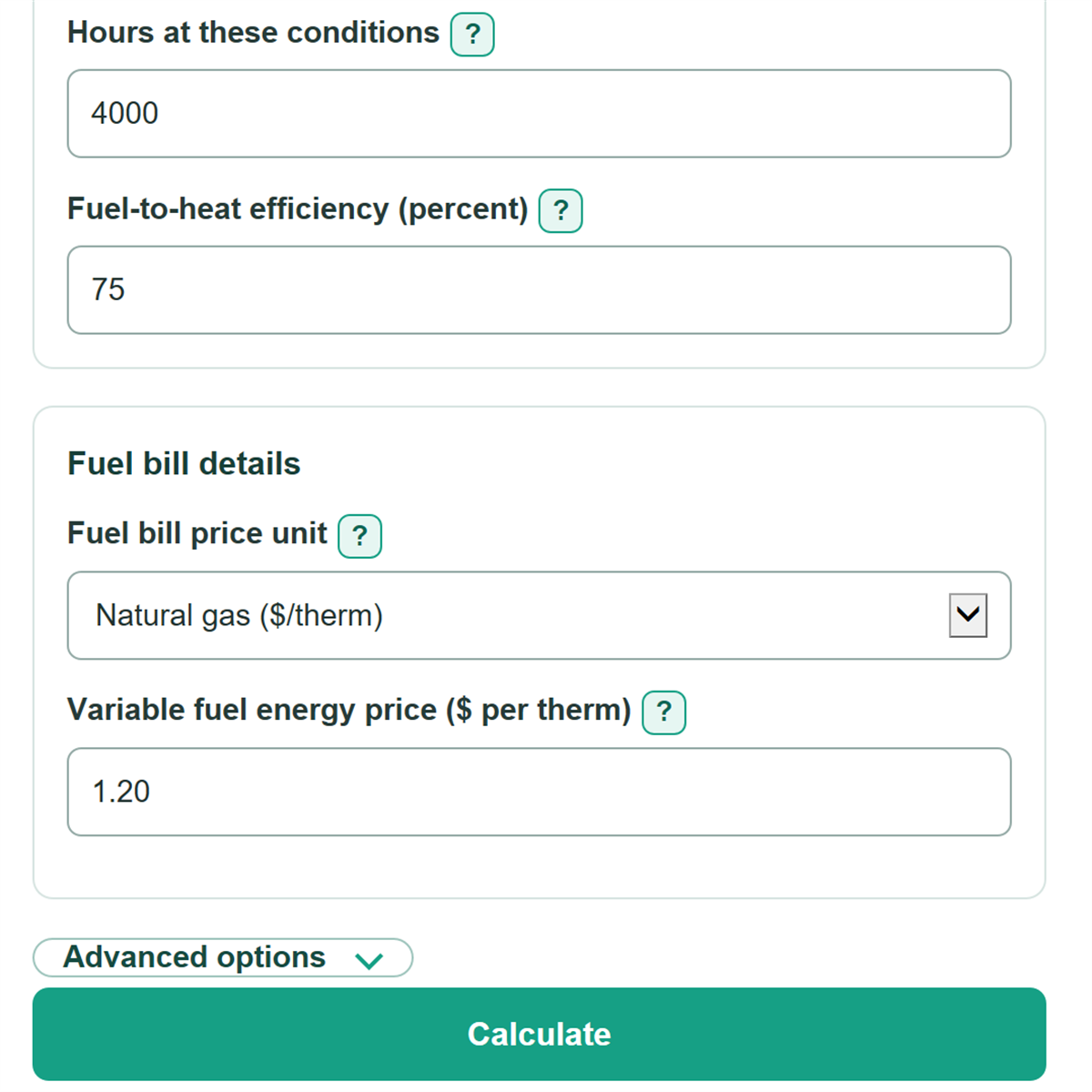
- Enter Hours at these conditions and Fuel-to-heat efficiency from your operating records or heat balance.
- Choose the exact Fuel bill price unit shown on the bill, then enter the variable energy price. For Ccf, Mcf, or gallons, also enter the supplier heat content.
- Calculate, then check that the cold-face temperature and heat loss per square foot are believable for the wall build. Add a second layer or site-specific outside heat-transfer coefficient in Advanced options when needed.
Definitions
Cold-face temperature: Estimated temperature at the outside, shell-side surface of the modeled wall. It is not a safe-touch rating.
Thermal conductivity: A material property showing how readily heat moves through a layer. Higher conductivity means less resistance at the same thickness.
Thermal resistance: A layer's thickness divided by conductivity. Higher total resistance lowers steady heat loss for the same temperature difference.
Heat flux: Heat-transfer rate through one square foot of wall, reported here in Btu/hr-ft2. [3]
MMBtu: One million Btu. This calculator uses it for heat lost and required fuel energy.
Therm: A billed natural-gas energy unit equal to 100,000 Btu.
Effective outside heat-transfer coefficient: A simplified value that connects shell temperature above ambient to heat released outside by convection and radiation.
Variable fuel rate: Commodity price plus any per-unit delivery charge and other per-unit charges that change with fuel use.
Common mistakes and quick fixes
Mistake: Using furnace setpoint as the Refractory hot-face temperature when the lining surface is known to be cooler.
Fix: Use an estimated refractory surface temperature from process data or a heat-balance study when available.
Mistake: Entering a room-temperature data-sheet value for Hot-side layer conductivity .
Fix: Copy conductivity for a mean temperature close to the layer's service temperature.
Mistake: Treating Steady heat loss per square foot as the whole wall loss.
Fix: Use Total wall heat loss rate , which multiplies heat loss per square foot by Wall area being checked .
Mistake: Putting a fixed monthly charge into Variable fuel energy price or Variable delivery charge .
Fix: Enter only charges that rise for each billed fuel unit. Fixed customer charges, minimum bills, and demand charges are excluded.
Mistake: Choosing Ccf, Mcf, or gallons for Fuel bill price unit without matching Fuel heat content to that same bill unit.
Fix: Copy Btu per Ccf, Mcf, or gallon from the supplier bill, quality statement, or contract.
Mistake: Filling only Cold-side layer thickness (in) or only Cold-side layer conductivity (Btu-in/hr-ft2-deg F) .
Fix: Enter both values for a second layer, or clear both fields to calculate a one-layer wall.
Limitations & Key Assumptions / Boundary Conditions
- This is a steady-state, flat-wall resistance estimate. It does not model warmup, cooldown, changing process temperature, or heat stored in the lining.
- Conductivity is treated as constant at the user-selected representative temperature, even though refractory conductivity can change with temperature and material condition.
- The model uses one effective outside heat-transfer coefficient rather than separately calculating wind, radiation, shell finish, and nearby hot equipment effects.
- Anchors, joints, cracks, penetrations, edge losses, contact resistance, internal gas-film resistance, and moisture effects are omitted.
- Use the cold-face estimate for engineering screening only. Confirm personnel-protection, material-limit, and code requirements with the project design basis.
- Fuel cost includes only usage-based charges. Fixed monthly charges, minimum bills, and electricity demand charges are excluded.
- For Ccf, Mcf, and gallon billing, cost accuracy depends on the supplier heat content entered. Do not substitute a price-based guess.
Methodology
Thermal calculation
Each refractory layer adds resistance to heat flow. The model also includes outside resistance from the effective outside heat-transfer coefficient. Temperature falls from the refractory hot face toward ambient air through those resistances. This follows the standard resistance approach for a temperature gradient through layered construction. [2]
R1 = thickness1 / conductivity1
R2 = thickness2 / conductivity2, or 0 when no second layer is entered
Rtotal = R1 + R2 + 1 / h_outside
q = (T_hot - T_ambient) / Rtotal
T_cold = T_ambient + q / h_outside
In these formulas, q is steady heat loss per square foot, T_cold is the estimated cold-face temperature, and h_outside is the effective outside heat-transfer coefficient.
Wall loss and fuel cost
The calculator multiplies heat flux by the entered wall area, then multiplies the resulting heat-loss rate by the entered operating hours. It divides that heat by fuel-to-heat efficiency to estimate fuel energy required to replace the loss.
wall_loss = q * wall_area
heat_lost_MMBtu = wall_loss * hours / 1000000
fuel_MMBtu = heat_lost_MMBtu / (efficiency_percent / 100)
variable_cost = billed_fuel_units * combined_variable_rate
For therm billing, one therm is 100,000 Btu. For MMBtu billing, one MMBtu is 1,000,000 Btu. For electricity, the calculator uses 1 kWh = 3,412.141633 Btu. [1] Ccf, Mcf, and gallon billing use the supplier heat content entered for one billed unit.
Worked example
With a 1,800 deg F hot face, 80 deg F ambient air, a 6 in layer with conductivity of 8 Btu-in/hr-ft2-deg F, and an outside coefficient of 2, the total resistance is 1.25 hr-ft2-deg F/Btu. Heat flux is 1,376 Btu/hr-ft2 and estimated cold-face temperature is 768 deg F. For 100 ft2 operating 4,000 hours, the wall loses 550.4 MMBtu. At 75 percent fuel-to-heat efficiency, that requires 733.87 MMBtu of fuel, or 7,338.67 therms. At $1.20 per therm, variable fuel cost is $8,806.40.
Calculation choices
Blank optional delivery and other usage-based rates count as $0. A second layer is included only when both its thickness and conductivity are entered. Zero operating hours keeps the instantaneous heat-loss results but sets period heat, fuel quantity, and variable fuel cost to zero.