
Calculate milling or turning MRR, spindle power headroom, cutting-time consistency, and transparent cycle cost per part from your job inputs.
Table of contents
How to use our CNC Machining MRR, Horsepower and Cycle Cost Calculator
- Choose Operation, then copy the active cut geometry and programmed feed from CAM, the setup sheet, or the CNC program.
- Enter Cutting power factor (HP min per in3) and Available spindle power at the cut (HP); use the machine power curve at the programmed RPM when available.
- Enter Material to remove per part (in3) and Total cycle time per part (min). Total cycle time should include rapids, tool changes, probing, and in-cycle handling.
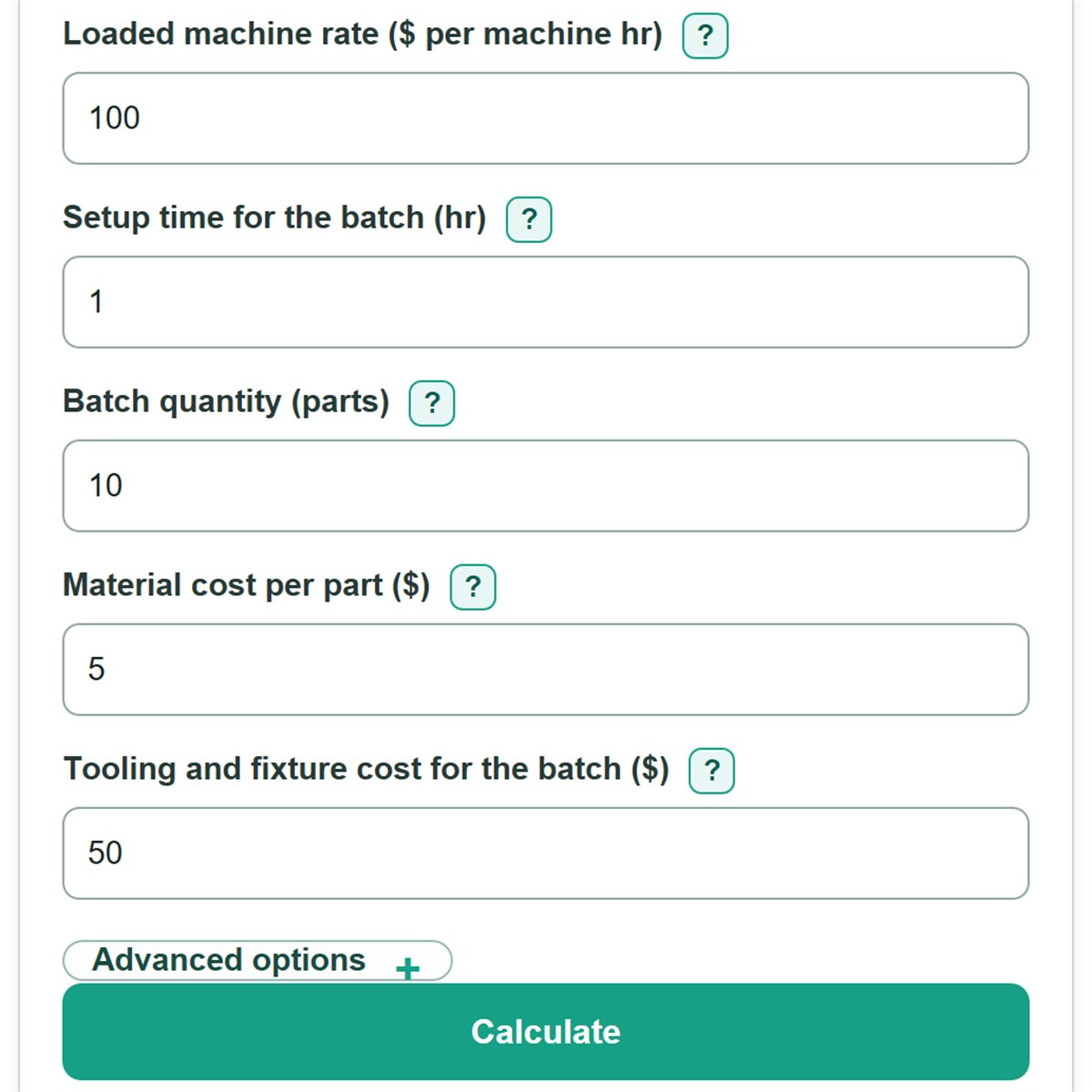
- Enter the loaded rate, setup time, batch quantity, material cost, and any batch tooling or fixture cost, then select Calculate.
- Sanity-check that Time beyond estimated cutting time is zero or positive and that Available spindle power headroom is positive before relying on the cost estimate.
Definitions
Material removal rate (MRR): The volume of material removed while cutting, shown in cubic inches per minute (in3/min). The milling and turning relationships used here are standard machining calculations. [1][2]
Axial depth of cut: In milling, the tool engagement depth along the tool axis.
Radial width of cut: In milling, the side engagement or stepover width.
IPM: Inches per minute, the programmed table feed used for milling in this calculator.
IPR: Inches per revolution, the programmed feed used for turning in this calculator.
Cutting power factor: Horsepower-minutes needed per cubic inch removed. It converts MRR into an estimated spindle power requirement.
Power headroom: Available spindle power minus estimated required spindle power. A negative headroom means the entered cut needs more power than is available.
Loaded machine rate: The shop's cost per machine hour used to price both cycle time and setup time.
Common mistakes and quick fixes
Mistake: Entering a turning feed in Programmed feed rate (IPM) .
Fix: In Turning mode, use Programmed feed per revolution (IPR) ; IPM and IPR are different feed bases.
Mistake: Using finished diameter for Work diameter before the cut (in) .
Fix: Enter the diameter at the beginning of the turning pass.
Mistake: Treating Radial depth of cut (in) as the total diameter reduction.
Fix: Enter the one-side radial depth; the diameter drops by twice that value.
Mistake: Entering only cutting time in Total cycle time per part (min) .
Fix: Include rapids, tool changes, probing, and in-cycle handling so Machine-time cost per part is not too low.
Mistake: Adding labor or electricity again after using Loaded machine rate ($ per machine hr) .
Fix: Check the shop rate card first; do not double count costs already included in the loaded rate.
Mistake: Ignoring a negative Available spindle power headroom .
Fix: A negative value is a power shortfall. Recheck the cut plan, cutting power factor, and available power at the cut.
Limitations & Key Assumptions / Boundary Conditions
- MRR is a geometry-based estimate. Actual removal can differ because of toolpath changes, interrupted cuts, chip thinning, tool wear, workholding, and machine limits.
- Estimated spindle power depends directly on the entered Cutting power factor (HP min per in3). It is not a machine-builder or tool-maker rating.
- For turning, the calculation uses the starting diameter and one constant radial depth for the pass. Constant surface speed and changing diameter can change actual RPM and power.
- Estimated cutting time per part covers material removal only. The entered Total cycle time per part (min) must include non-cutting machine time used for costing.
- Estimated cycle cost per part includes entered machine time, setup, material, and tooling or fixture cost. It excludes profit margin, tax, shipping, and separately billed engineering.
- Available spindle power should be the power available at the cut and programmed RPM. A motor nameplate value can be different.
Methodology
Cut calculations
For Milling, the calculator multiplies axial depth, radial width, and programmed IPM to find MRR.
MRR = axial depth of cut x radial width of cut x programmed feed rate
For Turning, it finds the annular cross-section removed by the radial cut, then multiplies it by IPR and RPM. This form uses π (the circle constant).
turning area = π x (starting diameter x radial depth - radial depth x radial depth)
MRR = turning area x programmed feed per revolution x programmed spindle speed
The required spindle-power estimate is MRR multiplied by the user-entered cutting power factor. Power headroom is available spindle power minus that estimate. These relationships follow common machining calculation practice. [1][2]
estimated spindle power required = MRR x cutting power factor
available spindle power headroom = available spindle power - estimated spindle power required
Time and cost calculations
Estimated cutting time is removed volume divided by MRR. The calculator blocks a total cycle time that is shorter than this theoretical cutting time when removed volume is above zero.
estimated cutting time = material to remove per part / MRR
machine-time cost per part = loaded machine rate x total cycle time per part / 60
setup cost per part = loaded machine rate x setup time for the batch / batch quantity
tooling and fixture cost per part = tooling and fixture cost for the batch / batch quantity
estimated cycle cost per part = machine-time cost + setup cost + material cost + tooling and fixture cost
Worked example
For a milling cut with 0.250 in axial depth, 0.250 in radial width, and 20 IPM feed, MRR is 1.25 in3/min. Removing 10 in3 takes 8 minutes. At $100 per machine hour, 8 minutes of machine time costs $13.33 per part before setup, material, and tooling shares.
Calculation choices
The calculator uses entered total cycle time for machine-time cost, not MRR-derived cutting time. It keeps negative power headroom visible because it indicates an estimated capacity shortfall. Display settings round results only after the underlying calculations are complete.