
Estimate CHP spark spread, annual operating savings, and simple payback from annual utility bills and a proposed system.
Proposed CHP system
Project cost
Advanced options
Performance assumptions
Maintenance and incentive
Result display
Calculation details
Table of contents
How to use our CHP Spark Spread, Savings and Payback Calculator
- Add totals from the same 12 months of bills for Annual electric bill cost ($), Annual electricity use (kWh), Annual boiler gas bill cost ($), and Annual boiler gas use (therms).
- Enter the Proposed CHP electric size (kW), CHP run time (hours per year), and Installed project cost ($) from a vendor proposal or planning estimate.
- Open Advanced options to confirm CHP electrical efficiency (percent), Useful heat recovery (percent), Existing boiler efficiency (percent), and CHP maintenance costs.
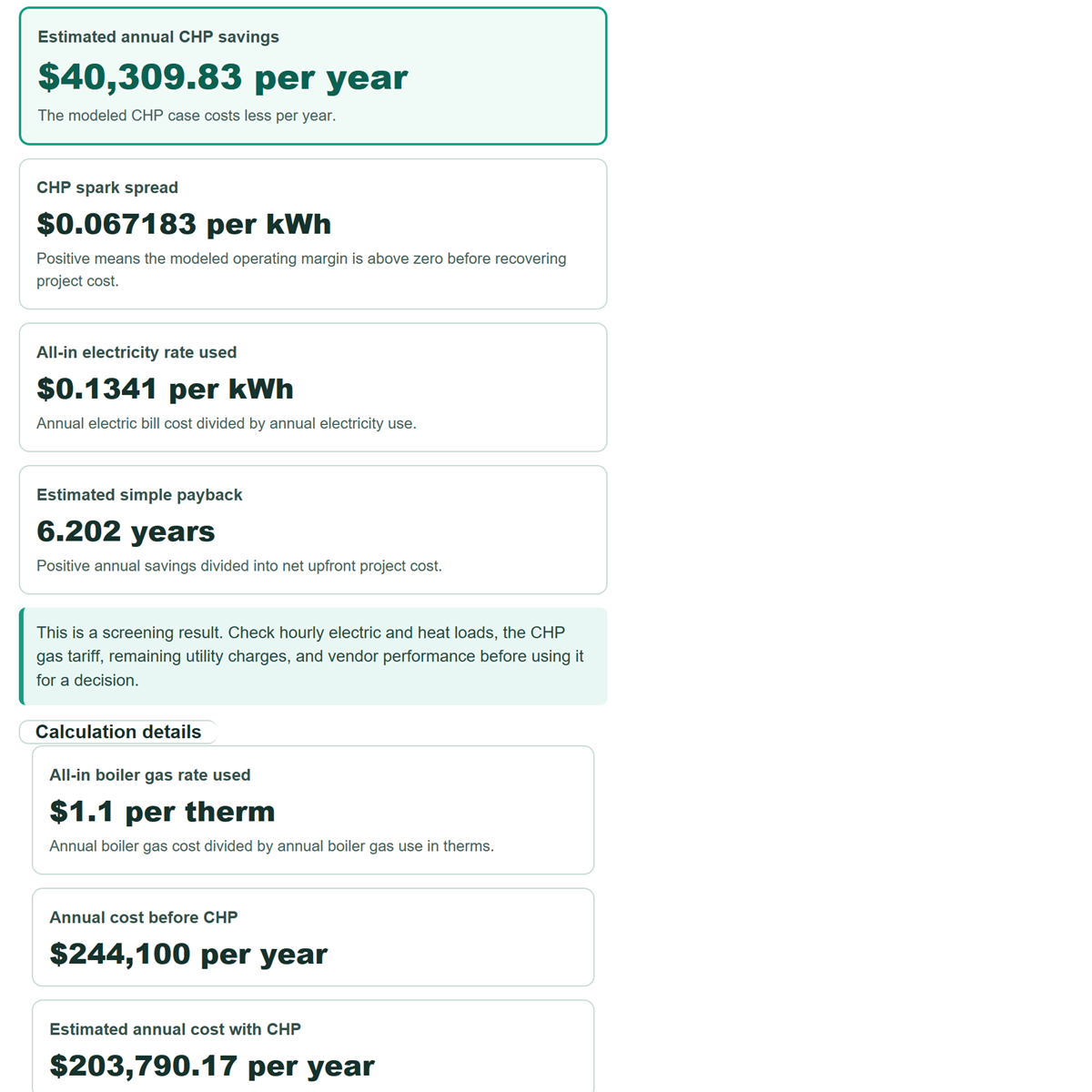
- Click Calculate to see Estimated annual CHP savings, CHP spark spread, Estimated simple payback, and the bill-derived electricity and gas rates used.
- Sanity-check All-in electricity rate used and All-in boiler gas rate used against your bills, then confirm Estimated CHP electricity generated does not exceed the facility load you expect during CHP operating hours.
Definitions
CHP: Combined heat and power. One fuel source produces electricity and useful heat at the site.
All-in electricity rate: Annual electric bill cost divided by annual electricity use. It may include charges that CHP does not fully avoid.
All-in boiler gas rate: Annual boiler gas bill cost divided by annual boiler gas use in therms.
Spark spread: The modeled value of one CHP kWh after CHP fuel cost, useful heat credit, and maintenance are included. A positive value is a positive operating margin before capital recovery.
Electrical efficiency: The share of CHP fuel energy converted to electric output. EPA treats electric and useful thermal output as separate parts of CHP performance. [2]
Useful heat recovery: The share of CHP fuel energy captured and used for heating or a process. Unused heat receives no credit.
Therm: A unit of fuel energy equal to 100,000 Btu, or 0.1 MMBtu. [1]
MMBtu: One million British thermal units, a common unit for large fuel and heat quantities.
Simple payback: Net upfront project cost divided by positive annual savings, stated in years.
Common mistakes and quick fixes
Mistake: Using one monthly total in Annual electric bill cost ($) and Annual electricity use (kWh).
Fix: Add matching values from a full 12-month period so the derived rate and annual savings use the same time period.
Mistake: Entering Ccf, Mcf, or MMBtu in Annual boiler gas use (therms).
Fix: Convert the bill quantity to therms before entry. Do not let the calculator guess the gas unit.
Mistake: Using peak demand as Proposed CHP electric size (kW) without checking the minimum facility load.
Fix: Use a proposed net CHP size from a vendor and check interval data before selecting a system size.
Mistake: Setting CHP run time (hours per year) above realistic availability or planned operating hours.
Fix: Include scheduled downtime and keep the value from 0 through 8,760 hours per year.
Mistake: Treating Useful heat recovery (percent) as savings even when the site cannot use the heat.
Fix: Enter only useful recovered heat. The calculator caps credited heat at the annual boiler heat need.
Mistake: Reading Estimated simple payback as a full project return analysis.
Fix: Use it only as a first-pass screening result; review financing, taxes, downtime, interconnection, future rates, and replacement costs separately.
Limitations & Key Assumptions / Boundary Conditions
- The estimate applies each bill-derived all-in rate to avoided electricity or boiler fuel. Fixed charges, demand charges, ratchets, riders, taxes, and non-bypassable charges may remain after CHP starts.
- Annual electricity and boiler fuel totals do not show hourly load matching. A CHP unit can produce more power or heat than the site needs at particular times even when annual totals fit.
- Exported electricity is not modeled. The calculator blocks a case where annual CHP generation exceeds entered annual electricity use.
- Recovered heat is credited only up to the annual useful boiler heat calculated from Annual boiler gas use (therms) and Existing boiler efficiency (percent). It does not confirm seasonal or hourly heat use.
- The same bill-derived gas rate is used for boiler fuel and CHP fuel. A CHP-specific tariff, transportation charge, or fuel contract can change the result.
- Simple payback excludes financing, taxes, depreciation, outages, interconnection costs, major replacements, escalation of fuel or electric rates, and the time value of money.
- Use vendor performance data at the expected site conditions. Part-load operation, ambient conditions, maintenance condition, and heat quality can change CHP electrical efficiency (percent) and Useful heat recovery (percent).
Methodology
Bill rates and energy balance
The calculator first turns annual bills into transparent all-in rates. This avoids requiring a separate cents-per-kWh or dollars-per-therm calculation before starting.
All-in electricity rate = annual electric bill cost / annual electricity use
All-in gas rate = annual boiler gas bill cost / annual boiler gas use
Annual CHP generation is proposed electric size multiplied by run time. The result must not exceed entered annual electricity use because this screening model does not value exported power.
Annual CHP generation = CHP electric size * CHP run time
Fuel input is based on generated electricity and CHP electrical efficiency. The calculation uses 0.003412142 MMBtu per kWh and 0.1 MMBtu per therm. These conversions follow EIA energy-unit definitions. [1]
CHP fuel MMBtu = CHP generation kWh * 0.003412142 / electrical efficiency as a decimal
Potential recovered heat equals CHP fuel energy times useful heat recovery. Credited heat is limited to the useful annual boiler heat calculated from annual boiler therms and boiler efficiency. This follows the separate accounting of electrical and useful thermal CHP output. [2]
Useful recovered heat = smaller of available recovered heat and baseline useful boiler heat
Costs, savings, and payback
The CHP case subtracts avoided grid electricity and avoided boiler fuel from the baseline, then adds CHP fuel, variable CHP maintenance, and fixed CHP maintenance. Annual savings stay negative if CHP costs more in the modeled case.
Annual savings = annual cost before CHP - estimated annual cost with CHP
Spark spread is the bill-derived electricity rate minus the effective CHP electric cost. The effective cost includes CHP fuel and maintenance, less the value of credited boiler fuel savings.
CHP spark spread = all-in electricity rate - effective CHP electric cost
Net upfront cost equals Installed project cost ($) minus One-time incentive ($). When annual savings are positive, simple payback divides net upfront cost by annual savings. A zero or negative net upfront cost gives a payback of 0 years; zero or negative annual savings gives no simple payback.
Simple payback years = net upfront project cost / annual savings
Worked mini-example
With a $134,100 electric bill for 1,000,000 kWh, the electricity rate is $0.1341 per kWh. With a $110,000 gas bill for 100,000 therms, the gas rate is $1.10 per therm. A 100 kW CHP unit running 6,000 hours generates 600,000 kWh. Using 35% electrical efficiency, 45% useful heat recovery, 80% boiler efficiency, and $0.02 per kWh variable maintenance, the modeled annual savings are about $40,310 and simple payback on a $250,000 installed cost is about 6.20 years.