
Calculate UV curing dose, exposure time, conveyor speed, or required irradiance using measured process values and direct unit choices.
Material target
UV measurement
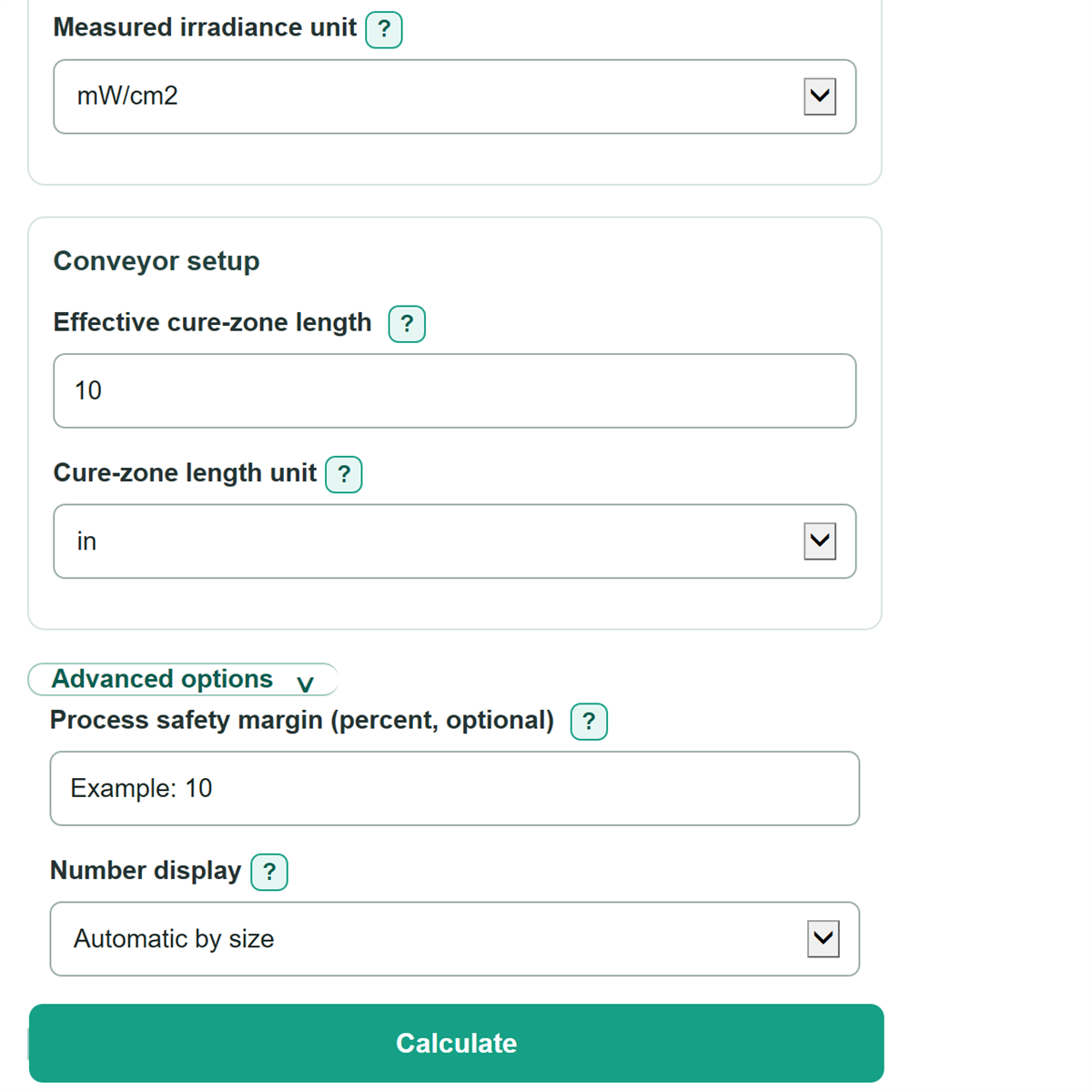
Conveyor setup
Advanced options
Table of contents
How to use our UV Curing Dose, Conveyor Speed and Exposure Time Calculator
- Choose what you need to find in Solve for: speed, time, delivered dose, or irradiance.
- Enter Required material dose from the material data sheet and choose the unit printed beside it.
- Enter Measured irradiance from a calibrated radiometer reading at the actual part surface, then select its displayed unit.
- For conveyor calculations, enter Effective cure-zone length, or enter Planned belt speed when checking delivered dose. For irradiance calculations, enter Exposure time.
- Click Calculate. Check that the unit choices match the source documents and, in delivered-dose mode, confirm that Adjusted dose target reached is at least 100 percent before validating on real parts.
Definitions
UV dose: Accumulated ultraviolet energy per area during an exposure, commonly written as mJ/cm2 or J/cm2. It is irradiance multiplied by exposure time. [1]
Irradiance: UV power per area at one moment, commonly written as mW/cm2 or W/cm2. Measure it at the part surface with the relevant UV band.
Effective cure-zone length: The usable UV distance a moving part travels through along the belt path. It can be shorter than the lamp housing.
Exposure time: The time a stationary part is under UV light, or the dwell time a moving part spends in the effective cure zone.
Process safety margin: An optional percentage added above the material dose target for planning. It is not a universal curing recommendation.
Dose margin above or below target: The signed percent difference between delivered dose and the dose target after any entered safety margin. A negative value means the estimate is below target.
Common mistakes and quick fixes
Mistake: Entering lamp electrical power as Measured irradiance.
Fix: Use a calibrated radiometer measurement at the part surface and select the unit shown by the instrument.
Mistake: Copying 0.8 from a data sheet but leaving Required dose unit set to mJ/cm2 when the sheet says J/cm2.
Fix: Choose J/cm2. A wrong milli-prefix choice changes the dose by 1,000 times.
Mistake: Using the full lamp housing length as Effective cure-zone length.
Fix: Use the usable UV length along belt travel from a validated measurement, mapping, drawing, or manual.
Mistake: Treating a positive Dose margin above or below target as proof that every part is cured.
Fix: Use it as a process estimate, then test real parts for the specified material, geometry, depth, and UV band.
Mistake: Adding a Process safety margin (percent, optional) without knowing why it is needed.
Fix: Leave it blank to use the material target exactly, or enter a margin from a validated process policy.
Limitations & Key Assumptions / Boundary Conditions
- The calculation treats the entered irradiance as an average value across the effective cure zone and exposure time.
- Use a radiometer reading at the actual part surface, working distance, and UV band. Lamp nameplate power is not irradiance at the part.
- A matching dose alone may not produce cure if the UV spectrum does not match the material, or if pigment, thickness, oxygen inhibition, shadows, part shape, or surface distance changes the process.
- Conveyor speed calculations use the effective cure-zone length along belt travel. Belt variation, part movement, and changing lamp output can change actual dwell time or dose.
- The optional process safety margin only raises the math target. It does not replace a validated work instruction or real-part cure testing.
Methodology
Calculation method
The calculator converts dose to mJ/cm2, irradiance to mW/cm2, cure-zone length to inches, and planned belt speed to inches per second before calculating. One J/cm2 equals 1,000 mJ/cm2, one W/cm2 equals 1,000 mW/cm2, and 1 foot equals 12 inches.
adjusted dose target (mJ/cm2) = required material dose x (1 + safety margin / 100)
required exposure time (seconds) = adjusted dose target (mJ/cm2) / measured irradiance (mW/cm2)
maximum belt speed (in/sec) = effective cure-zone length (in) / required exposure time (seconds)
delivered dose (mJ/cm2) = measured irradiance (mW/cm2) x exposure time at planned speed (seconds)
required irradiance (mW/cm2) = adjusted dose target (mJ/cm2) / exposure time (seconds)
Dividing mJ/cm2 by mW/cm2 gives seconds because both values use the same milli-prefix. Dose is accumulated energy, while irradiance is power at a moment. [1]
Worked example
Suppose the required material dose is 800 mJ/cm2, measured irradiance is 1,200 mW/cm2, effective cure-zone length is 10 inches, and the safety margin is 10 percent. The adjusted target is 880 mJ/cm2. Required exposure time is 880 / 1,200 = 0.7333 seconds. Maximum speed is 10 / 0.7333 = 13.636 in/sec, or 68.18 ft/min.
Calculation scope
In delivered-dose mode, the calculator divides effective cure-zone length by planned belt speed to find exposure time, then compares delivered dose with the adjusted target. A result of 100 percent means the simplified calculation target is reached. The model does not account for spectral mismatch, nonuniform light, shadows, material depth, lamp warm-up, lamp aging, or cure-test results.