
Enter your room dimensions to predict low-frequency standing waves, first axial modes, and nearby mode stacks in Hz.
Complete predicted mode list
| Mode indices (length, width, height) | Frequency | Type |
|---|
Table of contents
How to use our Room Mode and Standing Wave Calculator
- Choose Room measurement units that match your tape measure or floor plan.
- Enter the inside room dimensions. In US mode, enter whole feet and leftover inches separately for length, width, and ceiling height.
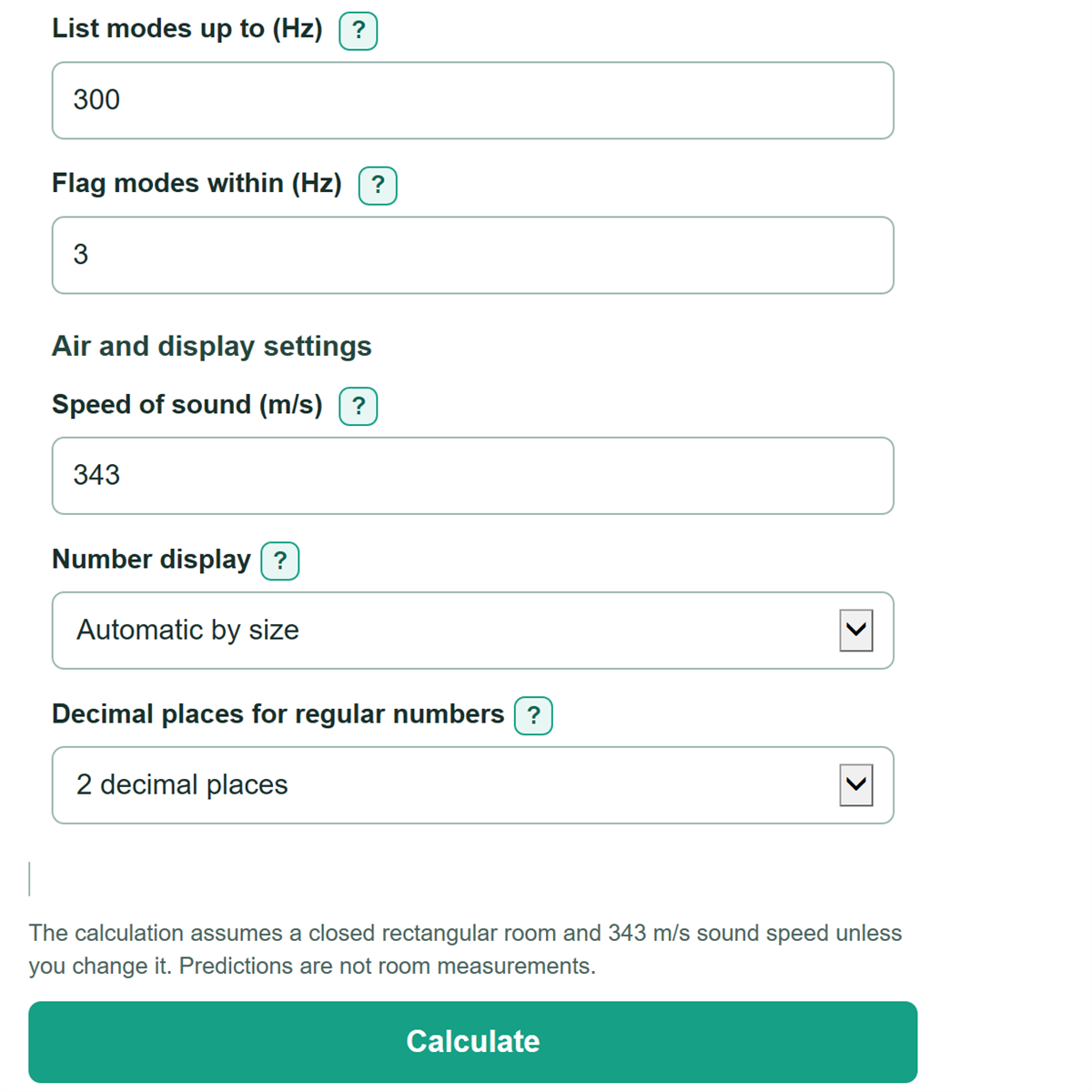
- Open Advanced options only if you want to change List modes up to (Hz), Flag modes within (Hz), or the sound-speed assumption.
- Click Calculate, then check the Lowest axial room mode and the three first axial modes before reviewing the full list.
- Sanity-check the result: the longest room dimension should usually have the lowest first axial frequency. Confirm important predicted frequencies with a sweep or room measurement.
Definitions
Standing wave: A repeating pressure pattern formed when sound reflects between room boundaries. It can create stronger and weaker bass at different locations. [1]
Room mode: A standing-wave resonance predicted from a room's dimensions. [2]
Hz: Hertz, or cycles per second. Room-mode frequency is shown in Hz.
Axial mode: A mode involving one pair of opposite surfaces only: front-to-back, side-to-side, or floor-to-ceiling.
Tangential mode: A mode involving two pairs of opposite surfaces.
Oblique mode: A mode involving all three pairs of opposite surfaces.
Closest stacked mode group: Two or more predicted modes grouped because each neighboring frequency is no farther apart than the chosen Flag modes within (Hz) value.
Modal index: A whole-number count that identifies the pressure pattern along length, width, and height. The 0, 0, 0 combination is excluded because it is not a room mode.
Common mistakes and quick fixes
Mistake: Entering 12 in for Room length (inches).
Fix: Add 1 to Room length (feet) and enter 0 for the inches remainder. Inches must be from 0 through 11.999.
Mistake: Measuring outside wall dimensions instead of the inside room for Room width (feet) and Room width (inches).
Fix: Measure between finished inside wall surfaces, because the model uses the air space inside the room.
Mistake: Leaving out ceiling height or using a wall height for Ceiling height (feet).
Fix: Measure from finished floor to finished ceiling. A wrong height can move the First floor-to-ceiling axial mode a lot.
Mistake: Treating the Closest stacked mode group as proof that bass will be boomy at every seat.
Fix: Use it as a frequency to test. Speaker position, listening position, openings, and absorption affect what you hear.
Mistake: Raising List modes up to (Hz) and assuming every listed frequency needs treatment.
Fix: Start with the lowest axial modes and close stacks, then measure or listen before making room changes.
Limitations & Key Assumptions / Boundary Conditions
- The calculation models a closed rectangular room with parallel boundaries. Open plans, large doorways, alcoves, sloped ceilings, and nonparallel walls can shift or weaken real modes.
- It predicts frequencies, not the loudness of peaks or depth of nulls at a specific seat. Speaker, subwoofer, listener, and furniture locations can strongly change the response.
- The default Speed of sound (m/s) is 343 m/s, a reference for air near 20 C. [3] Actual temperature and air conditions can shift frequencies slightly.
- Room surfaces are treated as ideal boundaries. Absorption, flexible walls, windows, and doors can reduce or alter resonances.
- Flag modes within (Hz) finds nearby calculated frequencies only. A stacked group is a measurement priority, not a confirmed acoustic fault.
- The full list includes every valid index combination through List modes up to (Hz), including different combinations that happen to have the same frequency.
Methodology
Calculation method
The calculator first converts active room dimensions to meters. In US mode, feet and inches are combined; a blank inches field counts as 0 only when its matching feet field has a value.
L(m) = (feet + inches / 12) * 0.3048
For each axis, the first axial mode is found by dividing the speed of sound by twice that room dimension.
ƒ = c / (2 * L)
In this formula, ƒ is frequency in Hz, c is Speed of sound (m/s), and L is the room dimension in meters. The lowest of the first front-to-back, side-to-side, and floor-to-ceiling values becomes Lowest axial room mode.
The complete list tests nonnegative whole-number modal indices for length, width, and height, excluding 0, 0, 0. One nonzero index is axial, two are tangential, and three are oblique.
ƒ = (c / 2) * sqrt((nL / L)^2 + (nW / W)^2 + (nH / H)^2)
Only modes at or below List modes up to (Hz) are retained. The frequencies are sorted, then neighboring entries no farther apart than Flag modes within (Hz) are placed in maximal groups. The qualifying group with the lowest starting frequency is shown as Closest stacked mode group.
Worked example
For a 5 m by 4 m by 2.5 m room with c = 343 m/s, the first front-to-back mode is 343 / (2 * 5) = 34.3 Hz. The first side-to-side mode is 42.875 Hz, and the first floor-to-ceiling mode is 68.6 Hz. The lowest axial mode is therefore 34.3 Hz.
Rectangular room-mode calculations use the standing-wave relationship between sound speed, room dimensions, and modal indices. [2]