
Estimate an air compressor's annual electricity cost, energy use, and power per rated CFM from its rating and run time.
Table of contents
How to use our Air Compressor Power, CFM and Annual Operating Cost Calculator
- Choose the power source you have under "How do you know the compressor power?" Use "Full-load package input" when the compressor sheet lists electrical kW.
- Enter "Rated air flow" and choose "How is the flow labeled on your source?" exactly as printed, such as SCFM or ACFM.
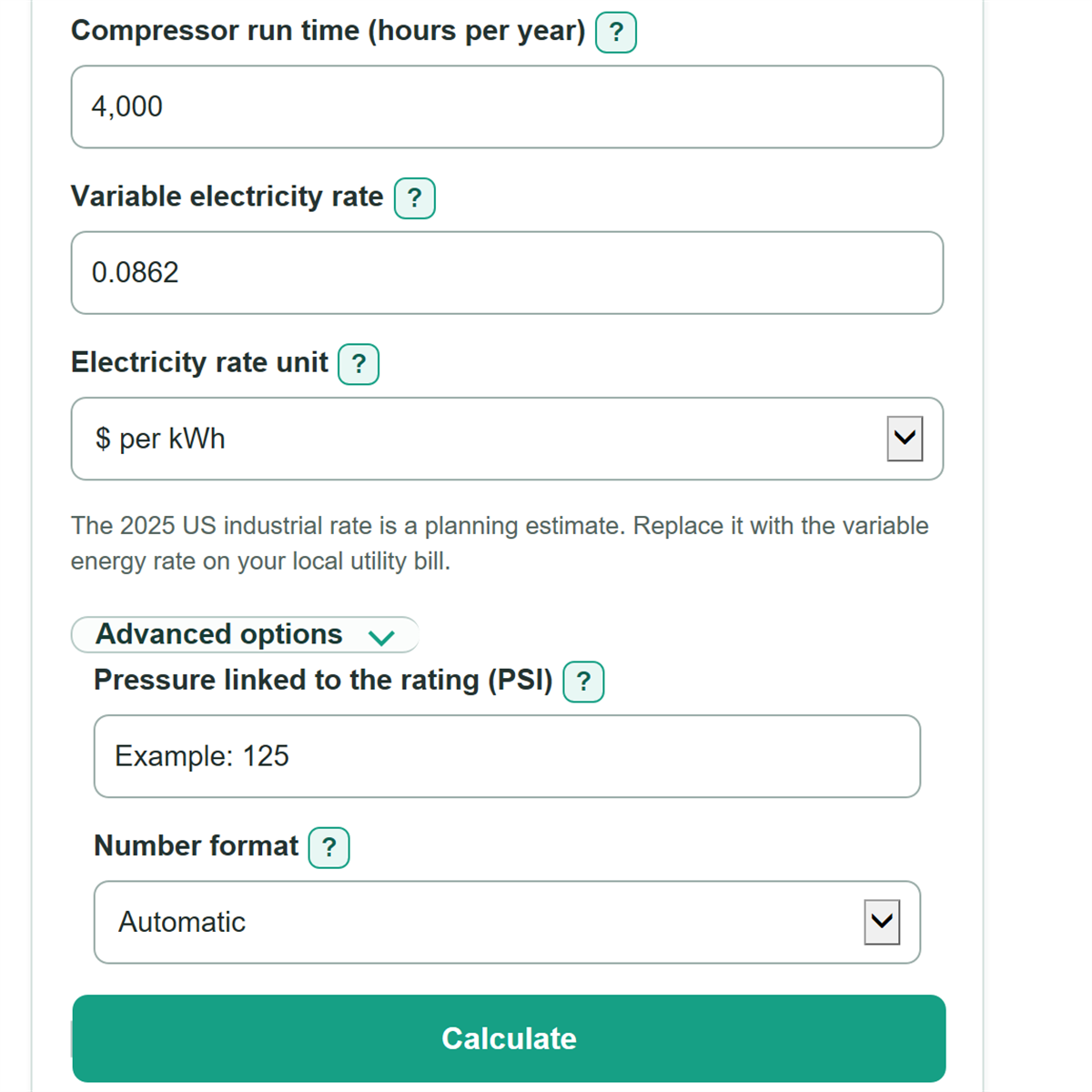
- Enter "Compressor run time" from a run-hour meter or yearly schedule, then enter the variable "Electricity rate" and its "Electricity rate unit" from the utility bill.
- Use "Motor nameplate power" and "Motor efficiency" only when estimating from motor HP, then select Calculate.
- Sanity-check "Estimated annual compressor energy use" by multiplying the displayed input kW by your annual hours. Compare compressors only when their flow basis and pressure conditions match.
Definitions
Package input kW: Electrical power used by the compressor package at its published rating. This is the preferred power input for estimating electricity use.
Motor nameplate power (HP): Mechanical output rating printed on the motor. The calculator converts it to estimated electrical input using motor efficiency.
Motor efficiency: The percent of electrical input converted into motor shaft output. It is not the compressor's load percentage.
CFM: Cubic feet of air per minute. A flow number needs its stated rating basis and pressure to be compared fairly.
SCFM: Standard cubic feet per minute, meaning flow adjusted to stated standard conditions.
ACFM: Actual cubic feet per minute, meaning flow at actual inlet conditions.
Full-load power per 100 rated CFM: Input kW divided by rated flow, then multiplied by 100. Lower values can indicate less power per rated flow when pressure and flow basis match.
Variable electricity rate: The per-kWh energy charge that changes with electricity use. Fixed customer fees are not part of this estimate.
Common mistakes and quick fixes
Mistake: Entering motor HP in "Full-load package input".
Fix: Choose the motor-HP path and enter "Motor nameplate power" plus "Motor efficiency", or copy electrical package kW into "Full-load package input".
Mistake: Treating SCFM and ACFM as the same rating.
Fix: Match "How is the flow labeled on your source?" to the compressor sheet before comparing "Full-load power per 100 rated CFM".
Mistake: Entering 8.62 as dollars when the bill shows 8.62 cents per kWh.
Fix: Keep "Electricity rate" as 8.62 and select "Cents per kWh" under "Electricity rate unit".
Mistake: Using all calendar hours instead of actual running time for "Compressor run time".
Fix: Use the run-hour meter or count only the hours when the compressor package runs.
Mistake: Assuming "Pressure linked to the rating (PSI)" changes the calculated electricity cost.
Fix: Use pressure to check that compressor ratings are comparable; the cost calculation uses the entered electrical power, run time, and electricity rate.
Limitations & Key Assumptions / Boundary Conditions
- The estimate treats every entered run hour as operating at the entered full-load package input kW or HP-based input estimate. It does not model changing demand, unloaded power, controls, or cycling.
- The motor-HP path estimates electrical input from nameplate HP and entered motor efficiency. It may miss compressor losses and package accessories, so published package kW is preferable.
- "Estimated annual compressor electricity cost" includes only the variable energy charge. It excludes demand charges, fixed utility fees, maintenance, dryers, filters, oil, and repairs.
- CFM, SCFM, and ACFM are kept as entered. The calculator does not convert between them because that requires supported temperature, pressure, and humidity conditions.
- "Pressure linked to the rating (PSI)" is comparison context only. It does not adjust power or cost because no compressor performance curve is used.
- Annual run time is limited to 0 through 8,760 hours for one year. A zero run time correctly produces zero modeled annual energy and cost.
Methodology
Calculation method
The calculator first converts the electricity rate to $ per kWh. A rate entered in cents per kWh is divided by 100. The default 0.0862 $ per kWh is a 2025 U.S. industrial planning estimate; replace it with the variable energy charge from your bill. [1]
rate per kWh = entered rate, or entered rate / 100 for cents per kWh
With "Full-load package input," the entered kW is used directly. With "Motor nameplate power," mechanical horsepower is converted using 1 HP = 0.745699872 kW, then divided by motor efficiency as a decimal. [2]
input kW = motor HP × 0.745699872 / (motor efficiency percent / 100)
Annual energy is input power multiplied by compressor run time. Annual electricity cost is annual energy multiplied by the normalized electricity rate.
annual energy (kWh) = input kW × hours per year
annual electricity cost ($) = annual energy (kWh) × rate ($ per kWh)
The flow-normalized measures divide by "Rated air flow." They are comparison aids, so the flow basis and linked pressure should match between compressors.
power per 100 rated CFM = input kW × 100 / rated CFM
annual cost per rated CFM = annual electricity cost / rated CFM
Worked example
A compressor with 75 kW package input, 4,000 hours per year, 400 SCFM, and a $0.0862 per kWh energy rate uses 300,000 kWh per year. Its estimated variable electricity cost is $25,860 per year, and its full-load power is 18.75 kW per 100 rated CFM.
Scope
The calculation uses a steady full-load power assumption during entered run hours. It does not estimate demand charges or change power based on entered PSI. Pressure and the CFM basis remain visible because matching rating conditions matter when comparing the flow-normalized outputs.