
Estimate annual compressed-air leak cost, expected repair savings, and simple payback using spending, cycle-test, or measured-flow records.
Advanced options
Table of contents
How to use our Compressed Air Leak Cost and Repair Payback Calculator
- Choose the option under What information do you have? that matches your records: annual compressor cost, a no-production cycle test, or measured leak flow.
- Enter only the fields shown for that method. For measured methods, use controller run hours and an electricity rate from the usage-dependent energy charge.
- Enter One-time repair program cost and the share in Leak cost expected to be removed. Use less than 100 percent if some modeled leaks may remain.
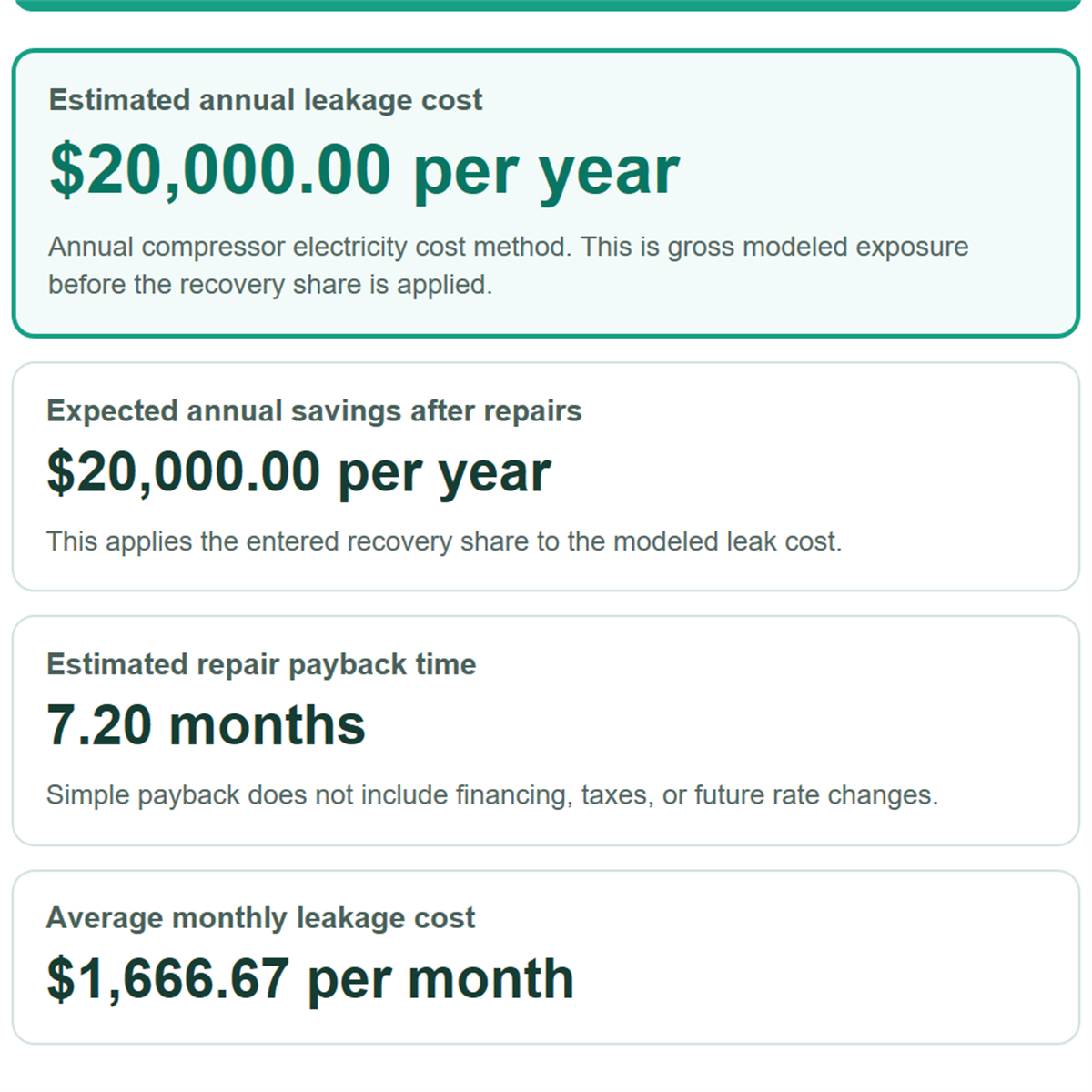
- Click Calculate. Read Estimated annual leakage cost as the gross exposure, then use Expected annual savings after repairs and Estimated repair payback time for the repair decision.
- Sanity-check the result by confirming that a higher runtime, electricity rate, leak flow, or loaded test time raises the estimated cost. If it does not match plant records, check the selected method and units.
Definitions
SCFM: Standard cubic feet per minute. It is an air-flow rate stated at defined standard conditions, which makes flow readings easier to compare.
Specific power: Electrical input power needed for each 100 SCFM of delivered air, entered as kW per 100 SCFM. Lower specific power means less electricity is used per unit of air at that operating point.
No-production cycle: A compressor load and unload cycle measured while normal production air use is stopped. The loaded share is used as an estimate of air demand from leaks.
Usage-dependent electricity cost: The part of the compressor electricity cost that can fall when kWh use falls. Fixed utility charges are not included.
Recovery share: The percentage of modeled leakage cost expected to be removed by the repair program. It converts gross leakage exposure into expected savings.
Simple payback: One-time repair program cost divided by expected annual savings, shown in months. It does not include financing, maintenance, production effects, or future rate changes.
Common mistakes and quick fixes
Mistake: Entering the whole facility electric bill in Annual compressor electricity cost that can change.
Fix: Use compressor-attributable, usage-dependent electricity cost only. Exclude fixed customer, meter, and minimum-bill charges.
Mistake: Typing 8.62 in Electricity rate while Electricity rate unit is set to $ per kWh.
Fix: Enter 0.0862 for $ per kWh, or select cents per kWh and enter 8.62.
Mistake: Using motor nameplate size for Compressor power while loaded.
Fix: Use measured or controller-reported electrical kW at the tested loaded condition.
Mistake: Using production-schedule hours for Compressor run time when the compressor also runs after production ends.
Fix: Use annual controller run hours or include all time the compressor can feed leaks.
Mistake: Setting Leak cost expected to be removed to 100 percent when repairs will address only part of the survey.
Fix: Enter the share of modeled leak cost expected to be removed, then compare that savings estimate with the repair cost.
Limitations & Key Assumptions / Boundary Conditions
- The annual-spend method treats the entered leak percentage as the share of usage-dependent compressor electricity cost caused by leaks. It does not calculate air flow or wasted kW.
- The no-production cycle method assumes the measured cycle is representative and that loaded electrical power is the applicable power for the test condition.
- The measured-flow method assumes the entered SCFM and specific power match the same compressor system, pressure, and operating condition.
- Fixed utility charges are excluded. Demand-charge savings are excluded unless they are known to be avoidable and already included in the entered variable cost or rate.
- Actual savings can differ if compressor controls change, other compressors sequence differently, pressure is reduced, leaks recur, or repairs do not remove the expected share.
- Payback is unavailable when expected annual savings are zero. A $0 repair cost with positive savings has a payback of 0 months.
Methodology
Calculation method
The calculator uses one evidence path at a time. It does not add a spending estimate, cycle test, and survey flow together. The annual-spend path multiplies compressor electricity cost that can change by the leakage percentage. The 20 percent default is a DOE planning scenario, not a finding about a specific plant. [1]
annual leakage cost = annual compressor electricity cost that can change x leak percentage / 100
For a no-production compressor cycle, the loaded fraction is loaded minutes divided by the full loaded-plus-unloaded cycle. That fraction is multiplied by measured loaded power to estimate electrical power serving leaks.
loaded fraction = loaded minutes / (loaded minutes + unloaded minutes)
estimated electrical power serving leaks = loaded power x loaded fraction
For measured leak flow, the calculator converts SCFM to electrical kW using the entered compressor input power per 100 SCFM.
estimated electrical power serving leaks = measured leak flow x compressor input power per 100 SCFM / 100
Both measured methods multiply estimated leak power by annual runtime and the usage-dependent electricity rate. If the rate is entered in cents per kWh, it is divided by 100 before use. The default $0.0862 per kWh is a 2025 US industrial planning estimate; replace it with the applicable plant rate. [2]
annual leakage cost = estimated electrical power serving leaks x compressor run time x electricity rate per kWh
The calculator then applies the entered recovery share and calculates simple payback. It shows payback as unavailable rather than dividing by zero when expected savings are zero.
expected annual savings after repairs = annual leakage cost x leak cost expected to be removed / 100
estimated repair payback time = one-time repair program cost / expected annual savings after repairs x 12
Worked example
With $100,000 of annual compressor electricity cost that can change, 20 percent assigned to leaks, and 80 percent expected recovery, annual leakage cost is $20,000 and expected savings are $16,000. A $12,000 repair program has a simple payback of 9 months.
Calculation choices
All calculations use full internal precision before display rounding. The annual result is divided by 12 for average monthly leakage cost. The formula uses 100 cents per dollar, 100 percent per whole, and 12 months per year.