
Estimate peak speaker SPL at your listening seat, or find the continuous watts per channel needed for a target peak level.
Speaker specifications
Listening setup
Advanced options
Table of contents
How to use our Speaker SPL, Distance and Amplifier Power Calculator
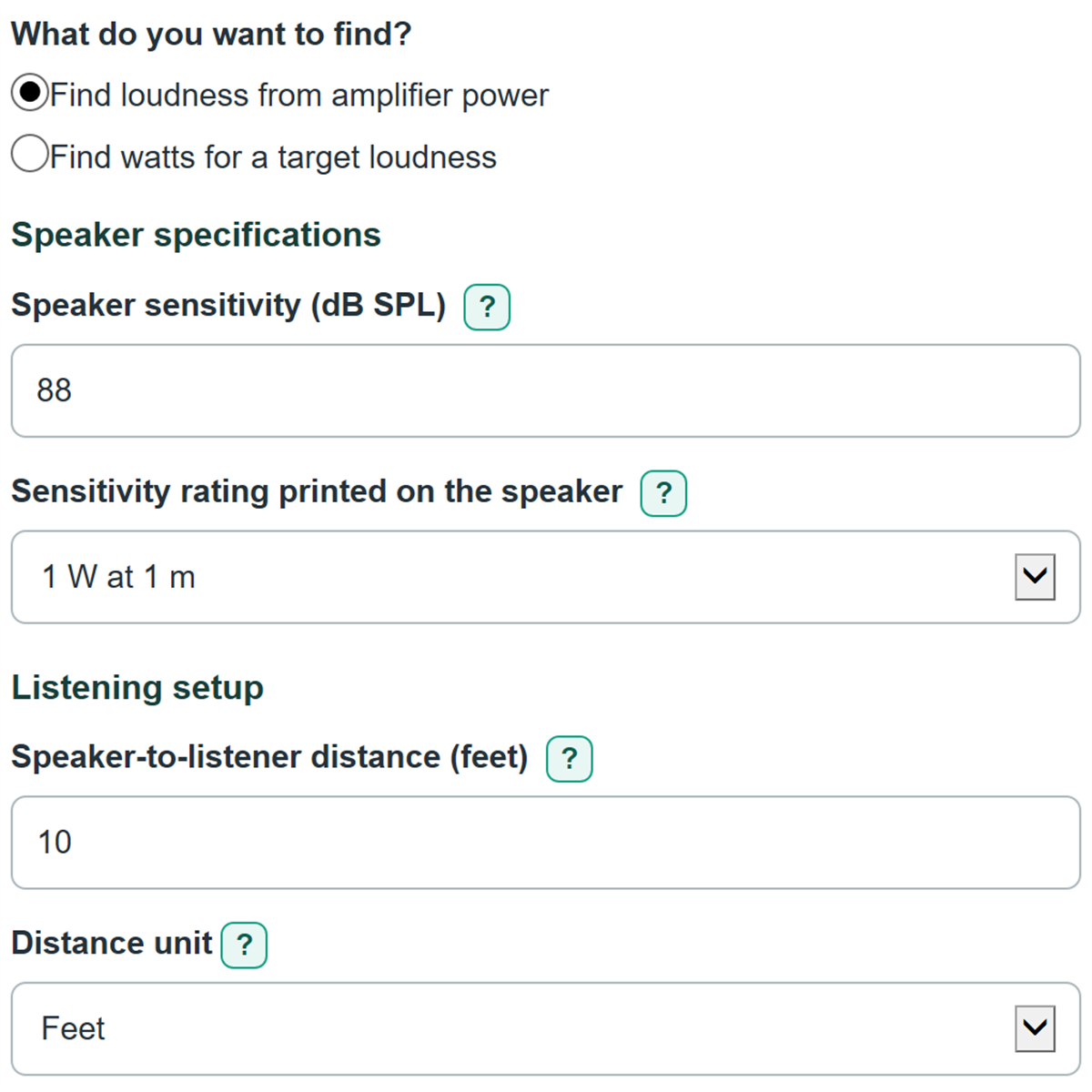
- Choose whether you know the amplifier power or want to find the watts needed for a target level.
- Copy the speaker's sensitivity number and choose the reference printed beside it: 1 W at 1 m or 2.83 V at 1 m.
- If the speaker uses a 2.83 V rating, enter its nominal impedance from the same specification sheet.
- Enter the speaker-to-listener distance in feet or meters, then enter amplifier power or your target peak sound level.
- Check the sensitivity used at 1 W and 1 m and the distance loss before relying on the main answer; a different reference or distance can change the estimate a lot.
Definitions
dB SPL: A sound-pressure level measured in decibels relative to a standard reference pressure.
Speaker sensitivity: The sound level a speaker specification states at 1 meter for a stated electrical input, such as 1 W or 2.83 V.
1 W at 1 m: A sensitivity reference using 1 watt of electrical power and a microphone distance of 1 meter.
2.83 V at 1 m: A sensitivity reference using 2.83 volts at 1 meter. The watts represented by 2.83 V depend on nominal impedance.
Nominal impedance: The speaker's published approximate electrical resistance rating, in ohms. It is used here to convert a 2.83 V sensitivity rating to a 1 W reference.
Continuous watts per channel: Amplifier power available to one speaker channel under the stated rating conditions, rather than a total-system or short peak claim.
Peak sound level: A short highest sound level in program material, not the same as a long-term average level.
Common mistakes and quick fixes
Mistake: Treating a 2.83 V at 1 m rating as if it were 1 W at 1 m.
Fix: Match the printed format in "Sensitivity rating printed on the speaker" and enter "Speaker nominal impedance" when 2.83 V is selected.
Mistake: Entering total receiver watts or a peak marketing number in "Continuous amplifier power per channel".
Fix: Use the continuous watts for one channel at your speaker's nominal impedance.
Mistake: Measuring across the room instead of from a speaker to the seat.
Fix: Measure the direct path for "Speaker-to-listener distance" and confirm the chosen "Distance unit".
Mistake: Using an average dBA exposure number as "Target peak sound level at the listener".
Fix: Enter a peak dB SPL system goal directly; this field does not convert hearing-exposure guidance into a peak target.
Mistake: Assuming two speakers always add the same amount in every room.
Fix: Choose "Speakers contributing at the listener" only when both speakers play the same program, then treat the adjustment as an estimate.
Limitations & Key Assumptions / Boundary Conditions
- The estimate uses free-field distance loss, which assumes sound spreads outward without room reflections. Walls, corners, and furnishings can raise or lower measured SPL.
- A 2.83 V sensitivity conversion treats nominal impedance as a resistive value. A real speaker's impedance changes with frequency.
- "Speakers contributing at the listener" supports one speaker or two speakers playing the same program. Stereo balance, timing, placement, and different program material can change the real combined level.
- Continuous amplifier power must be available at the speaker's nominal impedance. Amplifier protection, power-supply limits, and multiple driven channels can reduce available power.
- The calculation does not model speaker compression, distortion, safe power handling, or driver damage. A calculated watt requirement does not prove a speaker or amplifier can safely deliver it.
- Peak dB SPL is a system-planning value. It is not an occupational dBA exposure assessment or a hearing-safety recommendation.
Methodology
Calculation method
The calculator first puts both sensitivity labels onto a common 1 W at 1 m basis. It then applies amplifier power, free-field distance change, and the selected one-speaker or two-speaker adjustment.
reference_power_w = 1 for 1 W at 1 m, otherwise 2.83^2 / nominal_impedance_ohms
sensitivity_1w_1m_db = sensitivity_db - 10 * log10(reference_power_w)
distance_m = distance_value * 0.3048 for feet, otherwise distance_value
distance_loss_db = 20 * log10(distance_m / 1)
speaker_gain_db = 10 * log10(speaker_count)
expected_spl_db = sensitivity_1w_1m_db + 10 * log10(available_power_w) - distance_loss_db + speaker_gain_db
required_power_w = 10^((target_peak_spl_db - sensitivity_1w_1m_db + distance_loss_db - speaker_gain_db) / 10)
Worked example
For a speaker rated 88 dB SPL at 2.83 V and 1 m with 4 ohms nominal impedance, the reference represents 2.002225 W. Its converted sensitivity is about 84.98 dB SPL at 1 W and 1 m. At 10 feet, 100 watts per channel, and one speaker, the modeled peak level is about 95.30 dB SPL. Reaching 105 dB SPL in the same setup requires about 932.27 continuous watts per channel.
Calculation scope
The distance step is a simplified free-field model. The two-speaker step assumes equal contribution and adds about 3.01 dB for two speakers. Results are planning estimates rather than measured or manufacturer-rated performance.