
Calculate emergency-light battery capacity or check estimated runtime using connected load, required emergency time, battery voltage, and printed capacity.
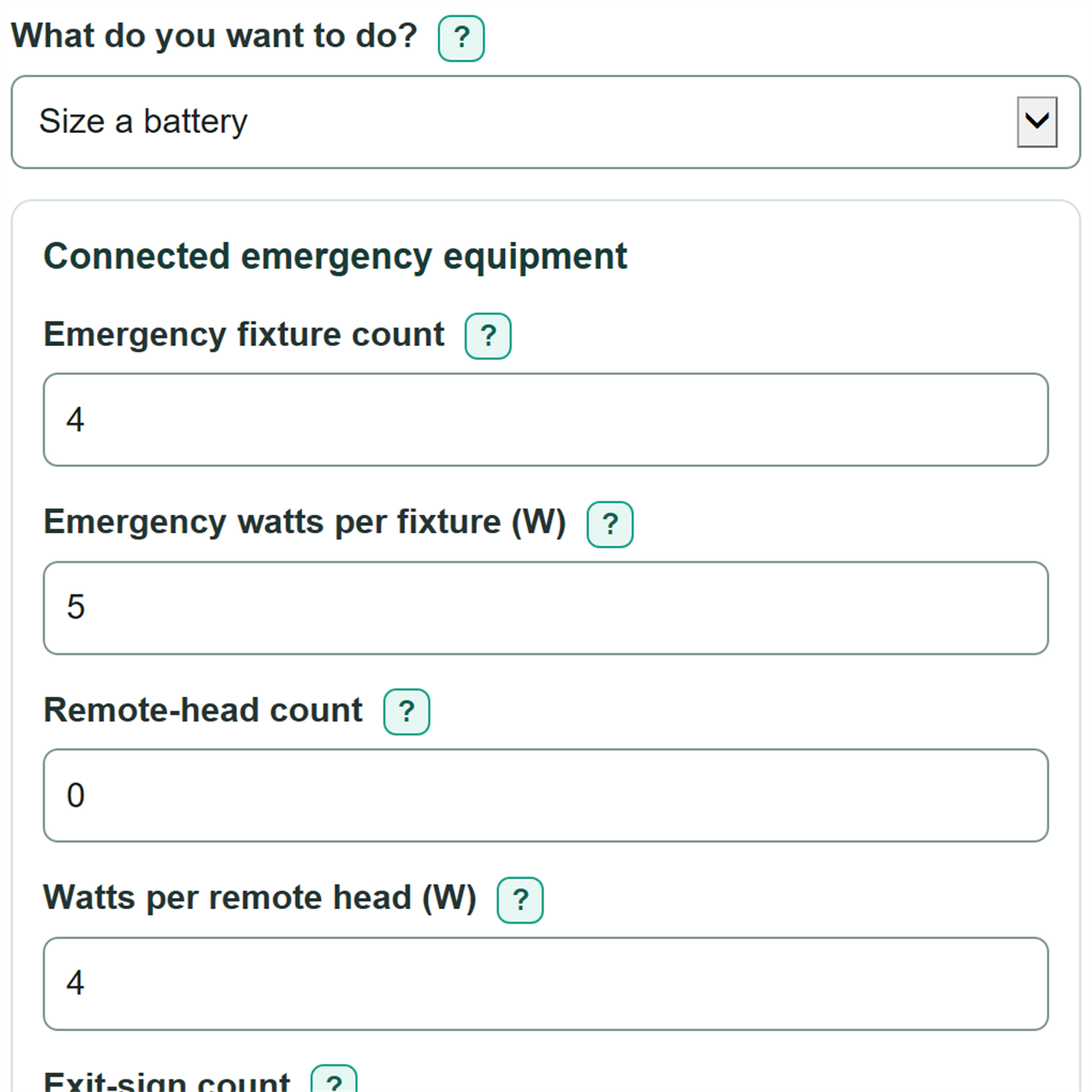
Connected emergency equipment
Time and battery bank
The 90-minute US value is a planning starting point. Replace it with the project requirement, approved plan, or direction from your local authority.
Advanced options
Table of contents
How to use our Emergency Lighting Battery Capacity and Runtime Calculator
- Choose "Size a battery" to find a minimum capacity, or "Check a battery" to estimate runtime for an installed battery.
- Enter each connected category using Emergency fixture count, Emergency watts per fixture, Remote-head count, Watts per remote head, Exit-sign count, and Watts per exit sign. Use emergency-mode watts from labels or cut sheets.
- Enter Required emergency time and choose the Battery-bank voltage printed for the complete battery bank.
- For "Check a battery," copy the label into Printed battery capacity and choose its exact Printed capacity unit: Ah, mAh, or Wh.
- Click Calculate, then compare Connected emergency load with your equipment list and review the Selected-duration check plus Calculation assumptions before selecting equipment.
Definitions
Connected emergency load (W): The total emergency power used by all counted fixtures, remote heads, and exit signs.
Watt (W): A measure of electrical power. More watts use battery energy faster.
Watt-hour (Wh): A measure of energy equal to one watt supplied for one hour.
Amp-hour (Ah): Battery capacity measured as current over time. At a fixed voltage, Wh divided by volts equals Ah.
Milliamp-hour (mAh): One thousandth of an Ah. 1,000 mAh equals 1 Ah.
Battery-bank voltage (V): The nominal DC voltage of the complete battery pack or bank used for the Ah conversion.
Battery-to-light efficiency (%): The share of nominal battery energy assumed to reach the emergency load after conversion losses.
Extra capacity margin (%): An added reserve for aging, uncertainty, or a project requirement.
Runtime time left or short: Estimated emergency runtime minus Required emergency time. A negative value means an estimated shortfall.
Common mistakes and quick fixes
Mistake: Entering normal fixture input watts instead of Emergency watts per fixture.
Fix: Use the emergency-mode watt rating from the fixture, emergency driver, or cut sheet.
Mistake: Using building supply voltage for Battery-bank voltage.
Fix: Select the nominal DC voltage printed on the battery pack or complete battery bank.
Mistake: Typing a battery label value without matching Printed capacity unit.
Fix: Copy the number into Printed battery capacity and choose Ah, mAh, or Wh exactly as printed.
Mistake: Leaving out connected remote lamps or signs from Remote-head count or Exit-sign count.
Fix: Count every item powered by this battery during an outage; enter 0 only for a category that is not connected.
Mistake: Treating a passing Selected-duration check as formal approval.
Fix: Use it as a planning check, then confirm project requirements, equipment listing, and local authority requirements.
Mistake: Using 100% Battery-to-light efficiency (%) for equipment with known conversion losses.
Fix: Enter a supported efficiency value from the equipment documentation and review the changed Calculation assumptions.
Limitations & Key Assumptions / Boundary Conditions
- This is a planning calculation based on entered nameplate or cut-sheet values. It does not replace a required discharge test, equipment instructions, listing requirements, project documents, or a decision by the local authority having jurisdiction.
- Use emergency-mode watts, not normal operating watts, when they differ. An omitted fixture, remote head, or exit sign makes the calculated load too low.
- The calculation treats Battery-bank voltage as nominal and uses the printed capacity as entered. Actual delivered energy can differ because of battery condition, age, temperature, discharge rate, wiring, charger behavior, and equipment shutdown limits.
- Battery-to-light efficiency (%) defaults to 100% when blank. Extra capacity margin (%) defaults to 0% when blank. Enter supported values when losses or a required reserve apply.
- A positive Selected-duration check means only that the entered model reaches the entered Required emergency time. It is not a finding of code compliance or UL listing compliance.
- For loose batteries or a custom bank, make sure the entered Printed battery capacity and Battery-bank voltage describe the complete configured bank, not one individual battery.
Methodology
Calculation method
The calculator first adds the emergency load from fixtures, remote heads, and exit signs. A category with a count of 0 adds 0 W, even if its watts-per-item field has a value.
connected load (W) = fixture count x fixture watts + remote-head count x remote-head watts + exit-sign count x exit-sign watts
Required emergency time is converted from minutes to hours without rounding first.
required time (hours) = required emergency time (minutes) / 60
For battery sizing, the calculator applies the selected extra capacity margin and divides by battery-to-light efficiency. A blank efficiency is treated as 100%; a blank margin is treated as 0%.
required nominal energy (Wh) = connected load (W) x required time (hours) x (1 + margin / 100) / (efficiency / 100)
The energy result is converted to nominal amp-hours using the selected battery-bank voltage.
minimum nominal battery capacity (Ah) = required nominal energy (Wh) / battery-bank voltage (V)
In "Check a battery" mode, Ah is multiplied by voltage, mAh is divided by 1,000 before multiplying by voltage, and Wh is used directly.
entered battery energy (Wh) = capacity x voltage for Ah; capacity x voltage / 1000 for mAh; capacity for Wh
The known battery energy is adjusted by the same efficiency and margin assumptions, divided by the connected load, then converted to minutes.
estimated emergency runtime (minutes) = entered battery energy (Wh) x (efficiency / 100) / (1 + margin / 100) / connected load (W) x 60
runtime time left or short (minutes) = estimated emergency runtime - required emergency time
Worked example
Four 5 W fixtures, two 4 W remote heads, and two 3 W exit signs create a 34 W connected emergency load. For 90 minutes, that is 1.5 hours. With 100% efficiency and 0% margin, the required nominal energy is 34 x 1.5 = 51 Wh. At 12 V, the minimum nominal capacity is 51 / 12 = 4.25 Ah. A 90-minute target is commonly used for emergency lighting planning, but the applicable requirement can differ. [1]
Calculation choices
The Selected-duration check passes when estimated runtime is equal to or greater than Required emergency time. A negative runtime margin is retained and shown as an estimated shortfall rather than changed to zero.