
Estimate LED-only and adaptive-dimming energy savings, net project costs, and simple payback for one group of parking garage fixtures.
Daily schedule
Electricity
Project quote and incentives
Advanced options
Measured dimming
Maintenance costs
Calculation details
Table of contents
How to use our Parking Garage LED Payback Calculator
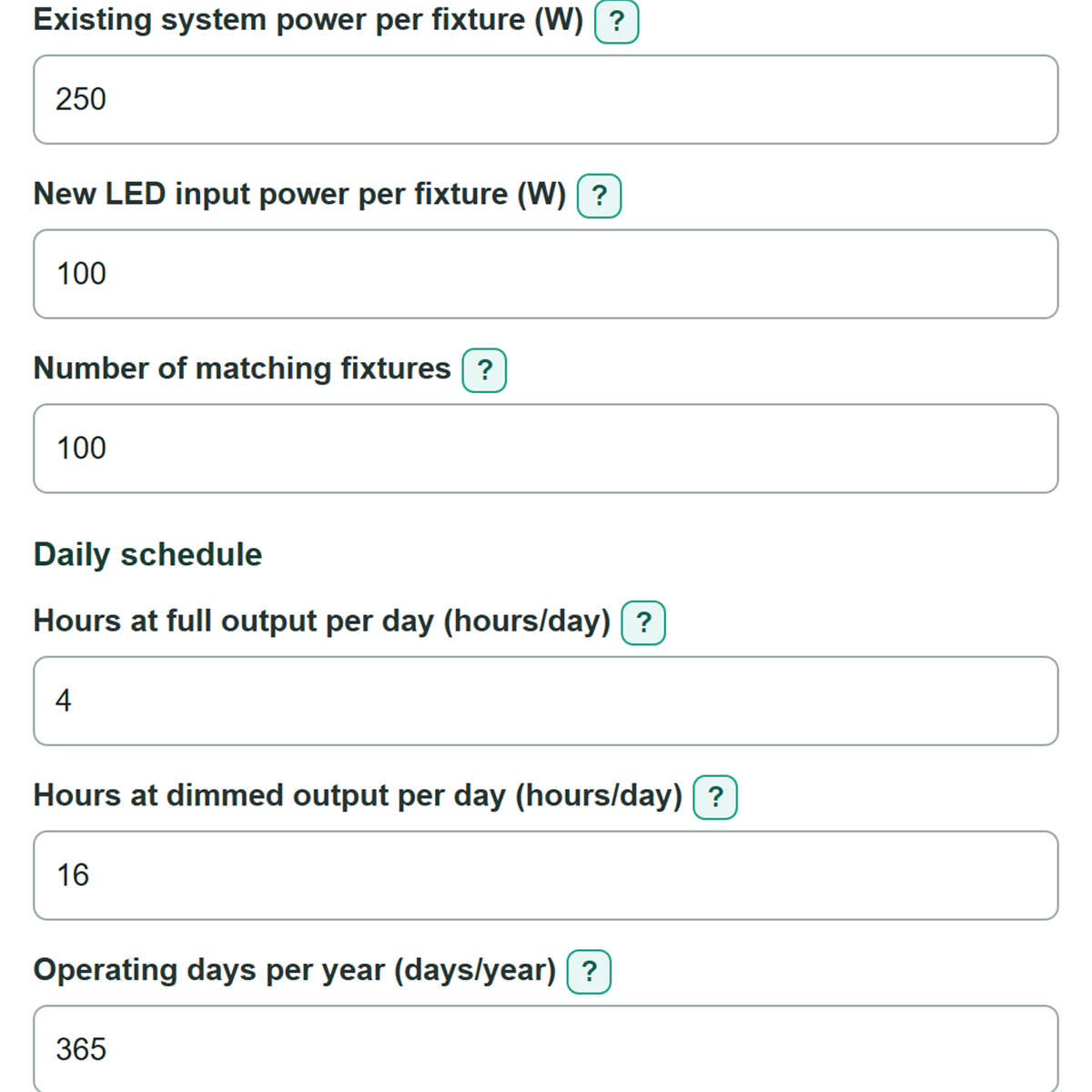
- Enter actual input watts for the existing fixtures and the new LEDs, plus the Number of matching fixtures.
- Split the daily schedule between Hours at full output per day and Hours at dimmed output per day. Their combined total cannot be more than 24 hours.
- Enter the Dimmed output level and the Electricity usage price with the matching Electricity price unit from the utility bill.
- Copy quoted costs and incentives into the LED and adaptive-controls cost and rebate fields. Add maintenance values in Advanced options only when you have annual records or estimates.
- Check that LED plus controls annual energy savings is positive and compare Adaptive controls add-on payback time with LED-only retrofit payback time before using the estimate for a project decision.
Definitions
Input power (W): Electrical power drawn by one fixture. Existing system power should include a ballast when one is present.
Dimmed output level: The selected low-light setting as a percent of full output. This calculator uses it as an estimate of dimmed power unless direct dimmed watts are entered.
kWh: Kilowatt-hour, the electricity unit used for most utility energy charges. One kWh equals 1,000 watts used for one hour.
Net upfront cost: Project cost before rebates minus the related rebate or incentive.
Simple payback time: Net upfront cost divided by annual savings, shown in months. It estimates how long savings take to recover the initial cost.
Common mistakes and quick fixes
Mistake: Entering nominal HID lamp watts in Existing system power per fixture instead of total fixture input power.
Fix: Use audited, measured, or nameplate system watts that include ballast draw.
Mistake: Using equivalent replacement watts for New LED input power per fixture.
Fix: Copy the listed LED input watts from the cut sheet, quote, or fixture label.
Mistake: Setting Hours at full output per day and Hours at dimmed output per day to more than 24 combined hours.
Fix: Enter only the two operating periods for one day; all remaining hours are treated as off.
Mistake: Entering a full utility bill or fixed monthly fee as Electricity usage price.
Fix: Enter only the usage-based price per kWh and choose the matching Electricity price unit.
Mistake: Including controls equipment in LED retrofit cost before rebates and again in Adaptive controls add-on cost before rebates.
Fix: Keep the LED retrofit and adaptive-controls add-on quotes separate so controls payback uses only the added controls cost.
Mistake: Treating Dimmed output level as exact electrical power when published dimming data are available.
Fix: Enter Published or measured dimmed power per LED fixture (W) in Advanced options when the cut sheet or a measurement provides it.
Limitations & Key Assumptions / Boundary Conditions
- The dimmed-output percentage is a planning estimate for power draw. Actual dimmed watts can differ by fixture, driver, controls settings, and measurement method; use Published or measured dimmed power per LED fixture (W) when available.
- One calculation covers fixtures with the same existing watts, LED watts, and daily schedule. Run separate estimates for ramps, decks, aisles, or other zones with different conditions.
- Only usage-based electricity charges are included. Fixed customer charges and demand charges are excluded because their savings depend on the tariff and the timing of the building peak.
- Payback is simple payback. It does not include financing, taxes, escalation in electricity prices, discount rates, equipment life, replacement timing, or future repair costs unless annual maintenance values are entered.
- Rebates reduce upfront cost once. Confirm eligibility, approval requirements, installation dates, and final incentive amounts with the program administrator.
- A zero or negative net upfront cost is shown as 0 months because the entered incentives already cover the entered cost. Negative annual savings means the proposed case costs more to operate under the entered assumptions.
Methodology
Calculation method
The calculator first converts the entered electricity price to dollars per kWh. The default $0.1341 per kWh is a 2025 US commercial-sector planning estimate from EIA; replace it with the local usage charge from the utility bill. [1]
scheduled_hours = (full_hours_per_day + dimmed_hours_per_day) * days_per_year
Existing fixtures use their entered system watts for all scheduled hours. The LED-only case keeps LEDs at full input power during those same hours.
existing_annual_kwh = existing_watts * fixture_count * scheduled_hours / 1000
led_only_annual_kwh = led_watts * fixture_count * scheduled_hours / 1000
For the LED plus controls case, full-output and dimmed-output periods are calculated separately. Direct dimmed watts override the percent-based estimate when entered.
dimmed_watts = led_watts * dim_level_percent / 100
combined_annual_kwh_use = fixture_count * days_per_year * (led_watts * full_hours_per_day + dimmed_watts * dimmed_hours_per_day) / 1000
Annual energy savings are existing annual energy minus the applicable LED annual energy. Annual dollar savings equal energy savings times the electricity price, plus current annual maintenance cost minus expected annual LED maintenance cost when those optional values are entered.
annual_cost_savings = annual_kwh_savings * electricity_rate + maintenance_savings
Each rebate is subtracted once from its matching cost. The controls add-on payback uses only the extra savings from dimming beyond LED-only operation, so LED fixture savings are not counted twice.
payback_months = round(12 * net_cost / annual_savings)
Worked example
With 100 existing 250 W fixtures, 100 W LEDs, 4 full-output hours, 16 dimmed hours at 30%, and 365 operating days, the existing case uses 182,500 kWh per year. The LED plus controls case uses 32,120 kWh per year, saving 150,380 kWh. At $0.1341 per kWh, that is $20,165.96 in annual energy savings. A combined net upfront cost of $62,000 gives a simple payback of 37 months after rounding.