
Compare desiccant and compressor dehumidifier costs using each unit's price, energy use, electricity rate, and planned ownership years.
Desiccant unit
Compressor unit
Electricity and time
The starting electricity rate is a 2026 U.S. residential planning estimate. Replace it with the delivered usage rate from your local bill or utility provider.
Advanced options
Annual maintenance
Room context
Number display
Calculation details
Table of contents
How to use our Desiccant vs Compressor Dehumidifier Lifetime Cost Calculator
- Choose the energy format you have under "Energy information you have": watts plus running time, measured daily kWh, or annual EnergyGuide kWh.
- Enter the quoted price for each unit and the energy numbers for both units using the selected format only.
- Set the electricity rate to match your bill, then enter "Years you expect to own each unit".
- Open Advanced options only if you know either unit's yearly maintenance cost or want to add room-temperature context.
- Click Calculate, then check that each unit's "energy use each year" looks reasonable for its watts, runtime, or measured kWh before using the lifetime cost difference.
Definitions
kWh: Kilowatt-hour, a unit of electrical energy used on utility bills and energy monitors.
Watts: A measure of power while a unit is running. Dividing watts by 1,000 converts them to kilowatts.
Annual electricity cost: The unit's yearly kWh multiplied by the entered electricity rate.
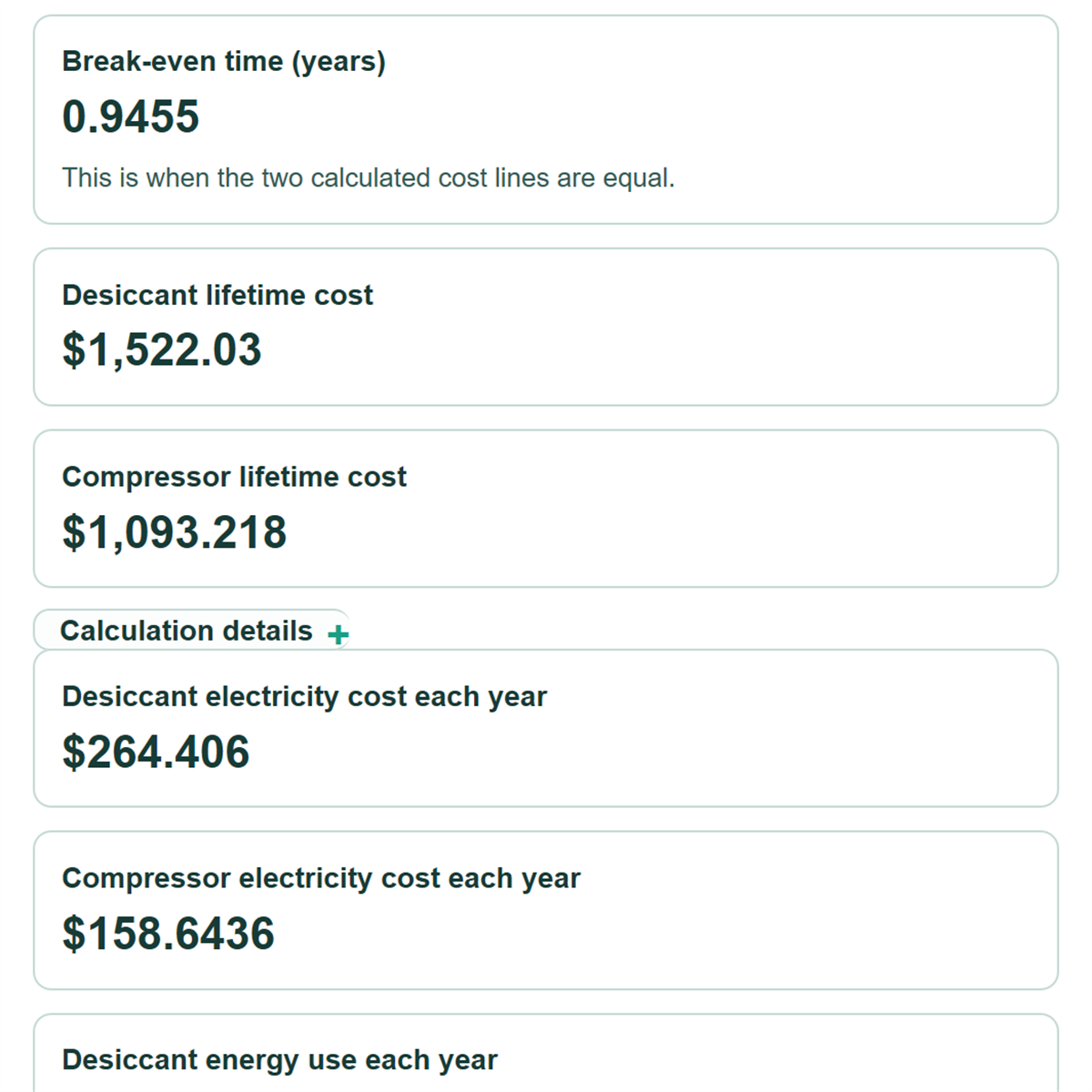
Lifetime cost: Purchase price plus electricity and entered yearly maintenance across the ownership period.
Lifetime cost difference: Desiccant lifetime cost minus compressor lifetime cost. A negative amount means desiccant costs less.
Break-even time: The year when the two calculated cost totals are equal. It appears only when a crossover occurs at year zero or later.
Common mistakes and quick fixes
Mistake: Treating hours plugged in as actual runtime for "Energy information you have" set to watts and running hours.
Fix: Use average hours drawing power. A humidistat may turn the unit on and off during the day.
Mistake: Entering watts and measured kWh for the same unit.
Fix: Pick one "Energy information you have" method and enter only the fields shown for that method.
Mistake: Typing a dollar rate when "Electricity rate" is set to cents per kWh.
Fix: Match the rate unit to the bill. Enter 18.1 for cents per kWh or 0.181 for $ per kWh.
Mistake: Adding a fixed monthly utility customer charge to "Electricity rate".
Fix: Use only the usage-based delivered rate per kWh because one appliance normally does not change the fixed charge.
Mistake: Forgetting recurring filters when comparing "Desiccant lifetime cost" and "Compressor lifetime cost".
Fix: Add known recurring costs in "Desiccant maintenance each year ($)" and "Compressor maintenance each year ($)".
Mistake: Reading a negative "Lifetime cost difference" as an error.
Fix: A negative value means the desiccant lifetime cost is lower; a positive value means the compressor lifetime cost is lower.
Limitations & Key Assumptions / Boundary Conditions
- The result is a planning comparison, not a prediction of actual moisture removal, comfort, noise, or reliability.
- Watts and runtime are treated as average running power and average hours drawing power every day for 365 days. Humidistat cycling and seasonal use can change actual kWh.
- Measured daily kWh and annual EnergyGuide kWh are used as entered. Do not combine either with watts and runtime for the same unit.
- The calculator uses one constant electricity rate over all ownership years. Future utility rates, taxes, and rate-plan changes can change real costs.
- Fixed monthly utility customer charges are excluded because an individual appliance usually does not change them.
- Blank maintenance is treated as $0. Repairs, replacement purchases, delivery, installation, resale value, and disposal costs are not included unless already included in the entered unit price or yearly maintenance.
- Typical room temperature provides context only. It does not alter energy use or cost because no model-specific temperature performance data is entered.
Methodology
Cost calculation
The calculator first finds annual energy use using the one energy method selected for both units. It then multiplies annual kWh by the electricity rate. If the rate is entered in cents per kWh, it is divided by 100 to convert it to dollars per kWh.
annual_kwh = watts * runtime_hours_per_day * 365 / 1000
annual_kwh = kwh_per_day * 365
annual_electricity_cost = annual_kwh * electricity_rate_dollars_per_kwh
For each unit, the lifetime total combines the one-time purchase price with yearly electricity and optional yearly maintenance over the entered ownership period.
lifetime_cost = price + ownership_years * (annual_electricity_cost + annual_maintenance)
The signed lifetime cost difference is desiccant cost minus compressor cost. The break-even calculation compares the upfront price gap with the yearly operating-cost gap. A break-even time is shown only if the cost lines meet at year zero or later.
lifetime_cost_difference = desiccant_lifetime_cost - compressor_lifetime_cost
break_even_year = -(desiccant_price - compressor_price) / annual_cost_gap
Mini-example
If a desiccant unit costs $200, uses 1,000 kWh per year, and a compressor costs $300 and uses 500 kWh per year, an electricity rate of $0.20 per kWh gives yearly electricity costs of $200 and $100. Over five years with no maintenance, the lifetime totals are $1,200 and $800, so the compressor costs $400 less. The break-even time is 1 year.
Calculation choices
The default electricity rate is an editable 2026 U.S. residential planning estimate from the U.S. Energy Information Administration. Replace it with the delivered usage-based rate from your own bill or utility portal. [1] The calculation uses 365 days per year and 1,000 watts per kilowatt. Blank annual maintenance is treated as $0; nonblank maintenance must be a valid nonnegative amount.