
Estimate the range hood CFM you need, compare a candidate hood, and check its outlet against an existing duct opening.
Advanced options
Calculation details
Table of contents
How to use our Range Hood CFM and Duct Size Calculator
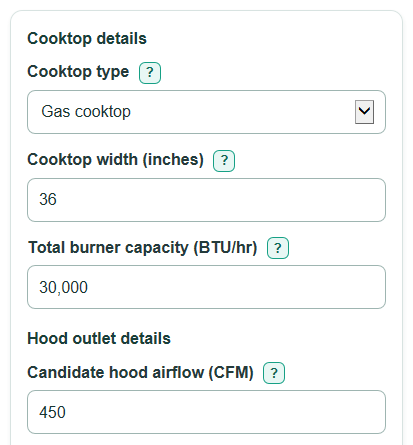
- Choose Cooktop type and enter Cooktop width in inches from the appliance specification sheet.
- For gas, enter Total burner capacity in BTU/hr by adding the ratings for all burners.
- Enter the candidate hood's maximum Candidate hood airflow and select its Hood outlet shape with the outlet dimensions from the installation manual.
- Open Advanced options and set Check an existing duct to Yes only if you are reusing a measured duct section.
- Check that the candidate airflow margin is zero or higher and that the smallest checked opening is 100 percent before reviewing the hood manual and local installation rules.
Definitions
CFM: Cubic feet per minute, a measure of how much air a fan moves.
BTU/hr: British thermal units per hour, a measure of a gas burner's heat input.
Hood outlet: The duct connector on the range hood. Its size can differ from the duct already installed in a wall or ceiling.
Candidate hood airflow margin: Candidate hood airflow minus the suggested hood airflow rating. A negative margin means the candidate rating is below the planning target.
Equal-area round duct estimate: A whole-inch round diameter whose opening area is at least as large as the entered hood outlet opening.
Makeup air: Outdoor or replacement air provided when exhaust equipment removes air from a home.
Common mistakes and quick fixes
Mistake: Entering the hood width instead of Cooktop width.
Fix: Copy the cooking appliance width, measured side to side, in inches.
Mistake: Entering one burner's rating as Total burner capacity.
Fix: Add the BTU/hr ratings of every gas burner before entering the total.
Mistake: Treating Candidate hood airflow as the airflow the kitchen needs.
Fix: Enter the hood's listed maximum CFM, then compare its margin with the suggested hood airflow rating.
Mistake: Measuring a wall opening but entering it as the Hood outlet diameter.
Fix: Use the hood installation drawing for the outlet, and use Smallest existing duct diameter (inches) only for the reused duct section.
Mistake: Leaving Check an existing duct set to No after measuring a reused duct.
Fix: Choose Yes, select the existing duct shape, and enter the smallest section that will stay in the path.
Mistake: Entering 3,25 for a rectangular duct measurement.
Fix: Use a decimal point, such as 3.25, in Hood outlet width or Smallest existing duct width (inches).
Limitations & Key Assumptions / Boundary Conditions
- This is an early residential planning estimate. The hood installation manual and locally adopted code control the final hood, outlet, transition, and duct size.
- The airflow estimate uses 100 CFM per linear foot of cooktop width and, for gas, 1 CFM per 100 BTU/hr. Gas uses the larger estimate, not their sum.
- The duct check compares opening areas only. It does not calculate pressure loss from duct length, elbows, transitions, dampers, wall or roof caps, grease buildup, or blower performance.
- An equal-area round duct can still perform differently from a rectangular duct. Do not use it to approve a reduction from a manufacturer-required outlet.
- The existing-duct check covers only the smallest entered section. A different smaller section anywhere in the completed path can still restrict airflow.
- The makeup-air message is a code-review reminder when the larger relevant airflow value exceeds 400 CFM. Local adoption and installation conditions determine any actual requirement. [1]
Methodology
Airflow calculation
The calculator first converts cooktop width from inches to feet and applies the planning rate of 100 CFM per linear foot.
width-based CFM = cooktop width (inches) x 100 / 12
For a gas cooktop, it also calculates an airflow estimate from the total burner rating, then uses the larger of the two estimates. Electric and induction cooktops use the width-based estimate only.
gas-based CFM = total burner capacity (BTU/hr) / 100
estimated minimum cooking airflow = larger of width-based CFM and gas-based CFM
The suggested shopping target rounds the estimated minimum upward to the next 50 CFM. This rounding step is a calculator policy, not a product-rating rule.
suggested hood airflow rating = round estimated minimum cooking airflow up to 50 CFM
Outlet and existing-duct check
The calculator finds the hood outlet opening area from its selected shape. A round opening uses π (the circle constant), while a rectangular opening uses width times height.
round opening area = π x diameter squared / 4
rectangular opening area = width x height
It rounds the diameter of an equal-area round opening up to a whole inch. If an existing duct check is active, the calculator divides the smaller opening area by the hood outlet area and caps the displayed percentage at 100 percent.
equal-area round diameter = round up square root of (4 x outlet area / π)
smallest checked opening percent = smaller opening area / hood outlet area x 100
Worked example
For a 36-inch gas cooktop with 30,000 BTU/hr, the width method gives 300 CFM and the gas method gives 300 CFM. The suggested rating is 300 CFM. A 450 CFM candidate hood has a 150 CFM margin. With an 8-inch round outlet and a 6-inch existing round duct, the existing opening is 56.25 percent of the outlet area.
Code-review trigger
The calculator displays a makeup-air review message when the higher of the candidate hood rating and suggested rating is greater than 400 CFM. It is a prompt to check applicable requirements, not an installation approval. [1]