
Estimate the yearly heating and cooling cost of outdoor makeup air replacing the air your range hood exhausts.
Advanced options
Table of contents
How to use our Range Hood Makeup Air Heating and Cooling Cost Calculator
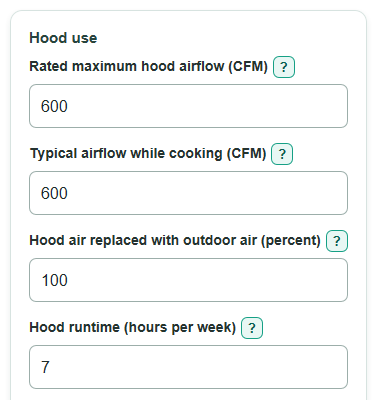
- Enter the hood's maximum rated airflow and the airflow you normally use while cooking. Use the same number for both only if you usually run the hood at full speed.
- Enter the share of hood air replaced with outdoor air and your usual Hood runtime in hours per week.
- Replace the example Annual heating degree days and Annual cooling degree days with local yearly values using a 65 F base.
- Open Advanced options to choose Heating method and replace the example energy prices and equipment COP or AFUE values with information from your utility bill and equipment records.
- Calculate, then compare the main yearly cost with the half-runtime and one-and-one-half-runtime results. A wide dollar spread means your actual hood runtime is an important uncertainty.
Definitions
CFM: Cubic feet per minute, a measure of airflow. A higher CFM moves more air.
Makeup air: Outdoor air that enters or is supplied to replace air exhausted by the range hood.
Heating degree days: A yearly measure of how much and how long outdoor temperatures are below 65 F. More heating degree days usually mean a larger heating load.
Cooling degree days: A yearly measure of how much and how long outdoor temperatures are above 65 F. More cooling degree days usually mean a larger sensible cooling load.
COP: Coefficient of performance. It is useful heating or cooling delivered divided by electricity used. A COP of 3 means 3 units of delivered heating or cooling per 1 unit of electricity.
AFUE: Annual fuel utilization efficiency. For a gas furnace, it is the percent of fuel energy delivered as useful seasonal heat.
Sensible load: Energy used to change air temperature. It does not include energy needed to remove moisture from humid air.
400 CFM reminder: Common US range-hood guidance uses 400 CFM as a makeup-air planning threshold, but the locally adopted code and rating method control. [1]
Common mistakes and quick fixes
Mistake: Entering Rated maximum hood airflow as if it were the speed used every day.
Fix: Use Typical airflow while cooking for the cost estimate, and keep Rated maximum hood airflow for the code reminder.
Mistake: Treating Annual heating degree days as the number of hours the hood runs.
Fix: Enter local yearly weather data for Annual heating degree days and enter actual use separately in Hood runtime.
Mistake: Including a fixed monthly customer charge in Electricity price or Natural gas price.
Fix: Use the usage-based energy charge from the bill when possible, because fixed charges usually do not change when the hood runs.
Mistake: Entering a seasonal cooling rating as Cooling COP without converting it.
Fix: Enter Cooling COP from equipment data, an energy audit, or an HVAC professional, not a different efficiency rating.
Mistake: Reading Estimated yearly makeup-air heating and cooling cost as an installation quote.
Fix: Treat it as an annual energy estimate; it does not include a damper, ductwork, controls, equipment, or labor.
Limitations & Key Assumptions / Boundary Conditions
- The estimate assumes hood use is spread through the year in the same pattern as local heating and cooling weather. Seasonal cooking habits can change the actual cost.
- Only sensible temperature change is modeled. Cooling costs can be higher in humid climates because moisture removal is excluded.
- The 1.08 air factor is an HVAC approximation. Air density and heat capacity vary with elevation, temperature, and humidity.
- Heat recovery, a separately tempered makeup-air unit, duct leakage, and building pressure effects can reduce or change the HVAC load.
- Fan electricity, fixed utility charges, makeup-air equipment, ductwork, controls, installation, and maintenance are excluded.
- The 400 CFM message is a planning reminder, not a permit, compliance, or equipment-sizing decision. Local requirements, exceptions, and airflow rating rules can differ.
Methodology
Calculation method
The calculator first finds the outdoor airflow used for the energy estimate from Typical airflow while cooking and Hood air replaced with outdoor air. It uses Rated maximum hood airflow only for the 400 CFM code reminder.
makeup_airflow_cfm = typical_hood_cfm * makeup_air_percent / 100
Weekly hood use is converted to a share of all 168 hours in a week. Heating and cooling degree days are then converted from degree-days to degree-hours by multiplying by 24.
runtime_fraction = hood_hours_per_week / 168
annual_heating_load_btu = 1.08 * makeup_airflow_cfm * heating_degree_days * 24 * runtime_fraction
annual_cooling_load_btu = 1.08 * makeup_airflow_cfm * cooling_degree_days * 24 * runtime_fraction
The heating load is priced using either electricity and Electric heating COP, or natural gas and Gas furnace efficiency. Cooling uses electricity and Cooling COP. One kWh equals 3,412.141633 Btu, and one therm equals 100,000 Btu.
annual_conditioning_cost = annual_heating_cost + annual_cooling_cost
The low-use and high-use values are simple runtime checks: 50 percent and 150 percent of the entered Hood runtime. Because this model is linear with runtime, the costs also scale by 0.5 and 1.5.
Worked example
With 600 CFM typical airflow, 100 percent outdoor-air replacement, 7 hours per week, 4,000 heating degree days, and 1,500 cooling degree days, the sensible heating load is 2,592,000 Btu per year and the sensible cooling load is 972,000 Btu per year. At $0.173 per kWh, electric resistance heat with COP 1, and cooling COP 3, the combined estimate is about $147.84 per year. The electricity planning price is an editable US planning value. [2]