
Compare estimated lifetime costs for a PHEV, hybrid, and gas car using your driving, prices, charging habits, and optional resale estimates.
PHEV
Hybrid
Gas car
Advanced options
Public charging
Optional yearly ownership costs
Optional resale values
Calculation details
Table of contents
How to use our PHEV vs Hybrid vs Gas Car Lifetime Cost Calculator
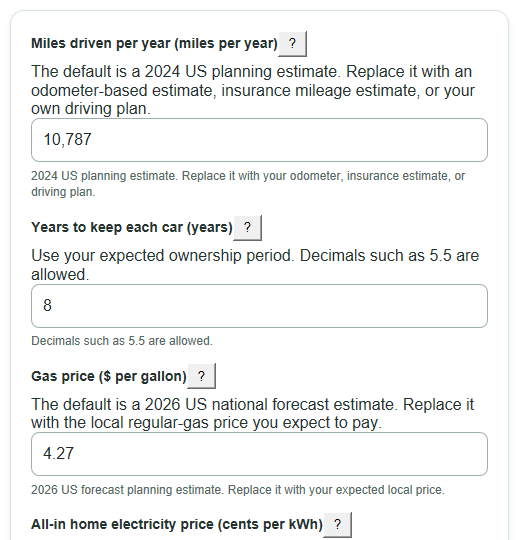
- Enter the same planned annual driving in Miles driven per year and ownership period in Years to keep each car for all three choices.
- Enter local energy prices in Gas price and All-in home electricity price; use your total electric bill divided by total kWh for a practical home rate.
- Copy each dealer quote into its matching out-the-door price field, then enter the vehicle-specific MPG values and the PHEV electricity use.
- Estimate PHEV miles driven on electricity from your real charging and trip routine, then use Advanced options if any PHEV charging is public or if you want to include annual ownership costs and resale.
- Check the lowest-cost vehicle and the cost gap, then change the electric-mile share or public charging price to see whether a reasonable change would reverse the choice.
Definitions
PHEV: A plug-in hybrid electric vehicle that can use electricity and gasoline. [1]
Out-the-door price: The amount paid to buy the car, including required taxes and dealer or DMV fees, after applied incentives.
MPG: Miles per gallon. Higher MPG means fewer gallons are used for the same driving distance.
kWh per 100 miles: Electricity used to drive 100 miles. Lower use means lower electricity use for the same electric miles.
PHEV miles driven on electricity: The percentage of all planned PHEV miles completed using electricity rather than gasoline. It depends on charging access and trip patterns.
PHEV weighted electricity price: The blended electricity price made from the home rate and public charging rate, based on the public charging share.
Resale value: The estimated amount received when selling or trading in the car at the end of the selected ownership period.
Common mistakes and quick fixes
Mistake: Entering MPGe in PHEV gasoline-only fuel economy.
Fix: Enter the PHEV's gasoline-only MPG. Use the separate PHEV electricity use field for electric driving.
Mistake: Using MSRP or a monthly payment for PHEV out-the-door price after incentives.
Fix: Use the full dealer quote including required taxes and fees, after incentives already applied.
Mistake: Entering only an electricity supply charge in All-in home electricity price.
Fix: Divide the total electric bill by total kWh when possible, so delivery charges and taxes are included.
Mistake: Treating PHEV electric charging done publicly as a share of all miles.
Fix: Enter the share of PHEV charging energy bought publicly, not the share of driving miles.
Mistake: Leaving Public charging price blank while public charging is above zero.
Fix: Enter a per-kWh public rate from a charging receipt or network app, or set public charging to 0%.
Mistake: Assuming blank Expected PHEV resale value is estimated automatically.
Fix: A blank field counts as $0. Enter an end-of-period resale estimate only if you want it subtracted from lifetime cost.
Limitations & Key Assumptions / Boundary Conditions
- This is a planning estimate, not a dealer quote or a prediction of future fuel, electricity, insurance, maintenance, or resale prices.
- Gas price, home electricity price, public charging price, annual miles, and the PHEV electric-driving share are held constant for every ownership year.
- The PHEV electric-driving share is an entered behavior assumption. It can change with charging access, weather, towing, long trips, and how often the car is plugged in.
- Blank annual ownership-cost and resale fields count as $0; the calculator does not estimate missing amounts.
- Public charging is priced only per kWh. Session fees, idle fees, parking charges, home charger purchase, financing, loan interest, taxes after purchase, tolls, and accident repairs are excluded.
- All three vehicles use the same annual miles and ownership period. A different replacement date or mileage plan for one car needs a separate comparison.
Methodology
Cost method
The calculator estimates each vehicle's upfront cost plus energy and entered yearly ownership costs, then subtracts entered resale value. A PHEV's miles are split between electric and gasoline driving. Fuel-economy labels distinguish MPG, MPGe, and electricity-use measures; use the label value that matches each input. [1]
electric miles = miles per year * PHEV miles driven on electricity / 100
gasoline miles = miles per year - electric miles
weighted electricity price = (1 - public charging share / 100) * (home electricity price / 100) + (public charging share / 100) * public charging price
PHEV annual energy cost = electric miles * kWh per 100 miles / 100 * weighted electricity price + gasoline miles / PHEV gasoline-only MPG * gas price
hybrid annual energy cost = miles per year / hybrid MPG * gas price
gas car annual energy cost = miles per year / gas car MPG * gas price
lifetime cost = out-the-door price + years to keep * (annual energy cost + annual ownership cost) - resale value
Comparison and example
The lowest estimated lifetime cost is the smallest of the three totals. The gap is the second-lowest total minus the lowest total. PHEV comparisons are signed: a positive amount means the PHEV costs more, while a negative amount means it costs less.
For example, with 12,000 miles per year, 60% electric PHEV miles, 30 kWh per 100 miles, a 20 cents per kWh home rate, 40 MPG gasoline operation, and $4 per gallon gas, the PHEV uses 7,200 electric miles and 4,800 gasoline miles. Its annual energy cost is $912 when all charging is at home.
Calculation choices
Home electricity cents are divided by 100 to convert them to dollars per kWh. Blank optional annual ownership costs and resale values count as zero. If public charging is 0% or blank, a blank public charging price has no effect. If public charging is above 0%, a public per-kWh price is required. The calculator keeps negative lifetime totals and signed cost differences rather than changing them to zero.