
Estimate your auto loan shortfall after a total loss using claim documents or a planning estimate and entered GAP policy terms.
Advanced options
Actual payment can differ because of exclusions, eligibility rules, and finalized claim figures.
Table of contents
How to use our GAP Insurance and Total-Loss Loan Shortfall Calculator
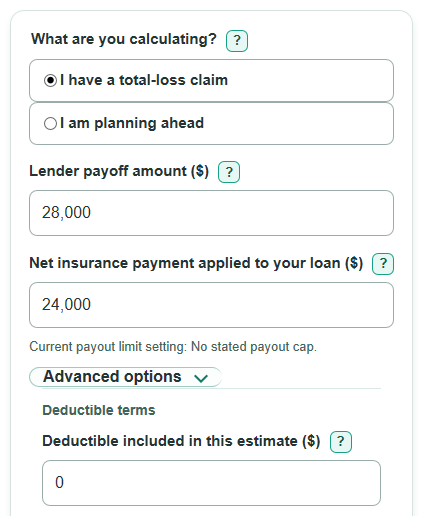
- Choose "I have a total-loss claim" if you have a lender payoff and settlement notice, or "I am planning ahead" for an estimate.
- For a claim, enter the "Lender payoff amount" and the "Net insurance payment applied to your loan" from your documents.
- For planning, enter your "Current loan balance" and "Estimated vehicle value."
- Open Advanced options only if you need to enter a deductible or a stated "GAP payout limit type" from your agreement, then select Calculate.
- Check that "Primary insurance amount applied to the loan" matches your settlement or estimate, then review "Estimated loan amount still unpaid after GAP."
Definitions
GAP insurance: Coverage that may pay some or all of the difference between what a primary auto insurer pays after a total loss and what is owed on the vehicle loan, subject to the agreement's terms. [1]
Lender payoff amount: The amount the lender says is needed to satisfy the loan at that time. It can differ from the balance on a regular statement.
Net insurance payment: The insurer payment actually applied to the loan after the deductible and other settlement adjustments.
Actual cash value (ACV): The vehicle value used by the insurer before a deductible is taken out. In this calculator, gross ACV is used only for a percent-of-ACV GAP limit in a claim.
Deductible: The part of a covered loss taken out of the primary insurance settlement under the auto policy.
Loan shortfall: The signed difference between the loan amount at loss and the primary insurance amount applied to the loan. A positive value means the loan is higher.
GAP payout limit: A maximum benefit stated as a dollar amount or a percent of ACV that can reduce the estimated GAP payment.
Common mistakes and quick fixes
Mistake: Using your original loan amount instead of the "Lender payoff amount."
Fix: Use a current payoff quote from the lender for a total-loss claim.
Mistake: Entering gross ACV as the "Net insurance payment applied to your loan."
Fix: Enter the payment after the deductible and settlement adjustments, or confirm the amount sent to the lender.
Mistake: Subtracting a deductible again from the "Net insurance payment applied to your loan."
Fix: Claim mode already uses the entered payment as net; enter the deductible only to check "How does GAP treat the deductible?"
Mistake: Choosing "Fully covered" for "How does GAP treat the deductible?" without checking the GAP agreement.
Fix: Select the wording that matches the agreement. If it has a maximum, choose limited coverage and enter the "Deductible coverage maximum."
Mistake: Typing a dollar amount into "Maximum GAP payment (percent of ACV)."
Fix: Enter the percent shown in the agreement, such as 25 for 25 percent, and use "Maximum GAP payment ($)" for a dollar maximum.
Limitations & Key Assumptions / Boundary Conditions
- This is an estimate based only on the amounts and policy terms entered. A lender payoff and insurer settlement can change before payment is finalized.
- Claim mode assumes "Net insurance payment applied to your loan" already reflects the deductible and other settlement adjustments. Do not enter gross ACV in that field.
- Planning mode estimates the primary insurance amount as "Estimated vehicle value" minus the entered deductible. It rejects a deductible greater than the vehicle value.
- "No stated payout cap" means the calculator applies no extra cap. It does not mean the agreement guarantees full payoff.
- Actual GAP coverage can be affected by exclusions, eligibility rules, missed payments, past-due amounts, fees, loan changes, and other agreement terms not entered here.
- A negative "Loan shortfall before GAP" means the entered primary insurance amount exceeds the entered loan amount. The calculator sets the estimated GAP payment to $0 in that case.
Methodology
Calculation method
The calculator uses the lender payoff for a current claim and the current balance for planning. It uses the net insurer payment for a claim, so it does not subtract the deductible a second time from that payment.
loan amount at loss = lender payoff amount (claim) or current loan balance (planning)
primary insurance applied = net insurance payment (claim) or estimated vehicle value - deductible (planning)
loan shortfall before GAP = loan amount at loss - primary insurance applied
The deductible outside GAP coverage is $0 when fully covered. With limited coverage, it is the deductible minus the deductible coverage maximum, with a minimum of $0. When not covered, it is the full entered deductible.
eligible GAP shortfall = max(0, loan shortfall before GAP - uncovered deductible)
The policy limit is the eligible shortfall when no stated cap is selected, the entered dollar maximum for a dollar cap, or gross ACV times the entered percent divided by 100 for a percent-of-ACV cap. Planning mode uses estimated vehicle value as ACV for that cap.
estimated GAP payment = min(eligible GAP shortfall, policy payment limit)
estimated loan amount still unpaid after GAP = loan shortfall before GAP - estimated GAP payment
Mini-example
For a claim with a $28,000 lender payoff and a $24,000 net insurance payment, the shortfall before GAP is $4,000. If the $1,000 deductible is not covered and there is no stated payout cap, the eligible GAP shortfall is $3,000. The estimated GAP payment is $3,000, leaving $1,000 unpaid.
Calculation boundaries
The calculator preserves a negative loan shortfall instead of changing it to $0, because it shows that the entered primary insurance amount exceeds the entered loan amount. GAP payment is floored at $0 because GAP does not create a benefit when there is no eligible shortfall. The estimate cannot determine coverage exclusions or replace the final lender payoff, settlement notice, or GAP agreement.