
Compare heat battery and storage-tank water heater costs while checking that both can deliver enough hot water.
Hot-water delivery
Yearly electricity use
Quotes and expected service life
Advanced options
Rebates and credits
Yearly maintenance
Future replacement prices
Calculation details
Table of contents
How to use our Heat Battery vs Hot Water Cylinder Lifetime Cost Calculator
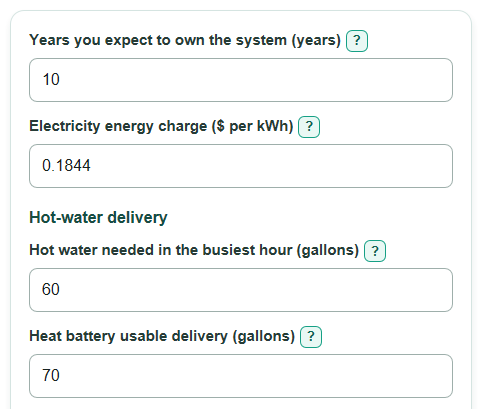
- Enter the years you expect to own the system and your variable Electricity energy charge from a utility bill.
- Enter Hot water needed in the busiest hour, then use comparable usable-delivery ratings for both systems.
- Enter annual electricity use, itemized quote costs, and expected service life for each option.
- Open Advanced options only if you have rebates, annual maintenance costs, or a different future replacement cost.
- Click Calculate, then confirm both delivery margins are zero or higher before using the lower-cost choice.
Definitions
Heat battery: Thermal storage that holds energy as heat for hot water. It is not a home electricity battery.
Storage-tank water heater: The common US name for a hot-water cylinder that stores heated water in a tank.
Usable delivery: Gallons of hot water a system can supply during the stated peak period at a stated delivery temperature.
Delivery margin: Usable delivery minus Hot water needed in the busiest hour. A negative value means the system falls short.
Electricity energy charge: The variable price for each kWh of electricity. It does not include fixed utility customer charges.
Service life: Expected working years before a scheduled replacement is counted in the comparison.
First cost catch-up year: The first whole year when the option that cost more at the start becomes no more expensive in cumulative cost.
Common mistakes and quick fixes
Mistake: Entering the whole electric bill divided by total kWh as Electricity energy charge.
Fix: Use the variable per-kWh energy charge and leave out fixed monthly customer charges.
Mistake: Using tank size as Storage-tank water heater usable delivery.
Fix: Use a usable-delivery or first-hour rating measured at the same delivery temperature as Heat battery usable delivery.
Mistake: Comparing Heat battery electricity use and Storage-tank water heater electricity use from different household-use estimates.
Fix: Use annual kWh estimates based on the same household hot-water demand and delivery-temperature basis.
Mistake: Subtracting a rebate from the quote and also entering it in Heat battery rebates and credits.
Fix: Enter the pre-rebate quote in the price fields, then enter the rebate once in Heat battery rebates and credits.
Mistake: Treating a warranty term as Heat battery expected service life or Storage-tank expected service life.
Fix: Enter the expected working life from the manufacturer or installer, which may differ from the warranty.
Mistake: Reading a negative Heat battery delivery margin as extra capacity.
Fix: A negative margin is a shortfall in gallons during the busiest hour, so that option is not adequately sized.
Limitations & Key Assumptions / Boundary Conditions
- This calculator applies only to electrically charged systems using the entered Electricity energy charge. It does not model gas, oil, district heat, boiler fuel, or a separate fuel price.
- Both annual electricity estimates must cover the same household hot-water demand and delivery-temperature basis. Different assumptions make the operating-cost comparison unreliable.
- All costs are treated as constant planning dollars. The calculation does not apply electricity-price inflation, discount future cash flows, financing charges, taxes beyond entered credits, demand charges, or time-of-use rates.
- A blank future replacement cost uses the original equipment plus installation cost before incentives. Future rebates are not assumed.
- Replacements are counted only when their service-life boundary occurs before the end of the ownership period. A replacement exactly at the end is not counted.
- The delivery check uses entered peak-hour gallons. It cannot replace installer sizing, plumbing review, temperature-mixing analysis, or local code requirements.
Methodology
Cost calculation
Each option starts with its equipment price plus installation and upgrades, minus its own rebates and credits. Annual electricity cost uses annual kWh multiplied by the Electricity energy charge. The editable default electricity price is a US residential planning estimate from EIA. [1]
net initial cost = equipment price + installation and upgrades - rebates and credits
annual electricity cost = electricity use per year x electricity energy charge
Lifetime cost adds the initial net cost, annual electricity cost, annual maintenance, and scheduled replacement costs during the selected ownership period.
replacement count = CEIL(years you expect to own / expected service life) - 1
lifetime cost = net initial cost + years owned x (annual electricity cost + annual maintenance) + replacement count x replacement cost used
A blank future replacement cost uses the entered equipment price plus installation and upgrades. The initial rebate is not applied again to a future replacement.
Delivery and catch-up checks
The calculator subtracts Hot water needed in the busiest hour from each usable-delivery rating. Both margins must be zero or higher before it identifies a lower-cost adequately sized option.
delivery margin = usable delivery - hot water needed in the busiest hour
For the catch-up result, the calculator checks cumulative costs at each whole year from year 0 through the selected end year. It reports the first year when the option with the higher starting cost is no more expensive. If starting costs match, the result is year 0.
Worked mini-example
Over 10 years at $0.20 per kWh, 2,500 kWh per year costs $500 per year and 3,500 kWh per year costs $700 per year. With no maintenance or replacements, a $9,000 heat battery setup totals $14,000, while a $5,000 storage-tank setup totals $12,000. The lifetime cost gap is $2,000. This cost comparison names a winner only if both entered delivery ratings meet the same peak-hour need.