
Compare like-for-like siding quotes with estimated heating and cooling savings to see if insulated siding earns back its added upfront cost.
Advanced options
Table of contents
How to use our Insulated vs Standard Siding Energy Cost Calculator
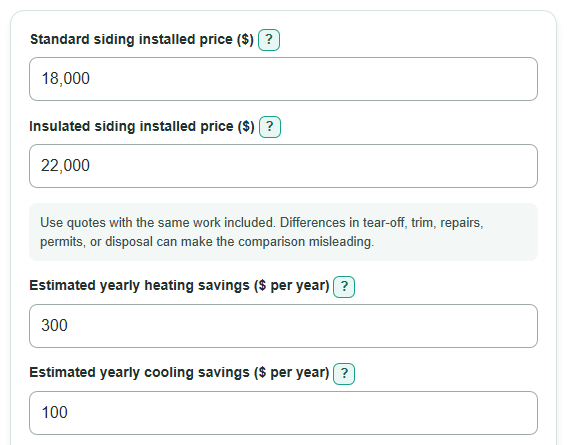
- Enter the full Standard siding installed price and Insulated siding installed price from quotes with the same tear-off, trim, repair, permit, and disposal work.
- Enter the estimated yearly heating and cooling bill reductions caused by insulated siding. Count usage-based charges only, not fixed utility charges.
- Set Years to compare to the time you expect to own the home or keep the siding.
- Open Advanced options only if needed to enter Net wall area, a Yearly energy price change, or a Discount rate.
- Click Calculate, then check whether the payback is within your selected years and whether the signed net advantage is positive or negative.
Definitions
Insulated siding price premium: Insulated siding installed price minus Standard siding installed price. A positive premium means insulated siding costs more upfront.
Estimated first-year energy savings: Estimated yearly heating savings plus Estimated yearly cooling savings. These are bill reductions from usage-based energy charges.
Simple payback: The years of first-year energy savings needed to recover a positive insulated siding price premium.
Discount rate: A percentage used to convert future savings into an equivalent value in today's dollars.
Net wall area: Exterior wall area receiving siding after major windows and doors are subtracted.
Common mistakes and quick fixes
Mistake: The Standard siding installed price and Insulated siding installed price include different work, such as tear-off or trim.
Fix: Ask for like-for-like quotes, then enter only totals with the same project scope.
Mistake: Estimated yearly heating savings includes the whole gas or electric bill.
Fix: Enter only the expected usage-based heating bill reduction from insulated siding.
Mistake: Estimated yearly cooling savings includes fixed customer or meter charges.
Fix: Exclude charges that stay the same when cooling energy use falls.
Mistake: Years to compare is set to the siding warranty length instead of your planning period.
Fix: Use the years you expect to own the home or evaluate this decision.
Mistake: Net wall area is entered as the home's floor area.
Fix: Enter exterior wall area covered by siding after subtracting major windows and doors, or leave it blank.
Mistake: A Yearly energy price change or Discount rate is entered as a dollar amount.
Fix: Enter a percent, such as 3 for 3%, or leave the default 0 for a simple comparison.
Limitations & Key Assumptions / Boundary Conditions
- Results depend on the heating and cooling savings you enter. Actual savings can differ because of climate, wall construction, air leakage, HVAC equipment, installation quality, and how occupants use the home.
- Compare quotes with matching work scope. Different tear-off, trim, sheathing repair, permits, disposal, or accessories can make the price premium misleading.
- Energy savings should include only charges that change with energy use. Fixed utility customer, meter, and minimum charges usually remain.
- The calculation excludes financing, maintenance, incentives, taxes, insurance, resale value, and siding replacement at a later date.
- With a nonzero Yearly energy price change or Discount rate, future savings are estimated once per year and treated as received at the end of each year.
- Net wall area affects only the premium-per-square-foot output. It does not create or revise the entered energy-savings estimate.
Methodology
Calculation method
The calculator first adds the separate heating and cooling savings. It then compares that first-year savings with the difference between the two installed quotes.
annual energy savings = estimated yearly heating savings + estimated yearly cooling savings
insulated siding price premium = insulated siding installed price - standard siding installed price
For the simple payback, a positive quote premium is divided by first-year energy savings. If the insulated quote costs the same or less, payback is immediate. If the premium is positive and yearly savings are zero, payback is shown as N/A.
simple payback years = insulated siding price premium / annual energy savings
Period energy savings use the selected number of years. The optional energy price change raises or lowers the dollar value of later savings. The optional discount rate converts later savings to today's-dollar value.
growth-discount ratio = (1 + yearly energy price change / 100) / (1 + discount rate / 100)
period energy savings = first-year discounted savings x years, when the ratio is 1
period energy savings = first-year discounted savings x (1 - ratio^years) / (1 - ratio), otherwise
The signed net advantage subtracts the insulated price premium from period energy savings. A positive amount means insulated siding is ahead over the selected period; a negative amount means standard siding remains less expensive.
insulated siding net advantage over the period = period energy savings - insulated siding price premium
Worked example
If standard siding costs $18,000, insulated siding costs $22,000, heating savings are $300 per year, cooling savings are $100 per year, and the comparison is 15 years with both optional rates at 0%, first-year savings are $400 and the premium is $4,000. Period energy savings are $6,000, simple payback is 10 years, and the insulated siding net advantage over the period is $2,000.