
Calculate the tank drawdown and nominal tank size needed for your well pump, or check whether an existing tank meets your run-time target.
Table of contents
How to use our Well Pressure Tank Size and Pump Cycling Calculator
- Choose "Size a new tank" to plan a replacement or "Check my existing tank" to compare a tank you already have.
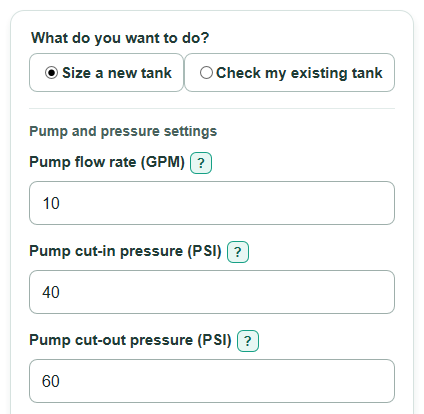
- Enter the actual Pump flow rate in GPM, then enter the pressure where the pump starts and stops.
- Set Target minimum pump run time to your pump or motor requirement. The starting value is an editable planning example.
- For an existing tank, enter its full label capacity in Existing tank volume. Add Manufacturer-listed drawdown in Advanced options if the manual gives it for your pressure range.
- Check that the chosen tank model lists at least the required drawdown at your actual pressures. A calculated nominal volume is a minimum, so round up to a suitable available model.
Definitions
Drawdown: Water the tank can deliver between pump shutoff at cut-out pressure and the next pump start at cut-in pressure.
Nominal tank volume: The tank's full labeled capacity in gallons. It is larger than drawdown.
Cut-in pressure: The lower pressure where the pressure switch starts the pump.
Cut-out pressure: The higher pressure where the pressure switch stops the pump.
Pre-charge pressure: Air pressure in an empty, drained tank before water enters. It is commonly set slightly below cut-in pressure.
Absolute pressure: Gauge pressure plus atmospheric pressure. The calculator uses 14.7 PSI as a sea-level planning value for the air-pressure calculation.
Common mistakes and quick fixes
Mistake: Entering pump horsepower as Pump flow rate.
Fix: Enter actual delivery in GPM from a pump curve, installer paperwork, or a representative timed flow test.
Mistake: Reversing Pump cut-in pressure and Pump cut-out pressure.
Fix: Enter the lower pressure where the pump starts as cut-in and the higher pressure where it stops as cut-out.
Mistake: Treating Existing tank volume as usable water storage.
Fix: Use the full nominal gallons from the tank label; the calculator estimates the smaller usable drawdown separately.
Mistake: Measuring Tank pre-charge pressure while the tank still has water pressure.
Fix: Turn off pump power and drain water pressure before checking the air valve, then enter the drained-tank reading.
Mistake: Using a catalog drawdown value that is for different pressure settings as Manufacturer-listed drawdown.
Fix: Use the model's drawdown table for your cut-in and cut-out pressures, or leave this field blank for the pressure-based estimate.
Mistake: Buying a tank equal to the displayed Minimum calculated tank volume without checking its specifications.
Fix: Round up and confirm the selected model lists at least the displayed Required usable drawdown.
Limitations & Key Assumptions / Boundary Conditions
- The calculation assumes no water is being used while the pump refills the tank. Household use or irrigation can change real pump-on time.
- Pump flow must be the delivery rate at the installed system pressure and head. A pump's horsepower or maximum catalog flow is not a substitute.
- The pressure-based drawdown estimate treats trapped air as behaving like an ideal gas at stable temperature. A manufacturer drawdown table for the exact tank and pressure range is preferable when available.
- The 14.7 PSI atmospheric-pressure value is a sea-level planning assumption. Atmospheric pressure changes with elevation and weather.
- A tank that falls short of the target may be undersized, incorrectly pre-charged, waterlogged, damaged, or affected by a switch or well problem. This calculation does not identify the cause.
- Do not adjust tank air charge with the system energized or pressurized. Follow the tank and pump manufacturer safety instructions.
Methodology
Calculation method
The calculator first estimates what fraction of a nominal tank can be used as drawdown. It converts gauge pressures to absolute pressures by adding 14.7 PSI, then applies the pressure-based air-volume relationship used for pressure-tank sizing [1].
drawdown_fraction = (precharge_psi + 14.7) * (1 / (cut_in_psi + 14.7) - 1 / (cut_out_psi + 14.7))
required_drawdown_gal = pump_flow_gpm * target_run_time_min
minimum_nominal_tank_gal = required_drawdown_gal / drawdown_fraction
Existing tank check
For an existing tank, the calculator multiplies its nominal gallons by the estimated drawdown fraction. If a valid manufacturer-listed drawdown is entered, that listed value replaces the estimate for the run-time check.
estimated_existing_drawdown_gal = existing_nominal_gal * drawdown_fraction
estimated_pump_run_time_min = existing_usable_drawdown_gal / pump_flow_gpm
tank_adequacy_percent = 100 * existing_usable_drawdown_gal / required_drawdown_gal
A result of 100 percent or more meets the selected run-time target. A lower result falls short.
Worked example
With 10 GPM flow, a 1-minute target, 40 PSI cut-in, 60 PSI cut-out, and 38 PSI pre-charge, required drawdown is 10 gallons. The estimated drawdown fraction is about 25.79 percent, so the calculated minimum nominal volume is about 38.77 gallons. Choose a larger available tank only after confirming its listed drawdown is at least 10 gallons at 40/60 PSI.
Calculation basis
Results assume a properly working bladder or diaphragm tank, stable pressure-switch settings, and no simultaneous water demand during refill. The calculator blocks invalid pressure order, pre-charge at or above cut-in, and nonpositive flow, run time, or tank volume because those inputs cannot produce a valid sizing estimate.