
Estimate cellular shade energy savings, net project cost, and the years needed for savings to recover your upfront cost.
Advanced options
Table of contents
How to use our Cellular Shades Energy Savings and Payback Calculator
- Enter the usage-related part of your yearly heating and cooling costs, using bills or an annual utility summary when possible.
- Enter the Cellular shade product cost and Installation cost from your cart or quote.
- Keep the 15% Expected heating and cooling savings value only as a planning example, or replace it with a project-specific estimate.
- Open Advanced options to add Extra discounts and rebates and choose a Savings comparison period.
- Check whether Estimated net savings by the chosen year is positive; a negative amount means estimated savings have not recovered the project cost yet.
Definitions
Annual heating energy cost: The yearly usage-related cost to heat the home. Fixed utility charges should be left out when possible.
Annual cooling electricity cost: The yearly electricity cost used for air conditioning, rather than the full household electric bill.
Expected heating and cooling savings: The estimated percent reduction applied to both entered energy costs. The 15% default is a DOE modeled upper-bound planning reference, not a guarantee. [1]
Net cellular shade project cost: Cellular shade product cost plus Installation cost, minus Extra discounts and rebates.
Estimated simple payback time: The number of years of estimated annual energy savings needed to equal the net project cost.
Estimated net savings by the chosen year: Estimated annual savings over the Savings comparison period minus the net project cost. A negative amount means costs have not been recovered yet.
Common mistakes and quick fixes
Mistake: Entering the entire utility bill as Annual heating energy cost.
Fix: Include the part used for space heating when possible, and leave out fixed customer charges and unrelated electricity use.
Mistake: Putting an already-applied store discount into Extra discounts and rebates.
Fix: Enter the post-discount price in Cellular shade product cost, then add only extra reductions not already removed.
Mistake: Treating Expected heating and cooling savings as a guaranteed result.
Fix: Replace the 15% planning value with a product, audit, or project estimate when you have one.
Mistake: Leaving out labor from Installation cost when an installer will charge separately.
Fix: Add the quoted labor cost, or enter 0 only when installation is included or you will install the shades yourself.
Mistake: Reading a negative Estimated net savings by the chosen year as an error.
Fix: A negative amount means the project has not reached simple payback during the selected Savings comparison period.
Limitations & Key Assumptions / Boundary Conditions
- This is a simple bill-based estimate. It applies one Expected heating and cooling savings percentage to both heating and cooling costs.
- The 15% default is an upper-bound planning scenario from modeled conditions, not a promise for a specific home, product, or installation.
- Actual savings can differ with climate, window size and direction, window condition, shade fit, shade operation, HVAC equipment, and utility rates.
- Only usage-related heating and cooling costs belong in the estimate. Fixed charges and non-HVAC electricity use usually do not fall because shades are installed.
- Simple payback does not include financing, taxes unless included in entered costs, maintenance, replacement, energy-price changes, or changes in annual energy use.
- A zero annual savings estimate has no calculable payback time.
Methodology
Calculation method
The calculator first finds the out-of-pocket project cost after any extra discounts or rebates. It then applies the same entered savings percentage to the heating and cooling costs separately, so each part remains visible.
net project cost = cellular shade product cost + installation cost - extra discounts and rebates
annual heating savings = annual heating energy cost x expected heating and cooling savings / 100
annual cooling savings = annual cooling electricity cost x expected heating and cooling savings / 100
annual heating and cooling savings = annual heating savings + annual cooling savings
estimated simple payback time = net project cost / annual heating and cooling savings
estimated net savings by the chosen year = annual heating and cooling savings x savings comparison period - net project cost
Worked example
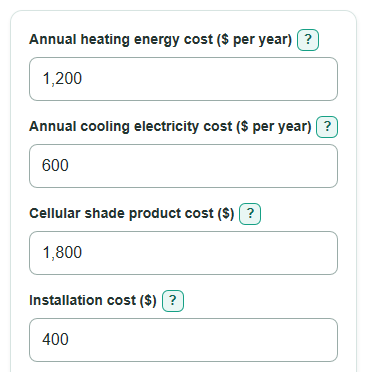
With $1,200 in annual heating energy cost, $600 in annual cooling electricity cost, a 15% savings estimate, $1,800 in shade cost, $400 installation, and no extra reductions, annual savings are $270 and net project cost is $2,200. Simple payback is about 8.15 years. Over 10 years, estimated net savings are $500.
Planning rate
The default 15% rate is based on a 2021 U.S. Department of Energy modeling reference for up to 15% total heating and cooling energy savings from interior cellular shades across 15 U.S. climate zones. Use it for initial planning and replace it with a project-specific estimate when available. [1]