
Compare salt-based softener and salt-free conditioner costs using your quotes, water use, utility rates, and media replacement schedule.
Advanced options
Table of contents
How to use our Salt-Based vs Salt-Free Conditioner Cost Calculator
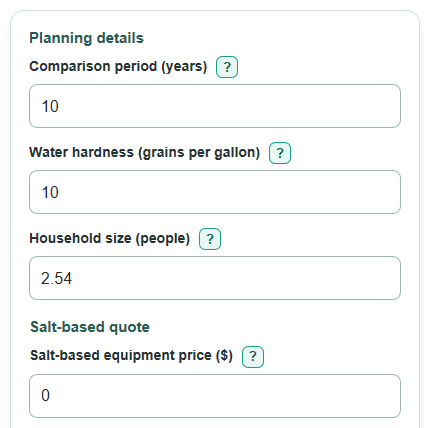
- Enter the Comparison period and each system's equipment and installation quote. If an installed quote is not split, enter it once as the equipment price and leave installation at $0.
- Enter Water hardness from a water report or test and your Household size. Use the Advanced options treated-water override if you know the gallons that actually pass through treatment.
- In Advanced options, enter yearly salt, utility, electricity, service, and conditioner media costs from receipts, bills, manuals, or quotes.
- Enter a positive Conditioner media replacement interval whenever media or media labor has a cost, then select Calculate.
- Check the signed Salt-based cost minus salt-free cost: a positive amount means salt-based costs more, while a negative amount means it costs less. Also read the treatment reminder before treating the two options as interchangeable.
Definitions
Water hardness: Dissolved calcium and magnesium in water. This calculator uses grains per gallon (gpg); divide mg/L as CaCO3 or ppm by 17.12 to estimate gpg. [1]
Regeneration: A salt-based softener cycle that restores its ability to remove hardness minerals. It uses water and usually sends wastewater to a drain.
Regeneration water: Water used during regeneration, entered as gallons per 1,000 grains of hardness removed.
Conditioner media: The material inside a salt-free conditioner that may need scheduled replacement. It is not softener resin.
Salt-free conditioner: A system intended to manage scale behavior; it does not remove hardness minerals from water the way ion-exchange softening does. [2]
CCF: One hundred cubic feet of water, equal to 748 gallons. Some utility bills use this unit instead of gallons.
Common mistakes and quick fixes
Mistake: Entering one installed quote as both Salt-based equipment price and Salt-based installation cost.
Fix: Enter the total installed quote once, then set the included part to $0.
Mistake: Using total billed water for Treated water override when irrigation or a pool bypasses treatment.
Fix: Enter only gallons per day that pass through the treatment system, or leave Treated water override blank to use Household size.
Mistake: Entering hardness reported as mg/L directly into Water hardness.
Fix: Divide mg/L as CaCO3, or ppm, by 17.12 before entering Water hardness in grains per gallon.
Mistake: Putting a fixed monthly bill charge in Water usage price or Sewer usage price.
Fix: Enter only the usage charge per 1,000 gallons because fixed account charges usually apply either way.
Mistake: Entering Conditioner replacement media cost without a Conditioner media replacement interval.
Fix: Enter the manufacturer's positive interval in years, or set both conditioner media cost fields to $0 if no event is being included.
Mistake: Reading a lower Salt-free conditioner lifetime ownership cost as proof of equal softening.
Fix: Read the Treatment result reminder: a salt-free conditioner does not remove hardness minerals.
Limitations & Key Assumptions / Boundary Conditions
- Costs are planning estimates based on the entered quotes, bills, manual values, and comparison period. They are not a repair, warranty, financing, tax, or resale-value forecast.
- The default treated-water estimate is household size times 88 gallons per person per day. Replace it with Treated water override when outdoor, pool, or bypassed water makes that estimate unsuitable.
- Estimated regeneration water uses a steady hardness load and the entered Regeneration water value. Actual cycles depend on the softener, settings, resin condition, water use pattern, and source-water changes.
- Fixed utility account charges are excluded. Water usage price and Sewer usage price include only usage-based charges.
- Media replacements are counted at every full Conditioner media replacement interval, including an event exactly at the end of the comparison period. Future media, labor, salt, utility, and service prices are held constant.
- The model does not estimate avoided scale damage, detergent use, appliance life, energy savings, or water-quality performance. A salt-based softener and salt-free conditioner do not provide the same treatment result.
Methodology
Cost calculation
The calculator first estimates treated water per day. A filled Treated water override replaces the household estimate; otherwise it uses 88 gallons per person per day. The EPA guide describes water-efficient softener selection and distinguishes softening from conditioning. [2]
treated_gpd = override_gpd, or household_size * 88
Annual hardness load is treated water times 365 days and water hardness in grains per gallon.
annual_grains = treated_gpd * 365 * hardness_gpg
Estimated regeneration water uses the entered gallons per 1,000 grains rating.
annual_regen_gallons = annual_grains / 1000 * regen_gallons_per_1000_grains
Its yearly utility cost uses the separate water and sewer usage prices.
annual_regen_utility_cost = annual_regen_gallons / 1000 * (water_price_per_1000_gallons + sewer_price_per_1000_gallons)
The salt-based yearly operating cost adds salt, regeneration utility cost, electricity, and service.
salt_based_annual_operating_cost = annual_salt_cost + annual_regen_utility_cost + salt_based_electricity_cost + salt_based_service
Conditioner media events occur at each full interval within the selected period, including an event exactly at the ending year.
media_replacements = floor(comparison_years / media_interval_years)
The calculator then adds up-front and recurring costs for each option.
salt_based_lifetime_cost = salt_based_equipment_price + salt_based_installation_cost + comparison_years * salt_based_annual_operating_cost
salt_free_lifetime_cost = salt_free_equipment_price + salt_free_installation_cost + comparison_years * salt_free_annual_service + media_replacements * (conditioner_media_cost + conditioner_media_labor)
The comparison keeps its sign so the direction is clear.
lifetime_cost_difference = salt_based_lifetime_cost - salt_free_lifetime_cost
Worked example
For 10 years, a $1,200 salt-based unit plus $500 installation and $200.25 yearly operating cost totals $3,702.50. A $1,800 conditioner plus $400 installation, $40 yearly service, and two $600 media events totals $3,800. The difference is -$97.50, so the salt-based option costs $97.50 less in this example.
Calculation choices
Blank optional money fields count as $0, but entered costs cannot be negative. If either conditioner media cost is above $0, a positive media interval is required. The next media year is the first scheduled event after the comparison period.
next_media_year = (floor(comparison_years / media_interval_years) + 1) * media_interval_years