
Compare two refrigerator models using purchase price, yearly energy use, electricity rate, and optional ownership costs over your chosen years.
Advanced options
Table of contents
How to use our French Door vs Side-by-Side Refrigerator Lifetime Cost Calculator
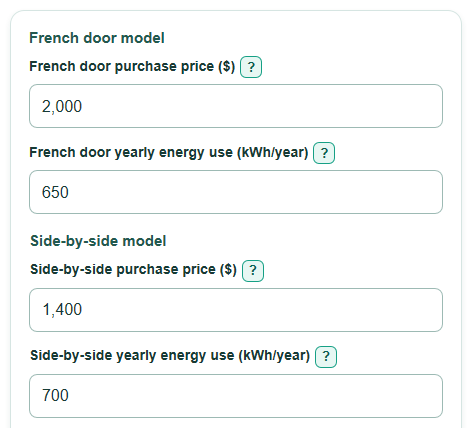
- Enter the quoted French door purchase price and Side-by-side purchase price before delivery, tax, or other checkout charges.
- Copy each model's French door yearly energy use and Side-by-side yearly energy use from its EnergyGuide label or specification sheet.
- Enter your usage-based Electricity rate from a utility bill and choose Years you expect to own it.
- Open Advanced options if you know delivery, tax, filter, or maintenance amounts, then select Calculate.
- Check that the displayed yearly electricity costs match the direction suggested by the kWh values, then use the lower-cost choice and signed cost gap for your selected years.
Definitions
EnergyGuide yearly energy use: The estimated electricity use for one year, shown in kWh/year for a specific refrigerator model.
kWh: Kilowatt-hour, a unit of electrical energy used on utility bills and appliance labels.
Electricity rate: The usage-based price paid for each kWh, entered in cents/kWh. It does not include a fixed customer charge.
Upfront cost: Purchase price plus entered delivery, installation, haul-away, and sales tax.
Recurring cost per year: Yearly electricity cost plus entered water-filter and maintenance amounts.
Cost crossover time: The positive number of years after purchase when the two calculated ownership costs are equal.
Common mistakes and quick fixes
Mistake: Entering the EnergyGuide yearly dollar estimate as French door yearly energy use or Side-by-side yearly energy use.
Fix: Enter the label's kWh/year number. The calculator applies your Electricity rate.
Mistake: Putting delivery, installation, or sales tax into French door purchase price and also entering it in French door delivery or French door sales tax.
Fix: Put the refrigerator's selling price in French door purchase price, then add each checkout charge only once.
Mistake: Using a fixed monthly utility customer charge as Electricity rate.
Fix: Use only the usage-based cents per kWh charge because the fixed charge usually stays the same for either refrigerator.
Mistake: Reading a positive French door cost minus side-by-side cost as savings from the French door model.
Fix: A positive number means the French door model costs more; a negative number means it costs less.
Mistake: Treating Cost crossover time as a predicted refrigerator lifespan.
Fix: It is only the calculated time when the two cost totals meet under the entered prices and yearly costs.
Limitations & Key Assumptions / Boundary Conditions
- The comparison uses the exact annual kWh values you enter. Door style alone does not determine energy use.
- Electricity cost assumes the entered Electricity rate stays constant for every selected year. Future utility prices can change.
- Years you expect to own it is a comparison horizon, not a predicted service life, warranty period, or replacement date.
- Water-filter and maintenance entries are user planning estimates. They are not reliability forecasts or guaranteed expenses.
- Purchase price, delivery, installation, haul-away, and sales tax are treated as one-time costs. Electricity, filters, and maintenance are treated as yearly costs.
- Fixed utility customer charges, financing interest, rebates, food loss, capacity, features, fit, and warranty differences are not included.
Methodology
Cost calculation
The calculator first converts each model's yearly electricity use into dollars using the shared Electricity rate. Use the model-specific annual kWh from its label or specifications rather than assuming one door style always uses less energy. [1]
yearly_energy_cost = annual_kwh * electricity_rate_cents_per_kwh * 0.01
It adds the itemized one-time charges to each purchase price.
upfront_cost = purchase_price + delivery + installation + haul_away + sales_tax
It then adds yearly electricity, water filters, and maintenance estimates.
yearly_ownership_cost = yearly_energy_cost + yearly_filter_cost + yearly_maintenance_cost
The total for the selected ownership period is the upfront cost plus recurring costs for that many years.
lifetime_cost = upfront_cost + ownership_years * yearly_ownership_cost
Comparison and crossover
The signed gap keeps its direction so the comparison is easy to read.
french_minus_side_cost = french_lifetime_cost - side_lifetime_cost
A positive gap means the French door model costs more. A negative gap means it costs less. The lower-cost choice uses unrounded totals, so a displayed cents-level tie does not hide a small difference.
crossover_years = -(french_upfront_cost - side_upfront_cost) / (french_yearly_ownership_cost - side_yearly_ownership_cost)
A numeric crossover is shown only when it is zero or later. If yearly recurring costs match, or the lines met before purchase, there is no positive crossover.
Mini example
With 650 kWh/year and an Electricity rate of 18.44 cents/kWh, the French door electricity cost per year is $119.86.
650 * 18.44 * 0.01 = 119.86
If its upfront cost is $2,000, recurring cost is $119.86 per year, and the comparison lasts 10 years, its cost over selected years is $3,198.60.
2000 + 10 * 119.86 = 3198.60