
Compare projected ownership costs for a washer-dryer combo and separate washer and dryer using your prices, energy use, and replacement plans.
Yearly electricity
Household plan
Advanced options
Setup and rebates
Water and supplies
Yearly repair planning
Replacement planning
Table of contents
How to use our Washer-Dryer Combo vs Separate Units Lifetime Cost Calculator
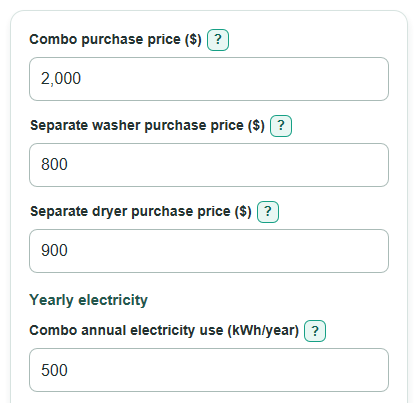
- Enter the quoted price for the combo, then enter the separate washer and dryer prices.
- Copy each model's yearly electricity use into the matching annual electricity field, then enter your Electricity rate from the usage part of your bill.
- Enter Loads washed per week and Years of ownership so both choices use the same household plan.
- Open Advanced options to add setup costs, rebates, water and sewer rates, repair reserves, or separate replacement schedules if they apply.
- Click Calculate, then check whether the Combo cost minus separate-unit cost is positive or negative and confirm the projected replacement spending matches your plan.
Definitions
Annual electricity use: Electricity a model is expected to use in one year, measured in kWh/year. Use the product's annual estimate rather than its nameplate watt rating.
Electricity rate: The usage charge for electricity, measured in $/kWh. It does not include a fixed monthly customer charge.
Annual operating cost: Estimated yearly electricity, water, sewer, laundry supplies, and repair-reserve cost. It excludes purchase, setup, rebates, and replacement purchases.
Repair reserve: A yearly planning amount for maintenance and repairs. It is separate from the cost of buying a replacement appliance.
Replacement interval: The number of years between planned purchases of that appliance. A blank interval means no replacement purchase is included.
Projected lifetime cost: Upfront cost plus annual operating cost over the selected years, plus modeled replacement spending.
Common mistakes and quick fixes
Mistake: Entering watts or kWh per load in Combo annual electricity use.
Fix: Enter the model's yearly kWh estimate from its EnergyGuide label or product documents.
Mistake: Adding a fixed monthly customer charge to Electricity rate.
Fix: Use the usage rate in $/kWh from the bill; fixed charges are excluded because they are usually paid anyway.
Mistake: Treating the separate washer and dryer as one replacement purchase.
Fix: Use Replace separate washer every and Replace separate dryer every independently, or leave either field blank for no planned replacement.
Mistake: Counting an expected replacement purchase in Combo repair reserve.
Fix: Put yearly maintenance and repair planning in Combo repair reserve, and use Replace combo every for a new appliance purchase.
Mistake: Reading a negative Combo cost minus separate-unit cost as an error.
Fix: A negative amount means the combo has the lower projected lifetime cost under the entered assumptions.
Limitations & Key Assumptions / Boundary Conditions
- Results are planning estimates using the prices, annual energy figures, utility rates, and ownership period you enter.
- Annual electricity use is treated as constant each year. Changes in utility prices, energy use, or household laundry habits are not projected.
- This version models an electric dryer only. Do not enter natural gas use as kWh/year.
- Water and sewer costs use flat marginal rates per 1,000 gallons. Tiered utility pricing, taxes, and fixed customer charges are excluded.
- Replacement purchases use today's entered appliance prices and exclude future setup costs, financing, inflation, resale value, and disposal costs.
- A replacement scheduled exactly at the end of Years of ownership is excluded because it provides no service within the comparison period.
- Rebates reduce upfront cost only. Confirm eligibility and whether a rebate can be combined with other discounts before relying on it.
Methodology
Calculation method
The calculator converts weekly laundry frequency to annual loads, then adds each option's electricity cost, water and sewer cost, supplies cost, and repair reserve. Annual electricity entries are already yearly estimates, so they are not multiplied by loads.
annual_loads = loads_per_week * 52
combo_annual_operating_cost = combo_annual_kwh * electricity_rate + combo_water_gallons * annual_loads * (water_rate + sewer_rate) / 1000 + supplies_per_load * annual_loads + combo_repair_reserve
separate_annual_operating_cost = (washer_annual_kwh + dryer_annual_kwh) * electricity_rate + washer_water_gallons * annual_loads * (water_rate + sewer_rate) / 1000 + supplies_per_load * annual_loads + washer_repair_reserve + dryer_repair_reserve
Upfront cost adds purchase and setup costs, then subtracts any rebate. A replacement interval creates purchases before, but not at, the final ownership year. The combo has one replacement schedule; the washer and dryer have separate schedules.
replacement_count = blank_interval ? 0 : max(0, ceil(ownership_years / replacement_interval) - 1)
combo_lifetime_cost = combo_upfront_cost + combo_annual_operating_cost * ownership_years + combo_replacement_spending
separate_lifetime_cost = separate_upfront_cost + separate_annual_operating_cost * ownership_years + separate_replacement_spending
combo_cost_minus_separate_cost = combo_lifetime_cost - separate_lifetime_cost
Mini-example
If the combo uses 500 kWh/year and electricity costs $0.20/kWh, its electricity cost is $100 per year before water, supplies, and repairs. If its lifetime cost is $5,700 and the separate units cost $5,980, the signed comparison is -$280, meaning the combo is lower by $280 under those entries.
The default electricity rate of $0.1811/kWh is a US residential planning average through May 2026; replace it with your local marginal usage rate when possible. [1]