
Compare two skylights to estimate peak summer heat gain and the yearly heating and cooling cost change.
Table of contents
How to use our Skylight Heat Gain and Annual Energy Cost Calculator
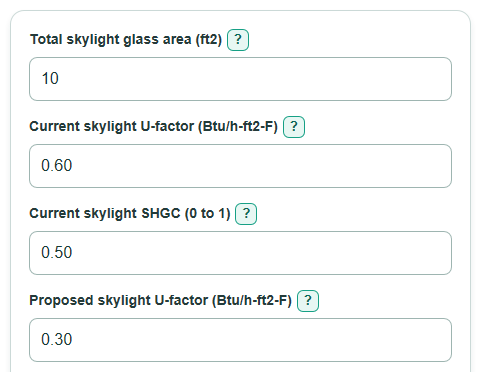
- Enter the visible glass area for all matching skylights, then copy the current and proposed U-factor and SHGC from each product label.
- Choose the heating energy source and enter your usage-based electricity price. For natural gas, also enter the usage price per therm.
- Open Advanced options and replace the example solar, temperature, and HVAC values with local model or energy-report values when available.
- Click Calculate and read the signed yearly cost change first: a negative amount means the proposed skylight is estimated to cost less to heat and cool.
- Sanity-check the peak heat gain and cost changes against the product ratings. A lower proposed U-factor and SHGC usually lower summer heat gain, while lower SHGC can also reduce useful winter solar heat.
Definitions
U-factor: A rating for conductive heat flow through the whole skylight. Lower values slow heat transfer.
SHGC: Solar heat gain coefficient. It is the share of solar heat entering through the skylight, from 0 to 1. Lower values reduce solar heat gain. DOE describes U-factor and SHGC as key fenestration energy ratings. [2]
Peak summer heat gain: The estimated solar heat plus conductive heat entering through the skylight under the entered hot, sunny condition, in Btu/h.
COP: Coefficient of performance. It is heat moved divided by electricity used; a COP of 3 means 3 units of heat moved per unit of electricity.
Degree-hours: The total hourly indoor-outdoor temperature difference during cooling or heating operation. They estimate seasonal conductive heat transfer.
Therm: A natural gas billing unit equal to 100,000 Btu.
Common mistakes and quick fixes
Mistake: Using the rough opening, curb, or frame size for Total skylight glass area.
Fix: Measure only visible glass, then add the glass areas of matching skylights.
Mistake: Entering an R-value in Current skylight U-factor or Proposed skylight U-factor.
Fix: Use the U-factor printed on the product label. Lower U-factor means less conductive heat flow.
Mistake: Treating Current skylight SHGC or Proposed skylight SHGC as a percent such as 25 instead of 0.25.
Fix: Enter SHGC as a number from 0 to 1, such as 0.25.
Mistake: Including fixed monthly charges in Electricity usage price or Natural gas usage price.
Fix: Enter only the usage-dependent price per kWh or per therm because fixed charges normally do not change with skylight energy use.
Mistake: Treating the example Cooling-season solar energy on skylight plane as local weather data.
Fix: Replace example solar exposure and temperature-difference values with roof-plane and hourly data for the building when a location-specific estimate is needed.
Limitations & Key Assumptions / Boundary Conditions
- This is a skylight-only screening estimate. It does not include walls, roof insulation, air leaks, ducts, indoor equipment heat, occupants, or other windows.
- Peak summer heat gain is not a complete HVAC design load and must not be used alone to size heating or cooling equipment.
- The default solar exposure, degree-hours, temperature difference, shade, and COP values are editable examples, not local weather or equipment data.
- Solar energy depends on roof tilt, direction, season, clouds, interior blinds, nearby buildings, and trees. The model applies one exterior shade percentage to both skylights.
- The calculation assumes both products use the same glass area and are installed in the same opening.
- Costs use usage-dependent electricity and natural gas prices only. Fixed charges, taxes, tiered rates, demand charges, and time-of-use pricing are excluded.
- A negative yearly heating load impact is allowed. It means modeled winter solar heat is greater than conductive heat loss through that skylight under the entered assumptions.
Methodology
Calculation method
The calculator evaluates the current and proposed skylight separately, then subtracts current from proposed. Solar and conductive heat are kept separate until each total is calculated.
solar_fraction = 1 - shade_reduction / 100
peak_solar_btu_per_h = glass_area * shgc * peak_solar_irradiance * solar_fraction
peak_conduction_btu_per_h = glass_area * u_factor * summer_temperature_difference
peak_total_btu_per_h = peak_solar_btu_per_h + peak_conduction_btu_per_h
For yearly cooling, the model adds solar heat during the cooling season and conductive heat during cooling temperature differences.
cooling_thermal_btu = glass_area * (shgc * cooling_solar_exposure * solar_fraction + u_factor * cooling_degree_hours)
For yearly heating, winter solar heat offsets conductive heat loss. The thermal result remains signed rather than being forced to zero.
heating_thermal_btu = glass_area * (u_factor * heating_degree_hours - shgc * heating_solar_exposure * solar_fraction)
Cooling thermal energy is converted to electricity using 3,412.142 Btu per kWh and the entered cooling COP. Electric heating uses the entered heating COP. Natural gas heating uses 100,000 Btu per therm and the entered heating efficiency.
cooling_kwh = cooling_thermal_btu / 3412.142 / cooling_cop
electric_heating_kwh = heating_thermal_btu / 3412.142 / heating_cop
gas_heating_therms = heating_thermal_btu / 100000 / (heating_efficiency / 100)
annual_cost = cooling_cost + heating_cost
change = proposed_value - current_value
Worked mini-example
With 10 ft2 of glass, 20% exterior shade, peak solar energy of 250 Btu/h-ft2, and a 20 F temperature difference, a proposed skylight with SHGC 0.25 and U-factor 0.30 has 10 * 0.25 * 250 * 0.80 = 500 Btu/h of peak solar gain and 10 * 0.30 * 20 = 60 Btu/h of peak conductive gain. Its combined peak estimate is 560 Btu/h.
Cost treatment
Cooling and heating costs use the entered usage prices. The electricity default is a US planning estimate and should be replaced with the usage-dependent rate from the utility bill. [1] Fixed monthly customer charges are excluded because this comparison estimates a change in energy use rather than a full utility bill.