
Compare high-velocity and conventional HVAC proposal costs over your planned ownership period, including energy, maintenance, incentives, and replacements.
Advanced options
Table of contents
How to use our High-Velocity vs Conventional HVAC Lifetime Cost Calculator
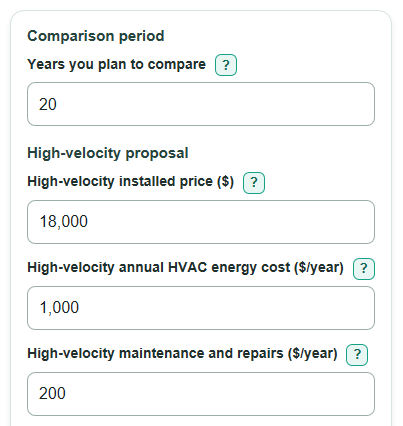
- Enter the Years you plan to compare, usually the years you expect to own the home or keep the system.
- Copy each proposal's full installed amount into High-velocity installed price and Conventional installed price, including ducts, permits, electrical work, removal, and repair work.
- Enter HVAC-only estimates for annual energy, maintenance, and expected life for each option. Do not use the full household utility bill.
- Open Advanced options to enter rebates, a separate replacement price, energy-cost growth, or a discount rate if those assumptions fit your plan.
- Check that each current annual operating cost matches your energy plus maintenance entries, then compare the lifetime cost gap and crossover year.
Definitions
High-velocity HVAC: A system that moves conditioned air through small supply ducts. It can use different heating equipment or fuels, so it does not by itself prove a certain energy cost.
Net upfront price: Installed price minus entered rebates and tax credits. Incentives are applied only to the initial project.
Annual operating cost: Annual HVAC energy cost plus annual maintenance and repairs for the first year.
Expected life: A planning estimate for when a full replacement is counted. The 15.3-year conventional sample is a reference-case planning value, not a guarantee. [1]
Discount rate: A percentage that gives future costs less weight than costs paid today.
Crossover year: The first whole-year checkpoint where cumulative high-velocity cost is no more than cumulative conventional cost after high velocity started with the higher net upfront price.
Common mistakes and quick fixes
Mistake: Entering an equipment-only amount for High-velocity installed price while Conventional installed price includes ductwork and permits.
Fix: Make both installed prices include the same project scope, including access work, removal, electrical work, and finish repairs.
Mistake: Using the entire utility bill for High-velocity annual HVAC energy cost or Conventional annual HVAC energy cost.
Fix: Enter only heating and cooling energy. Leave out lights, appliances, water heating, and fixed utility account charges.
Mistake: Treating High-velocity expected life or Conventional expected life as a warranty end date.
Fix: Use a personal planning estimate based on the quoted equipment and contractor guidance, then test a shorter or longer life if unsure.
Mistake: Adding a full system replacement into High-velocity maintenance and repairs or Conventional maintenance and repairs.
Fix: Enter routine service and an average repair allowance there. Use the replacement price fields for a future full replacement.
Mistake: Entering rebates that may not apply in High-velocity rebates and tax credits or Conventional rebates and tax credits.
Fix: Include only incentives you expect to receive, and keep each incentive no greater than its installed price.
Mistake: Reading a negative Lifetime cost gap: high velocity minus conventional as an error.
Fix: A negative gap means high velocity costs less over the selected years. A positive gap means it costs more.
Limitations & Key Assumptions / Boundary Conditions
- This is a planning comparison, not a contractor quote, equipment warranty, load calculation, or prediction of repair timing.
- Both installed-price entries need matching scope. Differences in ductwork, electrical upgrades, permits, demolition, access work, and wall or ceiling repair can outweigh equipment-price differences.
- Annual HVAC energy costs are user estimates. Actual costs vary with weather, thermostat settings, fuel prices, equipment sizing, maintenance, duct leakage, and how the home is used.
- Expected life triggers a modeled full replacement at each life interval. A replacement exactly at the end of the comparison period is excluded because it provides no service within that period.
- Energy-cost growth applies only to annual energy costs. Maintenance and replacement prices stay in today's entered dollars, and entered incentives are not repeated for replacements.
- A discount rate changes the weight of future costs, not the cash paid in a future year. Use 0% for a simple undiscounted comparison.
- The first crossover does not guarantee that high velocity stays cheaper afterward. Different replacement dates can reverse which option has the lower cumulative cost.
Methodology
Cost calculation
The calculator models each proposal separately over the same whole-year comparison period. It first subtracts that option's entered incentives from its installed price.
net upfront price = installed price - rebates and tax credits
For each year y, beginning with year 1, annual HVAC energy cost can rise by the entered annual energy-cost increase. Annual maintenance and repairs stay constant.
energy cost in year y = annual energy cost x (1 + energy-cost increase / 100)^(y - 1)
Each year's energy plus maintenance cost is discounted back to today's value when a discount rate is entered. The yearly cost is treated as occurring at the end of that year.
present value of yearly operating cost = (energy cost in year y + annual maintenance) / (1 + discount rate / 100)^y
A replacement is added at every expected-life interval strictly before the comparison ends. A blank replacement price uses that option's installed price before incentives. Replacement prices are discounted, but are not increased for inflation.
replacement time = replacement number x expected life, where replacement time is less than years compared
lifetime cost = net upfront price + discounted yearly operating costs + discounted replacement costs
The signed gap subtracts conventional lifetime cost from high-velocity lifetime cost. A positive gap means high velocity costs more; a negative gap means it costs less.
lifetime cost gap = high-velocity lifetime cost - conventional lifetime cost
Crossover check
The calculator checks cumulative cost at each whole-year checkpoint. It reports the first year high velocity is no more expensive only if its net upfront price started higher. Later replacement events can change the cost leader again.
crossover year = first whole year where high-velocity cumulative cost is less than or equal to conventional cumulative cost
Worked example
With a 20-year comparison, a high-velocity net upfront price of $18,000 and $1,200 yearly operating cost totals $42,000 when no replacement is due. A conventional net upfront price of $12,000, $1,500 yearly operating cost, and a $9,000 replacement in year 15 totals $51,000. With 0% growth and 0% discounting, high velocity first costs no more in year 15 and the lifetime gap is -$9,000.
The conventional expected-life sample is a planning reference for a 3-ton split-system case; replace it with information for the quoted equipment. [1]