
Estimate wine cellar cooling capacity and electricity cost from your room, construction, cooling unit, run time, and electric rate.
Construction
Electricity cost
Advanced options
Sizing adjustments
Bill adjustment
Table of contents
How to use our Wine Cellar Cooling Load and Operating Cost Calculator
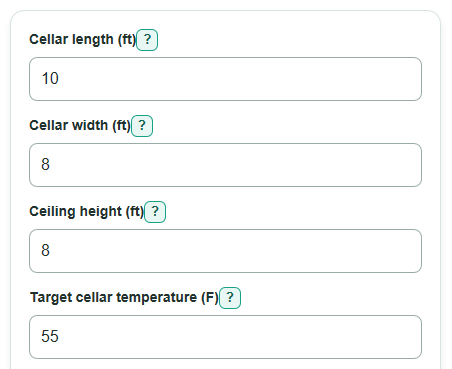
- Enter inside measurements for Cellar length, Cellar width, and Ceiling height, then enter the Target cellar temperature and the warmest expected Warm-side design temperature.
- Enter Average solid-surface R-value and Glass area. If Glass area is above zero, enter the whole-product Glass U-factor from its label or specification sheet.
- Enter Cooling unit input power, Estimated run time, and Electricity price. Use watts for input power, not the unit's BTU/hr cooling capacity.
- Open Advanced options only if you want to change Capacity reserve, add an Added heat load, or assign a Monthly bill charge assigned to cellar.
- Click Calculate, then check that the Upper end of recommended capacity range is within the selected unit's rated capacity at its actual condenser-air temperature. Compare Estimated monthly electricity use with later meter readings and update Estimated run time if needed.
Definitions
R-value: A measure of how much a solid surface resists heat flow. A higher Average solid-surface R-value means less heat gain in this simplified calculation.
U-factor: A measure of heat flow through glass. A lower Glass U-factor means less heat passes through the glass.
BTU/hr: British thermal units per hour. For this page, it is the rate of heat the cooling equipment needs to remove.
Watt (W): Electrical power used while the cooling unit is running. Cooling unit input power is different from cooling capacity in BTU/hr.
kWh: Kilowatt-hour, a unit of electricity use on an electric bill. One kWh equals using 1,000 watts for one hour.
Estimated run time: The percent of all hours that the unit is expected to draw its entered running power.
Capacity reserve: Extra percentage added to the calculated cooling load to create the upper planning target. It does not increase the energy-use calculation.
Electricity price: The usage-based charge in cents per kWh. The default is a U.S. residential planning estimate from EIA data for 2026 year-to-date through May [1].
Common mistakes and quick fixes
Mistake: Entering a cooling capacity in BTU/hr as Cooling unit input power.
Fix: Enter the unit's electrical running watts for Cooling unit input power; BTU/hr belongs to the capacity results.
Mistake: Using the normal house thermostat setting for Warm-side design temperature.
Fix: Use the warm design temperature outside the cellar enclosure, such as the adjacent room, garage, or other surrounding space.
Mistake: Leaving Glass U-factor blank while Glass area is greater than zero.
Fix: Enter the whole-product Glass U-factor from the glass door or window label, or change Glass area to zero if there is no glass.
Mistake: Treating Capacity reserve as extra Estimated run time.
Fix: Capacity reserve increases the equipment planning target only; Estimated run time controls the electricity estimate.
Mistake: Including a fixed customer charge in Electricity price and also entering it as Monthly bill charge assigned to cellar.
Fix: Put only usage-based cents per kWh in Electricity price, then enter only a separately assigned fixed amount in Monthly bill charge assigned to cellar.
Mistake: Entering all glass plus its frame area as Glass area.
Fix: Measure only the glass portion for Glass area and use the product's whole-unit Glass U-factor.
Limitations & Key Assumptions / Boundary Conditions
- This is a simplified rectangular-cellar estimate. It treats the four walls, ceiling, and floor as one enclosure with one average solid-surface R-value.
- Glass is treated as replacing solid wall area. Glass area cannot exceed the calculated area of the four walls.
- The calculation includes conductive heat gain through solid surfaces and glass, plus any Added heat load you enter. It does not derive door openings, air leakage, lighting, people, warm bottle deliveries, or humidity-related loads.
- Warm-side design temperature must be higher than Target cellar temperature. It describes the space around the cellar enclosure, not necessarily air at the condenser.
- Equipment must be able to deliver the Upper end of recommended capacity range at the actual condenser-air temperature. Rated capacity can differ under hotter condenser conditions.
- Estimated monthly electricity use assumes the entered Cooling unit input power and Estimated run time are representative of an average month. Seasonal weather, cycling behavior, installation quality, and equipment controls can change actual kWh.
- Estimated monthly operating cost includes the usage-based Electricity price and any Monthly bill charge assigned to cellar. It does not automatically assign a utility account's fixed customer charge.
Methodology
Cooling-load estimate
The calculator uses inside dimensions to find cellar volume and the area of four walls, ceiling, and floor. It subtracts Glass area from that enclosure area, then calculates heat gain through solid surfaces and glass using the temperature gap.
volume = length x width x height
total enclosure area = 2 x (length x width + length x height + width x height)
solid area = total enclosure area - glass area
temperature gap = warm-side design temperature - target cellar temperature
solid-surface load = solid area x temperature gap / average solid-surface R-value
glass load = glass area x glass U-factor x temperature gap
lower capacity target = solid-surface load + glass load + added heat load
upper capacity target = lower capacity target x (1 + capacity reserve / 100)
Electricity estimate
The energy estimate uses the cooling unit's running watts and Estimated run time. It uses 8,760 hours for a 365-day planning year and divides by 12 for an average month. The cost uses the usage-based Electricity price, then adds any separate Monthly bill charge assigned to cellar.
monthly kWh = (input power / 1000) x (run time / 100) x 8760 / 12
annual kWh = (input power / 1000) x (run time / 100) x 8760
monthly cost = monthly kWh x electricity price / 100 + assigned monthly bill charge
annual cost = monthly cost x 12
Worked example
For a 10 ft by 8 ft by 8 ft cellar, the volume is 640 cu ft and the total enclosure area is 448 sq ft. With 20 sq ft of glass, a 20 F temperature gap, R-19 solid surfaces, and glass U-factor 0.50, the lower capacity target is about 651 BTU/hr. A 20 percent Capacity reserve raises the upper target to about 781 BTU/hr. An 800 W unit running 50 percent of the time uses 292 kWh per average month; at 18.11 cents per kWh, the energy charge is about $52.88 per month before any assigned fixed charge.
Assumptions and limits
The calculation does not use cellar volume alone for sizing. It still simplifies real heat gain by using one average R-value and one warm-side temperature. Add a documented Added heat load when door use, leaks, lighting, people, or warm inventory are expected to matter. Check the final unit against manufacturer capacity data at the expected condenser-air condition.