
Compare two heat pump proposals by upfront price, heating electricity, auxiliary heat, and estimated cost over your chosen number of years.
Annual heating estimates
Planning assumptions
Advanced options
Price adjustments
Cold-weather performance
Yearly costs that differ
Long-term assumptions and display
Table of contents
How to use our Cold-Climate vs Standard Heat Pump Lifetime Cost Calculator
- Enter each contractor's full quoted price in Standard heat pump installed price and Cold-climate heat pump installed price before rebates or tax credits.
- Enter space-heating electricity only in each annual heating electricity field. Include auxiliary heat, but leave out cooling, lights, and other household use.
- Use the all-in variable rate from your electric bill for All-in electricity rate, then choose Years to compare based on how long you expect to own or use the system.
- Open Advanced options to add separate rebates, maintenance, and auxiliary-heat estimates. If available, enter the home load, capacity, and COP values at 5 F from documents for the exact indoor and outdoor equipment combination.
- Calculate, then compare Cold-climate lifetime savings and Cold-climate break-even year. Sanity-check that auxiliary-heat electricity is no greater than each option's annual heating electricity and that a positive savings amount matches the lower lifetime-cost option.
Definitions
Net installed cost: Installed price minus rebates and tax credits entered for that option.
All-in electricity rate: The variable electricity price per kWh, including supply and delivery charges that change with electricity use.
Auxiliary heat: Backup heat, often electric resistance heat, used when the heat pump cannot meet heating demand by itself.
Design heating load: The heat your home needs at the local cold design temperature, usually taken from a Manual J load calculation.
Capacity at 5 F: The heat a specific heat-pump system can deliver when outdoor temperature is 5 F, measured in Btu/hr.
Capacity gap at 5 F: Equipment capacity at 5 F minus the entered design heating load. A negative gap means the entered capacity is below the entered load.
COP: Coefficient of performance. It is heat delivered divided by electricity used; a higher COP means more heat per unit of electricity at that temperature.
Discount rate: A percentage used to give future costs less weight than costs paid today.
Common mistakes and quick fixes
Mistake: Entering a contractor quote after rebates in Standard heat pump installed price, then also entering the rebate in Standard option rebates and tax credits.
Fix: Enter the full pre-incentive quote as the installed price and enter expected incentives only once.
Mistake: Using total household electricity in Standard option annual heating electricity.
Fix: Enter space-heating electricity only, including auxiliary heat but excluding cooling and other appliances.
Mistake: Using only the supply charge for All-in electricity rate.
Fix: Use the variable supply and delivery charges per kWh from the bill. Do not include fixed monthly charges unless they differ between options.
Mistake: Adding Standard option auxiliary-heat electricity on top of Standard option annual heating electricity.
Fix: Auxiliary electricity is already part of annual heating electricity. Enter it only to show its cost breakdown.
Mistake: Entering the unit's nameplate size as Standard option heating capacity at 5 F.
Fix: Use the published heating capacity at 5 F for the exact proposed equipment combination.
Mistake: Treating a negative Cold-climate lifetime savings value as an error.
Fix: A negative value means the standard option costs less over the selected Years to compare.
Limitations & Key Assumptions / Boundary Conditions
- The comparison uses user-entered quotes, energy estimates, maintenance costs, and incentives. Incorrect or incomplete inputs change the result.
- Annual heating electricity must already include auxiliary heat. The auxiliary-heat cost cards are a breakdown, not an extra lifetime charge.
- Only electricity costs grow with Yearly electricity price change. Maintenance and extra fixed service charges stay constant in nominal dollars.
- The result excludes financing, cooling costs, major repairs, replacement equipment, resale value, and costs that are identical for both options.
- A 5 F capacity gap compares one entered temperature with one entered home load. It does not replace a Manual J calculation, manufacturer performance tables across temperatures, or equipment sizing by a qualified contractor.
- Rebate and tax-credit eligibility can depend on equipment model, installation date, income, location, and tax situation.
- A positive Cold-climate lifetime savings amount is an estimate over Years to compare, not a guarantee of future utility bills or equipment life.
Methodology
Cost calculation
For each option, the calculator subtracts its own entered incentives from its installed price. The default electricity rate of $0.1730 per kWh is a US planning estimate; replace it with your bill rate. [1] The 15-year default is a planning horizon, not a warranty or predicted equipment life. [2]
net installed cost = installed price - incentives
annual energy cost = annual heating electricity x electricity rate
current annual heating cost = annual energy cost + yearly maintenance + extra fixed service charges
Lifetime cost
Each year of heating electricity is allowed to change by the entered Yearly electricity price change. Each future year's energy, maintenance, and differing fixed charges are discounted using the entered Discount rate. With both rates set to 0%, the calculation is a simple cash total across the selected years.
energy PV factor = sum from t=1 to N of ((1 + g)^(t - 1) / (1 + d)^t)
recurring PV factor = sum from t=1 to N of (1 / (1 + d)^t)
lifetime cost = net installed cost + annual energy cost x energy PV factor + recurring costs x recurring PV factor
In these formulas, N is Years to compare, g is Yearly electricity price change divided by 100, and d is Discount rate divided by 100.
Comparison outputs
The savings value keeps its sign so it remains useful: positive Cold-climate lifetime savings means the cold-climate option costs less, while a negative value means the standard option costs less.
cold-climate lifetime savings = standard lifetime cost - cold-climate lifetime cost
The break-even scan starts at year 0 using net installed costs, then adds discounted yearly costs one year at a time. It reports the first whole year when cold-climate cumulative cost is no higher than standard cumulative cost.
capacity gap at 5 F = heating capacity at 5 F - design heating load
COP advantage at 5 F = cold-climate COP at 5 F - standard COP at 5 F
Worked example
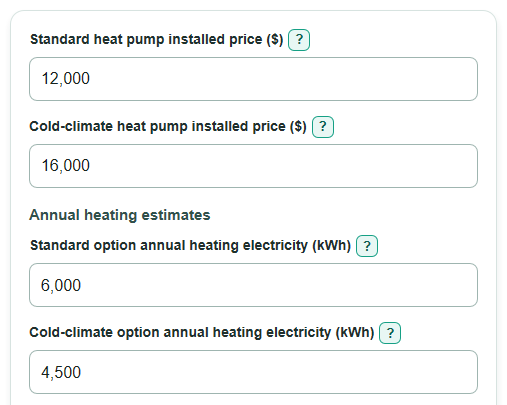
With a $12,000 standard quote, a $16,000 cold-climate quote, $2,000 cold-climate incentives, 6,000 and 4,500 kWh of annual heating electricity, a $0.1730 per kWh rate, and 15 years with no growth or discounting, net installed costs are $12,000 and $14,000. With the example maintenance inputs, lifetime costs are $29,820 and $28,377.50, so Cold-climate lifetime savings is $1,442.50 and break-even occurs in year 9.