
Compare cooling-only upfront, electricity, maintenance, and replacement costs to see when a mini split saves money over your planned ownership period.
Table of contents
How to use our Window AC vs Mini Split Lifetime Cost Calculator
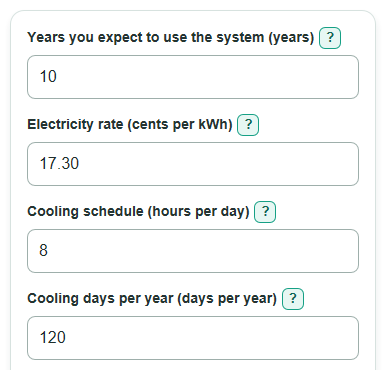
- Enter Years you expect to use the system, your typical Cooling schedule, Cooling days per year, and the usage-based Electricity rate from your bill.
- Enter each option's equipment price, setup or installation cost, and first-purchase rebates separately.
- Use product specifications or measurements for each power-draw field, then enter yearly maintenance and expected equipment life.
- Open Advanced options only if you want to adjust Window AC active cooling time or Mini-split active cooling time below 100 percent.
- Click Calculate, then compare Mini-split lifetime savings, lifetime costs, replacement events, and the break-even year. Check that both setups cool a similar area before using the comparison for a purchase decision.
Definitions
Electricity rate: The usage-based price of electricity, entered in cents per kWh. Fixed monthly utility charges are not included.
kWh: Kilowatt-hour, a unit of electrical energy used for billing. One kilowatt equals 1,000 watts.
Active cooling time: The percent of scheduled cooling hours represented by the entered cooling watts. It can be less than 100 percent when equipment cycles or the entered watts are not a full-period average.
Upfront cost after rebates: Equipment price plus setup or installation cost, minus a rebate that applies to the first purchase.
Scheduled replacement cost: Future lump-sum spending for complete-system replacements before the selected ownership period ends. The initial rebate is not applied again.
Mini-split lifetime savings: Window AC lifetime cost minus mini-split lifetime cost. A positive value means the mini split costs less; a negative value means it costs more.
Break-even year: The first completed year when cumulative mini-split cost is no more than cumulative window AC cost.
Common mistakes and quick fixes
Mistake: Entering BTU/hr in Window AC power draw while cooling or Mini-split power draw while cooling.
Fix: Enter electrical input in watts from a specification sheet, nameplate, EnergyGuide information, or a power measurement.
Mistake: Including a fixed monthly account charge in Electricity rate.
Fix: Use only usage-based electricity charges divided by billed kWh, stated in cents per kWh.
Mistake: Putting all project spending into Mini-split equipment price.
Fix: Put equipment in that field and labor, electrical work, permits, and related work in Mini-split installation and electrical cost.
Mistake: Treating Window AC active cooling time as the hours the unit is switched on.
Fix: Use the share of scheduled hours represented by the entered watts. Leave it at 100 percent if the watt value is already a whole-period average.
Mistake: Reusing a first-purchase incentive in expected replacements.
Fix: Enter the incentive only in Window AC rebates or Mini-split rebates ; scheduled replacement costs do not repeat rebates.
Mistake: Comparing systems that serve very different spaces.
Fix: Confirm that the setups behind Window AC power draw while cooling and Mini-split power draw while cooling provide similar planned cooling coverage.
Limitations & Key Assumptions / Boundary Conditions
- This is a cooling-only comparison. It does not include mini-split heating savings, heating fuel costs, or backup heating.
- Both options should provide similar cooling coverage. The calculator does not adjust for different room sizes, capacities, insulation, humidity, thermostat settings, or comfort levels.
- Entered watts and active cooling time are planning estimates. Variable-speed mini splits can draw different power as outdoor temperature and load change.
- Electricity price, equipment price, installation cost, and maintenance cost are held constant. The calculation does not include inflation, financing, taxes beyond entered rebates, discounting of future costs, or resale value.
- Replacement events use the entered expected life and current equipment plus setup or installation cost. A replacement exactly at the end of the selected period is not counted.
- Rebates reduce only the first purchase because future program eligibility and amounts are uncertain.
Methodology
How costs are calculated
For each option, the calculator estimates one cooling season of electricity use from watts, schedule, cooling days, and active cooling time.
Annual kWh = watts / 1,000 * hours per day * cooling days per year * active cooling time / 100
Annual electricity cost converts that energy use using the entered rate in cents per kWh.
Annual electricity cost = annual kWh * electricity rate / 100
The starting electricity-rate entry of 17.30 cents per kWh is a 2025 US residential planning average; replace it with your own usage-based bill rate when possible. [1]
First-purchase cost includes the rebate once. Replacements use equipment plus setup or installation cost with no repeat rebate.
Upfront cost = equipment price + setup or installation cost - rebate
Replacement events = ceil(ownership years / expected life) - 1
Maintenance and electricity costs repeat across the ownership period, while replacement costs are added as future lump sums.
Lifetime cost = upfront cost + annual electricity cost * ownership years + annual maintenance * ownership years + scheduled replacement cost
The displayed savings keeps its sign: window AC lifetime cost minus mini-split lifetime cost. The calculator checks each completed year in order and reports the first year when cumulative mini-split cost is no more than cumulative window AC cost.
Worked example
A 2,000-watt window AC setup used 8 hours per day for 120 days at 75 percent active cooling time uses 1,440 kWh per cooling season. A 1,000-watt mini split at the same schedule and 60 percent active cooling time uses 576 kWh. At 20 cents per kWh over 10 years, with the example purchase, maintenance, and life entries, the window setup totals $5,780 and the mini split totals $6,152. Mini-split lifetime savings is -$372, meaning the mini split costs $372 more during that selected period.