
Estimate heating-bill savings and simple payback for garage walls, doors, ceilings, and shared walls using your own project details.
Table of contents
How to use our Garage Insulation Savings Calculator
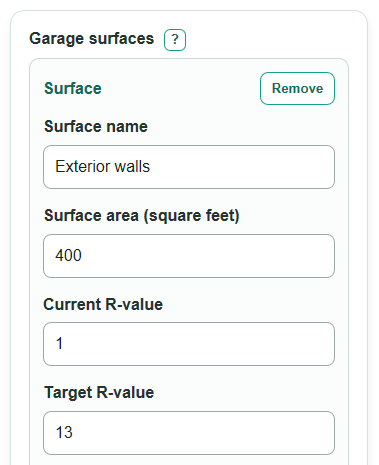
- Add each project under Garage surfaces. Enter its area, current R-value, target R-value, and installed project cost.
- Choose Garage heating status. For a partly heated garage, enter Share of winter heating time as a percent.
- Enter Local heating degree days, choose Heating energy source, and enter the matching Energy price and equipment efficiency.
- Click Calculate, then compare Savings by garage surface to see which entered surface has the largest estimated annual savings.
- Sanity-check the result by confirming that a larger area, a bigger R-value increase, or more heating degree days generally produces more estimated heat savings.
Definitions
R-value: A measure of resistance to heat flow. A higher R-value resists more heat flow through the entered surface.
Heating degree days: A yearly measure of how much and how long outdoor temperatures were below a base temperature. This calculator uses base 65 F. [1]
Therm: A natural-gas energy unit equal to 100,000 Btu.
Btu: British thermal unit, a unit of heat energy.
COP: Coefficient of performance. For a heat pump, it is heat delivered divided by electricity used.
Simple payback: Installed project cost divided by estimated annual heating-bill savings. It estimates years to recover the entered cost without financing or future price changes.
Common mistakes and quick fixes
Mistake: Entering wall length instead of area in Garage surfaces.
Fix: Enter square feet for each surface, such as length times height minus major openings.
Mistake: Setting a target R-value that is equal to or below the current R-value in Garage surfaces.
Fix: Enter a target R-value higher than the current R-value so the project reduces modeled heat flow.
Mistake: Using a local cooling figure instead of Local heating degree days.
Fix: Use annual heating degree days with a base of 65 F.
Mistake: Entering a gas price after choosing an electric Heating energy source.
Fix: For electric resistance or a heat pump, enter Energy price in $ per kWh; for natural gas, enter it in $ per therm.
Mistake: Typing 0.80 instead of 80 for Gas heating equipment efficiency.
Fix: Enter the percentage as a whole percent, such as 80 for an 80% efficient furnace.
Mistake: Expecting Estimated annual heating-bill savings for a garage marked Not directly heated.
Fix: Choose a directly heated status only when the garage has its own heating use; this model does not estimate indirect heat loss to nearby rooms.
Limitations & Key Assumptions / Boundary Conditions
- This is a heating-only estimate of conductive heat flow through the surfaces entered. It does not estimate cooling savings.
- It assumes the entered R-values describe the whole surface. Studs, framing, gaps, thermal bridges, and imperfect installation can change actual heat loss.
- For a partly heated garage, the result scales linearly with Share of winter heating time. Actual thermostat settings and garage temperatures may not follow that pattern.
- A garage marked Not directly heated has no direct heating-bill estimate in this model. Heat moving between an unheated garage and living space needs a whole-home model.
- Air leaks, garage-door seals, moisture control, ventilation, comfort, and local code requirements are outside the calculation.
- Simple payback uses the entered installed cost and current energy price. It excludes maintenance, financing, rebates, taxes, energy-price changes, and future repairs.
Methodology
Heating-season heat saved
For each entered surface, the calculator estimates the heat kept from escaping during the heating season. It uses area, local heating degree days, the heating-time share, and the change in R-value. Heating degree days use a 65 F base. [1]
Q_i = A_i * HDD * 24 * f * (1/R_current_i - 1/R_target_i)
Q_i is heat saved for one surface in Btu per year; A_i is area in square feet; HDD is local heating degree days; f is the heating-time share; and the two R values are the current and target R-values. The calculator adds all valid surface values for total heat saved. R-value describes resistance to heat flow. [2]
Bill-savings calculation
For natural gas, delivered heat saved is divided by heating equipment efficiency, converted from Btu to therms, then multiplied by the gas price.
S_gas = Q_total / efficiency / 100000 * gas_price
For electric resistance heat, the calculator converts Btu to kWh. For a heat pump, it also divides by COP because one kWh of electricity can deliver more than one kWh of heat.
S_electric = Q_total / 3412 * electricity_price
S_heatpump = Q_total / COP / 3412 * electricity_price
Payback and example
Combined simple payback divides the total installed project cost by estimated annual heating-bill savings. No numeric payback is shown when direct savings are unavailable or zero.
payback_years = total_installed_cost / annual_heating_savings
Example: a fully heated 400 square foot wall changing from R-1 to R-13 in a 5,000 heating-degree-day climate saves about 44,307,692 Btu per year in this model. With an 80% gas heater and gas at $1.50 per therm, that is about $830.77 per year. A $2,400 project has a simple payback of about 2.89 years.
Calculation choices
The model requires a target R-value higher than the current R-value, uses 24 hours per degree day, treats electric resistance heat as 100% conversion at the equipment, and uses the price and efficiency entered by the user. It does not adjust for air leakage, framing, thermostat behavior, solar gain, or changing energy prices.