
Estimate window heating-season costs and compare how a lower replacement U-factor could change your heating bill.
Advanced options
Table of contents
How to use our Window Heat Loss Cost Calculator
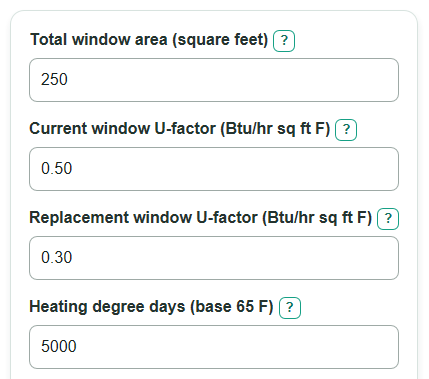
- Enter the combined frame-and-glass area in Total window area and the U-factors for your current and replacement windows.
- Enter Heating degree days for the heating season or year you want to estimate, using a base of 65 F.
- Choose Heating source, then enter Heating energy price in the billing unit shown on your utility bill and enter Heating system efficiency.
- Select Calculate to see estimated costs, purchased energy, and the signed savings amount. A positive savings amount means the replacement option costs less to heat.
- Sanity-check the result by confirming that a lower Replacement window U-factor produces lower billed energy when all other entries stay the same.
Definitions
U-factor: A measure of how easily heat passes through a window. Lower U-factor means less conductive heat loss. [3]
Heating degree days: A weather total that adds up how far and how long outdoor temperatures are below a base temperature. This calculator uses base 65 F degree days. [1]
Btu: British thermal unit, a unit of heat energy used in heating calculations. [2]
Therm: A natural-gas billing unit equal to 100,000 Btu in this calculation.
Heating system efficiency: The percent of purchased fuel energy that becomes heat delivered to the home in this simple model.
Conductive heat loss: Heat moving through the window materials. It does not include air leaking around a window.
Common mistakes and quick fixes
Mistake: Entering only glass size in Total window area and leaving out frames.
Fix: Use the full window area, including frame, for every window in the comparison.
Mistake: Treating a lower Current window U-factor as worse.
Fix: U-factor measures heat flow, so lower values lose less heat through the window.
Mistake: Entering a gas price in Heating energy price after selecting Electricity.
Fix: Match Heating energy price to Heating source: therms for natural gas, gallons for propane or heating oil, and kWh for electricity.
Mistake: Entering a heat-pump seasonal rating as Heating system efficiency.
Fix: This calculator accepts delivered-heat efficiency from above 0 to 100 percent; use 100 only for electric resistance heat.
Mistake: Expecting Heating degree days to describe one cold day.
Fix: Use the total base-65 F Heating degree days for the full season or year being estimated.
Mistake: Reading a negative Estimated annual heating cost saved by replacement windows as an error.
Fix: A negative value means the entered Replacement window U-factor is higher, so that option is estimated to cost more to heat.
Limitations & Key Assumptions / Boundary Conditions
- This is a conduction-only estimate for the entered window area. It excludes air leaks, solar heat gain, shade, orientation, curtains, and installation quality.
- Heating degree days and U-factor are treated as season-wide averages. Actual heat loss changes hour by hour with weather and indoor temperature.
- The calculation assumes the heating system replaces all conductive window heat loss at the entered Heating system efficiency.
- Use efficiency from above 0 to 100 percent. Heat pumps use a seasonal performance measure that this model does not convert.
- Utility bills can include fixed charges, taxes, tiered rates, and delivery fees. Entering only the energy price may not reproduce the exact bill change.
- Cooling costs, moisture effects, comfort near glass, window purchase price, and payback time are outside this calculation.
Methodology
Seasonal heat loss
The calculator estimates heat conducted through the current and replacement window options separately. Heating degree days are converted to degree hours by multiplying by 24. [1]
Seasonal heat loss (Btu) = U-factor (Btu/hr sq ft F) x window area (sq ft) x heating degree days x 24
Fuel use and cost
Seasonal heat loss is divided by heating-system efficiency and the energy in one billing unit. The billing-unit conversion is 100,000 Btu per therm for natural gas, 91,452 Btu per gallon for propane, 137,381 Btu per gallon for heating oil, and 3,412.142 Btu per kWh for electricity. [2]
Billed energy = seasonal heat loss / (efficiency as a decimal x Btu per billing unit)
Annual heating cost ($) = billed energy x heating energy price
Annual cost savings ($) = current-window cost - replacement-window cost
Temperature spot check
The optional temperatures calculate a heat-loss rate for one indoor-outdoor temperature difference. They do not change seasonal costs.
Heat-loss rate (Btu/hr) = U-factor x window area x (indoor temperature - outdoor temperature)
Worked example
For 100 square feet of windows, 5,000 heating degree days, a current U-factor of 0.50, and a replacement U-factor of 0.30, seasonal conductive heat loss is 6,000,000 Btu for the current windows and 3,600,000 Btu for the replacement windows. With natural gas, 80 percent efficiency, and $2 per therm, billed energy is 75 versus 45 therms, costs are $150 versus $90, and estimated savings are $60 per heating season.
Calculation choices
Negative savings are kept as negative values. They mean the entered replacement U-factor is higher and the replacement option loses more conductive heat. A negative spot-check rate means the entered indoor temperature is lower than the outdoor temperature, so heat flow reverses under those conditions.