
Estimate how long a conventional gas or electric-resistance storage water heater needs to reheat a full tank or one hot-water draw, using US customary or metric inputs.
Table of contents
How to use our Water Heater Recovery Time Calculator
- Choose US customary or Metric units. Switching units converts values already entered.
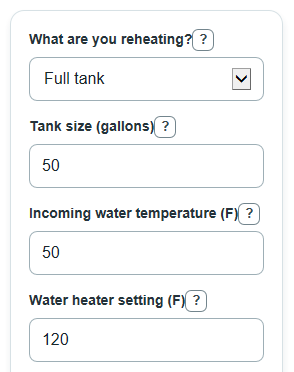
- Choose whether you are reheating the full tank or one hot-water draw, then enter the tank capacity and temperatures.
- Choose Gas or Electric resistance and enter the heater input shown on its label. Gas input uses BTU per hour in US mode and kW in Metric mode; electric input uses kW.
- Open Advanced options only when you have a manufacturer recovery or thermal-efficiency value. Otherwise the calculator uses an 80% gas or 100% electric-resistance planning assumption.
- Click Calculate. Results update immediately; compare recovery time with recovery rate as a reasonableness check.
Definitions
Recovery time: Estimated minutes needed to heat the selected water amount from the incoming temperature to the heater setting.
Temperature rise: Difference between the heater setting and incoming-water temperature.
Heater input: Gas input in BTU per hour or kW, or electric-resistance element power in kW.
Recovery efficiency assumption: Share of input energy assumed to reach the water. Use manufacturer data when available; the built-in planning defaults are 80% for gas and 100% for electric resistance.
Simplified first-hour supply: Tank capacity plus one hour of calculated recovery. It is not a standardized manufacturer first-hour rating.
Common mistakes and quick fixes
Mistake: Entering the amount of water expected for a shower as Tank size.
Fix: Enter the water heater's rated capacity for Tank size, then use Hot water used for one draw event.
Mistake: Setting Incoming water temperature equal to or above Water heater setting.
Fix: Enter a Water heater setting that is higher than Incoming water temperature.
Mistake: Using a recovery rating instead of the label input rating for Gas heater input.
Fix: Use the heater's input rating in BTU per hour for Gas heater input.
Mistake: Entering total household electric service size as Electric element power.
Fix: Use the active heating element's kW rating for Electric element power.
Mistake: Entering Hot water used larger than Tank size.
Fix: Enter a Hot water used amount no greater than Tank size for this simplified tank model.
Mistake: Treating Heating efficiency as a number from 0 to 1.
Fix: Enter Heating efficiency as a percent, such as 80 for 80 percent.
Limitations & Key Assumptions / Boundary Conditions
- This is an energy-balance planning estimate for conventional gas or electric-resistance storage water heaters. It is not a heat-pump water-heater model.
- Actual recovery can differ because inlet temperature, thermostat behavior, burner or element cycling, tank mixing, and heat loss change during heating.
- The simplified first-hour supply assumes the tank begins full and hot. DOE and manufacturer first-hour ratings use standardized test procedures, so do not treat this result as a rated FHR. [2]
- The hot-water-used scenario treats the entered draw as water reheated from incoming temperature to the heater setting. It does not model warm-water mixing at a fixture.
- Use a manufacturer recovery or thermal-efficiency value when available. The mode-aware defaults are broad planning assumptions and exclude standby loss.
Methodology
Calculation method
The calculator converts metric entries to gallons, degrees Fahrenheit, and BTU per hour internally, then applies the same energy balance in either unit mode.
temperature rise = heater setting - incoming-water temperature
usable heating rate = heater input x recovery efficiency / 100
The heat calculation uses 8.34 pounds per gallon as an approximate water weight. [1]
heat needed (BTU) = heated gallons x 8.34 x temperature rise (F)
recovery time (minutes) = heat needed / usable BTU per hour x 60
recovery rate = usable BTU per hour / (8.34 x temperature rise)
simplified first-hour supply = tank capacity + one hour of calculated recovery
Mini-example
For a 50-gallon gas tank, 50 F incoming water, a 120 F setting, 40,000 BTU per hour input, and 80% recovery efficiency, heat needed is 29,190 BTU. Usable power is 32,000 BTU per hour, giving about 54.7 minutes of recovery time and 54.8 gallons per hour.
Standardized-rating boundary
DOE test procedures determine first-hour rating using a standardized draw test. This calculator uses the simpler tank-capacity-plus-recovery relationship, so its first-hour result is deliberately labeled as a planning estimate rather than a rated FHR. [2]