
Estimate smart plug payback from standby power savings after subtracting the electricity used by the plugs themselves.
Table of contents
How to use our Smart Plug Payback Calculator
- Enter the standby load in Power the plug can shut off, using watts per plug, not the device's normal running watts.
- Enter Time shut off by the smart plug, Electricity rate, Smart plugs needed, and Price per smart plug for one matching setup.
- Open Advanced options if you want to change Smart plug's own power use, Days per week this schedule runs, or Standby power actually blocked.
- Click Calculate and read Payback time after plug power first, then check Yearly bill savings after plug power to see if the yearly savings are positive.
- Sanity-check the result: if the device uses only 1 or 2 standby watts, the Yearly cost to run the smart plugs may erase most or all savings.
Definitions
Standby power: Power a device uses while it looks off, is asleep, or is not being used.
Power the plug can shut off: The standby watts for the device or devices controlled by one smart plug.
Electricity rate: The price you pay for each kilowatt-hour, or kWh, of electricity.
kWh: A kilowatt-hour is the energy from using 1,000 watts for 1 hour [1].
Smart plug's own power use: The watts used by the smart plug itself while it stays connected all day.
Payback time after plug power: The number of months until net savings cover the smart plug purchase cost.
Yearly bill savings after plug power: Device energy savings minus the electricity cost of running the smart plugs.
Common mistakes and quick fixes
Mistake: Using normal running watts in Power the plug can shut off.
Fix: Use standby watts, meaning the power used while the device looks off, asleep, or idle.
Mistake: Typing 17 in Electricity rate when your bill says 17 cents per kWh.
Fix: Enter 0.17 for Electricity rate because the field uses dollars per kWh.
Mistake: Counting device count instead of outlet count in Smart plugs needed.
Fix: Enter the number of smart plugs you will buy, and keep it as a whole number of at least 1.
Mistake: Leaving Smart plug's own power use at the default when your plug's rated draw is different.
Fix: Change Smart plug's own power use to the plug's measured or listed watts if you know it.
Mistake: Setting Time shut off by the smart plug to 24 when the device still needs power part of the day.
Fix: Use only the hours per day when the smart plug actually cuts power.
Mistake: Treating a negative Yearly bill savings after plug power as a typo.
Fix: Check Smart plug's own power use and Power the plug can shut off; a low-standby device can cost more to control than it saves.
Limitations & Key Assumptions / Boundary Conditions
- The calculator uses one flat Electricity rate. It does not model time-of-use prices, tiered rates, taxes, or demand charges.
- Each smart plug is treated as having the same Power the plug can shut off, Time shut off by the smart plug, Days per week this schedule runs, and Smart plug's own power use.
- Standby watts are treated as constant. Real devices can change power use during updates, charging, Wi-Fi activity, or sleep modes.
- Price per smart plug is purchase price only. Tax, shipping, batteries, subscriptions, replacement plugs, and setup time are not included.
- Payback time after plug power is not calculated when Yearly bill savings after plug power is zero or negative.
- Do not shut off devices that need continuous power for safety, clocks, medical use, security, network access, or required updates.
Methodology
Energy method
The calculator estimates the device energy blocked by the smart plugs, then subtracts the energy used by the smart plugs themselves. Electricity billing commonly uses kilowatt-hours, so watt-hours are divided by 1,000 [1]. Standby power is the power used by equipment when it is off, asleep, or not actively doing its main job [2].
annual_device_energy_blocked_kwh = standby_watts_per_plug * off_hours_per_day * active_days_per_week * 52 * smart_plug_count * (blocked_percent / 100) / 1000
smart_plug_energy_kwh_year = smart_plug_watts * 24 * 365 * smart_plug_count / 1000
net_annual_bill_savings = (annual_device_energy_blocked_kwh - smart_plug_energy_kwh_year) * electricity_rate
smart_plug_power_cost_year = smart_plug_energy_kwh_year * electricity_rate
total_smart_plug_cost = smart_plug_count * smart_plug_cost_each
payback_months_after_plug_power = total_smart_plug_cost / net_annual_bill_savings * 12
If Yearly bill savings after plug power is zero or negative, Payback time after plug power is not shown because dividing by zero or a negative savings value would not describe a real payback period.
Worked mini-example
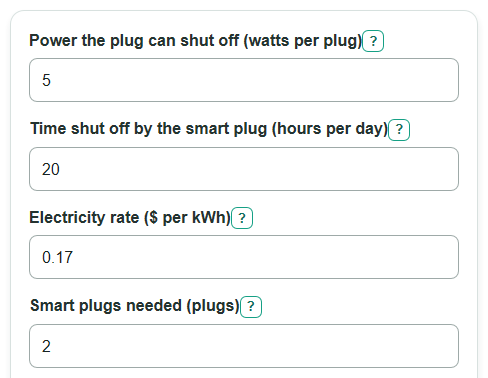
Suppose Power the plug can shut off is 5 W, Time shut off by the smart plug is 20 hours per day, Days per week this schedule runs is 7, Smart plugs needed is 2, Standby power actually blocked is 100%, Smart plug's own power use is 1 W, Electricity rate is $0.17 per kWh, and Price per smart plug is $12. Device energy blocked is 72.8 kWh per year. The smart plugs use 17.52 kWh per year, which costs $2.98 per year. Net yearly savings are $9.40, total purchase cost is $24.00, and payback is about 30.6 months.