
Estimate the yearly bill cost of measured duct leakage and the possible savings from sealing it.
Advanced options
Table of contents
How to use our Duct Leakage Cost Calculator
- Enter Leakage to outdoors from duct test in CFM25 from your duct test report, not total duct leakage unless total leakage is all to outdoors.
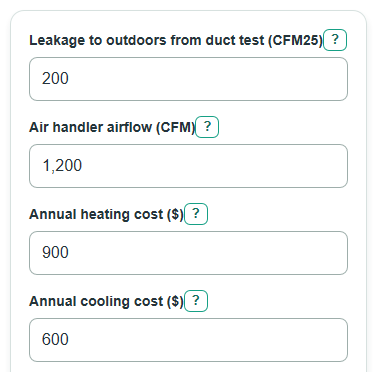
- Enter Air handler airflow in CFM, then add your yearly Annual heating cost and Annual cooling cost.
- Open Advanced options if you want to change Leak left after sealing, One-time duct sealing cost, or Cost impact factor.
- Click Calculate and read the yearly leakage cost first, then the estimated savings, payback time, and heating/cooling split.
- Sanity-check the output: if Duct leakage as percent of air handler airflow is unusually high or over 100%, recheck the CFM25 and airflow entries.
Definitions
CFM25: Cubic feet per minute of duct leakage measured while the duct system is held at 25 pascals of test pressure.
Leakage to outdoors: The part of duct leakage that connects to attics, crawlspaces, garages, or outside air, rather than just leaking inside conditioned rooms.
Air handler airflow: The amount of air the HVAC blower moves through the system, measured in cubic feet per minute.
Duct leakage as percent of air handler airflow: The CFM25 leakage to outdoors divided by air handler airflow, then shown as a percent.
Leak left after sealing: The percent of the current measured leak that you expect to remain after duct sealing.
Cost impact factor: The percent of the calculated leakage effect that you want to count in the dollar estimate.
Simple payback time: The one-time duct sealing cost divided by the estimated annual savings after sealing.
Common mistakes and quick fixes
Mistake: Entering total duct leakage in Leakage to outdoors from duct test when the report also lists leakage to outdoors.
Fix: Use the leakage-to-outdoors CFM25 number because the cost estimate is based on air lost to or pulled from outside the conditioned space.
Mistake: Putting equipment size in tons into Air handler airflow .
Fix: Enter airflow in CFM from the setup sheet, test report, or measured airflow value.
Mistake: Combining all utility costs into Annual heating cost or Annual cooling cost .
Fix: Use only the heating and cooling portions, not lighting, appliances, water heating, or service fees.
Mistake: Setting Leak left after sealing to 0 when the project will reduce leakage but not remove every leak.
Fix: Use a realistic percent of the current leak expected to remain after sealing.
Mistake: Leaving Cost impact factor at 100 when you know the leak effect should only be partly counted.
Fix: Lower the cost impact factor if an energy audit or local analysis supports counting only part of the measured leakage.
Mistake: Reading Simple payback time for duct sealing as a guaranteed contract result.
Fix: Treat it as a simple estimate based on the entered costs, leak reduction, and annual savings after sealing.
Limitations & Key Assumptions / Boundary Conditions
- This is a proportional estimate. It does not simulate hourly weather, equipment runtime, duct location, supply leaks, return leaks, or room-by-room pressure effects.
- CFM25 is a test-pressure measurement. Actual leakage during normal HVAC operation can differ from the test number.
- The cost estimate depends on the heating and cooling bill amounts you enter. If those amounts include non-HVAC energy use, the leakage cost will be overstated.
- The calculator assumes the same leakage percent and cost impact factor apply to heating and cooling. Real systems can have different effects by season.
- Payback uses simple payback only. It does not include financing, tax credits, rebates, energy price changes, maintenance, comfort value, or equipment life.
- If leakage to outdoors is greater than air handler airflow, the calculator can still compute, but that input combination should be checked before using the result.
Methodology
Calculation steps
The calculator first turns the duct test result into a leakage fraction by comparing leakage to outdoors with air handler airflow.
leakage_fraction = leakage_cfm25_outdoors / system_airflow_cfm
duct_leakage_percent_airflow = leakage_fraction * 100
It then applies that fraction to the entered yearly heating and cooling costs. The cost impact factor lets you count all or part of that proportional effect.
annual_leakage_cost = (annual_heating_cost + annual_cooling_cost) * leakage_fraction * (cost_impact_percent / 100)
The heating and cooling split uses the same leakage fraction and cost impact factor.
heating_cost_from_leakage = annual_heating_cost * leakage_fraction * (cost_impact_percent / 100)
cooling_cost_from_leakage = annual_cooling_cost * leakage_fraction * (cost_impact_percent / 100)
Savings after sealing are based on the percent of the current leak expected to remain. Monthly savings are the annual savings divided by 12.
annual_savings_after_sealing = annual_leakage_cost - annual_leakage_cost * (leak_left_percent / 100)
monthly_savings_after_sealing = annual_savings_after_sealing / 12
If estimated annual savings are greater than 0, simple payback divides the one-time sealing cost by those annual savings. If savings are 0 or less, payback is shown as N/A.
simple_payback_years = sealing_cost / annual_savings_after_sealing
Mini example
Suppose leakage to outdoors is 200 CFM25, air handler airflow is 1,200 CFM, annual heating cost is $900, annual cooling cost is $600, leak left after sealing is 30%, sealing cost is $1,000, and cost impact factor is 100%. The leakage fraction is 200 / 1,200 = 0.1667, so duct leakage is 16.67% of airflow. The estimated annual bill cost from duct leakage is ($900 + $600) * 0.1667 * 1.00 = $250. If 30% of the leak remains after sealing, the estimated annual savings are $250 - ($250 * 0.30) = $175. Simple payback is $1,000 / $175 = 5.71 years.