
Estimate annual HVAC savings from zoning by entering your current HVAC cost, zone use, setback, and effectiveness assumptions.
Table of contents
How to use our Zoned HVAC Savings Calculator
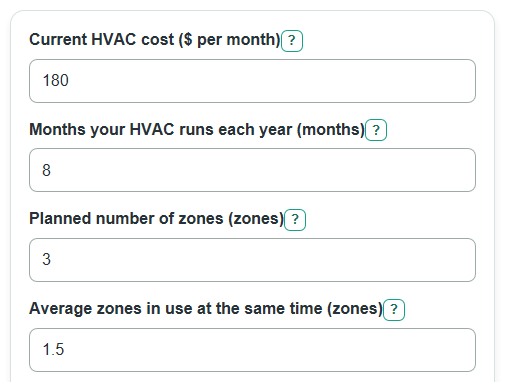
- Enter Current HVAC cost as the heating and cooling part of your bill, then enter Months your HVAC runs each year.
- Enter Planned number of zones and Average zones in use at the same time to describe how much of the home is usually active.
- Enter Unused-zone setback as the degrees F you would let unused areas drift from the main comfort setting.
- Open Advanced options if you want to change Usual inside-to-outside temperature gap, Likely zoning effectiveness, or add Installed zoning cost for payback.
- Check whether the Current annual HVAC cost used and Likely percent off current HVAC cost look believable before using the savings estimate for a quote decision.
Definitions
Current HVAC cost: The heating and cooling part of your bill in dollars per month, not necessarily your whole utility bill.
Planned number of zones: The number of areas that could be controlled separately, such as upstairs, downstairs, and bedrooms.
Average zones in use at the same time: The typical number of zones that need comfort at once across the day and night.
Unused-zone setback: The number of degrees F you let unused areas move away from the main comfort setting.
Usual inside-to-outside temperature gap: The typical degrees F between the indoor setting and outdoor temperature while heating or cooling runs.
Likely zoning effectiveness: The percent of the simple theoretical savings you expect to keep after air mixing, duct leakage, damper limits, and equipment cycling.
Simple payback time: Installed zoning cost divided by Likely annual HVAC savings, shown in years when savings are above zero.
Common mistakes and quick fixes
Mistake: Entering the full electric or gas bill as Current HVAC cost when other appliances are included.
Fix: Use the HVAC-only part if you know it, or lower Current HVAC cost to a careful estimate.
Mistake: Setting Months your HVAC runs each year to 12 when heating or cooling is only regular for part of the year.
Fix: Count only the months when HVAC is a normal bill driver.
Mistake: Making Average zones in use at the same time higher than Planned number of zones.
Fix: Keep Average zones in use at the same time from 0 up to Planned number of zones.
Mistake: Entering an Unused-zone setback larger than Usual inside-to-outside temperature gap.
Fix: Lower Unused-zone setback or raise Usual inside-to-outside temperature gap so the setback does not exceed the gap.
Mistake: Treating Likely zoning effectiveness as a product guarantee.
Fix: Use a lower Likely zoning effectiveness if your home has open stairs, leaky ducts, or zones that mix air easily.
Mistake: Reading Simple payback time as a full project return calculation.
Fix: Use Simple payback time only as Installed zoning cost divided by likely yearly bill savings; it does not include financing, repairs, or comfort value.
Limitations & Key Assumptions / Boundary Conditions
- This is a planning estimate, not a contractor quote or a utility-bill guarantee.
- The model assumes HVAC cost changes roughly with temperature difference. Real equipment cycling, humidity control, fan energy, and heat pump behavior can change actual savings.
- The calculator treats all zones as equal in load. A sunny upstairs zone, basement, large addition, or poorly insulated room may not match that simple average.
- Likely zoning effectiveness is user chosen. Duct leakage, bypass air, open stairways, and weak dampers can make real savings lower.
- Installed zoning cost is used only for Simple payback time. It does not include financing, maintenance, repair risk, rebates, tax credits, utility rate changes, or added comfort value.
- If Average zones in use at the same time equals Planned number of zones, the modeled savings are zero because no zones are unused on average.
Methodology
How the estimate is built
The calculator starts with your current HVAC spending, then estimates how much of that load could be reduced when unused zones are allowed to drift by the setback amount. Degree-day methods use temperature difference over time to describe heating and cooling demand, so this calculator uses the setback divided by the usual indoor-outdoor gap as a simple load share [1].
current_annual_hvac_cost = current_monthly_hvac_cost * months_hvac_runs
unused_zone_share = (number_of_zones - average_zones_in_use) / number_of_zones
setback_share = unused_zone_setback_f / typical_indoor_outdoor_gap_f
savings_percent_likely = unused_zone_share * setback_share * (zoning_effectiveness_percent / 100) * 100
Low and high checks use the same formula but change the effectiveness by 20 percentage points. The low check uses a floor of 0 percent. The high check uses a cap of 100 percent.
annual_savings_x = current_annual_hvac_cost * (savings_percent_x / 100)
zoned_annual_cost_likely = current_annual_hvac_cost - likely_annual_savings
simple_payback_years = installed_zoning_cost / likely_annual_savings
Worked mini-example
If Current HVAC cost is $180 per month and Months your HVAC runs each year is 8, the Current annual HVAC cost used is $1,440. With 3 zones, 1.5 zones in use, a 4 degrees F setback, a 25 degrees F usual gap, and 60 percent effectiveness, the unused zone share is 0.5 and the setback share is 0.16. The likely savings percent is 0.5 * 0.16 * 0.60 * 100 = 4.8 percent. The Likely annual HVAC savings is $1,440 * 4.8 percent = $69.12, and the Estimated annual HVAC cost with zoning is $1,370.88. If Installed zoning cost is $3,000, Simple payback time is about 43.4 years.
Calculation notes
The calculator rejects negative costs, months outside 1 to 12, less than 1 planned zone, average zone use above the zone count, a setback above the usual temperature gap, and effectiveness outside 0 to 100 percent. If Installed zoning cost is blank, payback is not shown. If modeled savings are zero, payback cannot be calculated because division by zero would not give a useful time.