
Estimate annual kWh savings, electricity cost savings, payback time, and five-year net savings from adding lighting controls.
Table of contents
How to use our Lighting Controls Savings Calculator
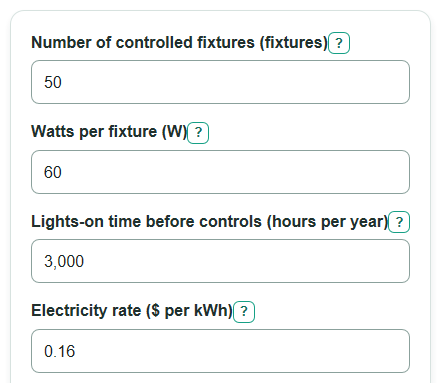
- Enter the Number of controlled fixtures, Watts per fixture, and Lights-on time before controls for only the fixtures affected by the project.
- Enter the Electricity rate and Installed controls cost using the same project scope.
- Open Advanced options if you want to change Occupancy sensing cut, Daylight dimming cut, Schedule or task tuning cut, or How to combine control cuts.
- Click Calculate and review Annual electricity savings from controls first, then compare Simple payback time and Five-year net savings after controls cost.
- Sanity-check the output by confirming Annual lighting energy before controls matches your expected load and that Combined lighting energy cut is reasonable for your chosen control cuts.
Definitions
Controlled fixtures: The lights included in the control project. Fixtures outside the project should not be counted.
Watts per fixture: The electric power used by one fixture. Divide total watts by 1,000 to get kilowatts.
kWh: Kilowatt-hour, a unit of energy. One kilowatt used for one hour equals one kWh.
Control cut: The percent of lighting energy a control strategy is expected to remove.
Combined lighting energy cut: The total percent reduction after the occupancy, daylight, and schedule or task tuning cuts are combined.
Simple payback time: Installed controls cost divided by annual electricity savings. It is a basic years-to-recover-cost measure.
Common mistakes and quick fixes
Mistake: Using the total building fixture count in Number of controlled fixtures when only one area will get controls.
Fix: Count only the fixtures that the controls will affect.
Mistake: Entering lamp wattage in Watts per fixture when the fixture has ballast or driver losses that you know about.
Fix: Use the full input wattage of one fixture when available.
Mistake: Using post-control hours in Lights-on time before controls.
Fix: Enter the current yearly lights-on hours before the new controls reduce runtime or brightness.
Mistake: Adding Occupancy sensing cut, Daylight dimming cut, and Schedule or task tuning cut by hand, then also choosing Each cut applies to what is left.
Fix: Let Combined lighting energy cut do the overlap math, or choose Add cuts, max 100% if that is the method you want to test.
Mistake: Putting demand charges or maintenance savings into Electricity rate.
Fix: Enter only the $ per kWh energy rate because Annual electricity savings from controls is energy-charge savings only.
Mistake: Treating a negative Five-year net savings after controls cost as an error.
Fix: Read it as the amount still not recovered within five years under the entered Installed controls cost and savings.
Limitations & Key Assumptions / Boundary Conditions
- The estimate uses energy charges only. It does not include demand charges, maintenance savings, rebates, tax effects, or HVAC cooling and heating effects.
- Lights-on time before controls should describe the current baseline. If the baseline hours are wrong, all savings outputs will be wrong by the same direction.
- Control cut percentages are user estimates. Real savings can differ because of sensor placement, commissioning, space use, daylight availability, and occupant overrides.
- The default combination method treats each cut as applying to the energy left after the earlier cuts. This avoids double counting but is still a simplified model.
- Five-year net savings after controls cost uses a fixed five-year period and does not discount future savings for the time value of money.
- Simple payback time is not reached when annual electricity savings are zero. If Installed controls cost is $0 and savings are positive, payback is 0 years.
Methodology
Energy use before controls
The calculator first finds the lighting load for the controlled fixtures, then multiplies by yearly lights-on hours.
baseline_kw = fixture_count * fixture_watts / 1000
annual_kwh_before = baseline_kw * hours_per_year
Combining control cuts
The default method is sequential. Each control cut is applied to the energy that remains after the previous cuts, so overlapping strategies are not counted twice.
combined_fraction = 1 - (1 - occupancy_cut_percent / 100) * (1 - daylight_cut_percent / 100) * (1 - schedule_cut_percent / 100)
The alternate additive method adds the three entered cuts and caps the total at 100 percent.
combined_fraction = min((occupancy_cut_percent + daylight_cut_percent + schedule_cut_percent) / 100, 1)
Savings and payback
Annual lighting energy saved is the baseline energy multiplied by the combined control fraction. Dollar savings use the entered electricity rate.
annual_kwh_saved = annual_kwh_before * combined_fraction
annual_cost_savings = annual_kwh_saved * electricity_rate
annual_cost_after = (annual_kwh_before - annual_kwh_saved) * electricity_rate
simple_payback_years = project_cost / annual_cost_savings
five_year_net_savings = annual_cost_savings * 5 - project_cost
Mini-example
For 50 fixtures at 60 W each, the baseline load is 50 * 60 / 1000 = 3 kW. At 3,000 hours per year, annual lighting energy before controls is 9,000 kWh. With 20% occupancy sensing, 10% daylight dimming, and 10% schedule or task tuning, the sequential combined cut is 35.2%. The calculator saves 3,168 kWh per year. At $0.16 per kWh, annual electricity savings are $506.88. With a $2,500 installed cost, simple payback is about 4.93 years and five-year net savings are $34.40.