
Estimate yearly LED retrofit savings, electricity saved, demand-charge savings, net cost, and simple payback from your lighting inputs.
Advanced options
Table of contents
How to use our LED Retrofit Savings Calculator
- Enter Fixture count, Current fixture power, New LED fixture power, Operating time, and Electric rate from your lighting plan or bill.
- Open Advanced options if you want to add Extra ballast power to add, Installed LED cost, Rebate or incentive, Maintenance savings, or demand-charge details.
- Use Demand charge rate and Lights on during peak demand only if your electric bill has a $ per kW demand charge.
- Select Calculate and read Annual savings including demand charges first, then Simple payback time and the supporting energy and cost outputs.
- Sanity-check the output by confirming Annual electricity saved is positive for a real efficiency upgrade and that Operating time is not above 8760 hours per year.
Definitions
Fixture count: The number of lighting fixtures being replaced in the project.
Current fixture power: The watts used by one existing fixture before the retrofit.
New LED fixture power: The watts used by one replacement LED fixture.
Operating time: The number of hours the lights run in one year.
Electric rate: The energy price in $ per kilowatt-hour, often shown as $ per kWh on an electric bill [1].
Demand charge rate: A bill charge based on peak power demand, entered here as $ per kW per month.
Lights on during peak demand: The percent of the lighting watt reduction that happens during the billed peak period, when system demand is high [3].
Simple payback time: Net project cost divided by yearly savings, shown in years when both values are positive.
Common mistakes and quick fixes
Mistake: Entering one bulb count in Fixture count when the retrofit is priced by fixture.
Fix: Use the same Fixture count basis for Current fixture power, New LED fixture power, Installed LED cost, and Rebate or incentive.
Mistake: Using Current fixture power that leaves out ballast power, then also leaving Extra ballast power to add at 0 when old ballasts are still part of the load.
Fix: Add the ballast percent in Extra ballast power to add, or enter a Current fixture power value that already includes ballast watts.
Mistake: Typing a monthly runtime into Operating time instead of hours per year.
Fix: Convert to yearly hours first, such as hours per day times days per year, and keep Operating time between 0 and 8760.
Mistake: Putting the whole electric bill average into Electric rate when it includes demand charges and fixed fees.
Fix: Use the energy rate for Electric rate and put the separate $ per kW charge in Demand charge rate.
Mistake: Leaving Lights on during peak demand at 100 percent when the lights are usually off during the utility peak.
Fix: Lower Lights on during peak demand to the share of the lighting reduction that happens during peak demand, or use 0 percent if it does not overlap.
Mistake: Treating Simple payback time as a full financial return measure.
Fix: Use Simple payback time as a quick years-to-recover-cost estimate, then review financing, taxes, rate changes, and equipment life separately.
Limitations & Key Assumptions / Boundary Conditions
- The calculator uses simple payback only. It does not include loan interest, taxes, depreciation, inflation, equipment life, or time value of money.
- Demand-charge savings assume the same Demand charge rate applies for all 12 months and that the entered Lights on during peak demand percent matches the utility billing peak.
- Electric Rate is treated as a flat $ per kWh energy rate. Time-of-use rates, seasonal rates, tiered rates, and fixed bill fees are not modeled.
- HVAC cooling or heating effects from lower lighting heat are not included. In some buildings, LEDs can slightly reduce cooling load or increase heating needs.
- Annual electricity saved can be negative if New LED fixture power is higher than adjusted Current fixture power. The calculator keeps that sign instead of hiding the increase.
- Net project cost after rebates can be negative when Rebate or incentive is larger than Installed LED cost. The calculator preserves that value because it follows the entered costs.
- Operating time is capped at 8760 hours per year, the number of hours in a 365-day year.
Methodology
Energy savings math
The calculator first adjusts the old fixture watts if you enter Extra ballast power to add. It then compares the adjusted old watts with the New LED fixture power and converts the watt difference to kilowatts. Kilowatt-hours are a standard way to measure electricity use over time [1].
adjusted_existing_watts = existing_watts * (1 + ballast_loss_percent / 100)
power_reduction_kw = fixture_count * (adjusted_existing_watts - led_watts) / 1000
annual_kwh_saved = power_reduction_kw * hours_per_year
annual_energy_cost_savings = annual_kwh_saved * electric_rate
Demand charges and maintenance
If you enter a Demand charge rate, the calculator estimates the peak kW reduction that is actually present during the billed peak period. On-peak periods are times of relatively high system demand [3]. Maintenance savings are added separately because they are not part of the electric rate.
peak_kw_reduction = power_reduction_kw * peak_lighting_percent / 100
annual_demand_charge_savings = peak_kw_reduction * demand_rate_kw_month * 12
annual_maintenance_savings = fixture_count * maintenance_savings_per_fixture_year
Project cost and payback
The net project cost uses the entered installed cost and rebate per fixture. The main money output adds energy savings, demand-charge savings, and maintenance savings. Simple payback is shown as a number only when the net project cost and annual savings are both positive.
net_project_cost = fixture_count * (installed_cost_per_fixture - rebate_per_fixture)
annual_total_savings = annual_energy_cost_savings + annual_demand_charge_savings + annual_maintenance_savings
simple_payback_years = net_project_cost / annual_total_savings
Mini-example
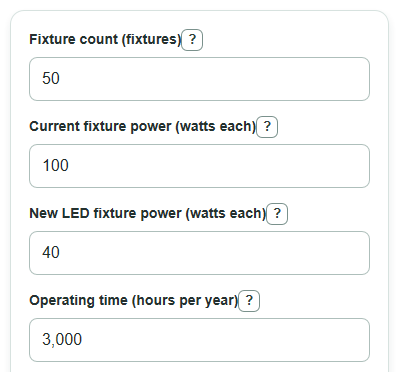
For 50 fixtures, 100 watts each now, 40 watts each after retrofit, 3000 hours per year, and $0.14 per kWh, the power reduction is 3 kW. Annual electricity saved is 9000 kWh, and annual energy cost savings are $1260. If Installed LED cost is $75 per fixture with no rebate or maintenance savings, net project cost is $3750 and simple payback is about 2.98 years. If Demand charge rate is $12 per kW per month and Lights on during peak demand is 80 percent, demand-charge savings add $345.60 per year, bringing Annual savings including demand charges to $1605.60.