
Enter three voltage readings to find NEMA voltage unbalance and compare the true line-to-line method when it applies.
Table of contents
How to use our Three-Phase Voltage Unbalance Calculator
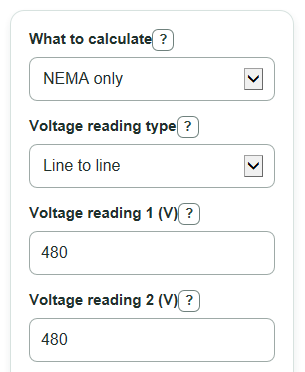
- Choose What to calculate. Use NEMA only for the common motor check, or choose NEMA plus true comparison when you have line-to-line readings.
- Choose Voltage reading type, then enter Voltage reading 1, Voltage reading 2, and Voltage reading 3 in volts.
- Click Calculate and read NEMA voltage unbalance first. Lower percent unbalance is better for most motor checks.
- If the true comparison is shown, compare True voltage unbalance factor with True method minus NEMA method to see how much the method changes the answer.
- Sanity-check the Average of the three readings and Largest miss from the average. If either looks wrong, recheck that all three readings use the same meter setup.
Definitions
Three-phase voltage unbalance: A measure of how uneven the three voltage readings are in a three-phase electrical system.
NEMA voltage unbalance: The largest voltage miss from the average, divided by the average voltage, then multiplied by 100.
Average of the three readings: The simple average of Voltage reading 1, Voltage reading 2, and Voltage reading 3.
Largest miss from the average: The biggest absolute difference between one entered voltage and the average voltage.
True voltage unbalance factor: A line-to-line method based on the negative-sequence voltage divided by the positive-sequence voltage, shown as a percent.
Percentage points: A direct difference between two percent values. For example, 2.4% minus 2.1% is 0.3 percentage points.
Common mistakes and quick fixes
Mistake: Mixing line-to-line and line-to-neutral values in Voltage reading 1, Voltage reading 2, and Voltage reading 3.
Fix: Set Voltage reading type to match the meter setup, then enter all three readings using that same setup.
Mistake: Choosing NEMA plus true comparison in What to calculate while Voltage reading type is line to neutral.
Fix: Choose line to line for the true comparison, or choose NEMA only for line-to-neutral readings.
Mistake: Treating Points above 1% motor limit as the same thing as NEMA voltage unbalance.
Fix: Read NEMA voltage unbalance as the unbalance percent. Points above 1% motor limit is that percent minus 1 percentage point.
Mistake: Reading True method minus NEMA method as a percent of the motor voltage.
Fix: Treat True method minus NEMA method as percentage points. A value of 0.30 means the true method is 0.30 percentage points higher than NEMA.
Mistake: Ignoring Reading 1 miss from average, Reading 2 miss from average, and Reading 3 miss from average after seeing the main answer.
Fix: Use those miss values to find which entered voltage is farthest from the group.
Limitations & Key Assumptions / Boundary Conditions
- The NEMA check uses a fixed 1% motor guide limit. Your motor manual, plant rule, or protection setting may use a different action level.
- The true voltage unbalance factor is calculated only for line-to-line voltage magnitudes. Line-to-neutral readings do not produce the true comparison here.
- The calculator uses entered RMS voltage magnitudes only. It does not check phase angles, waveform distortion, frequency variation, meter accuracy, or load changes during measurement.
- If three line-to-line readings cannot form a possible voltage triangle, the true comparison is unsupported even though the NEMA result can still be computed.
- Very small rounding differences can happen because the true method uses powers and square roots.
- The result is a calculation aid, not a full motor protection study or a substitute for site safety procedures.
Methodology
NEMA method
The calculator first finds the average of the three entered voltages. It then finds how far each reading is from that average. The NEMA voltage unbalance percent uses the largest of those misses divided by the average voltage. This follows the common max-miss-from-average method used in motor guidance, with a 1% reference limit for the status margin [1].
average_voltage = (voltage_1 + voltage_2 + voltage_3) / 3
nema_voltage_unbalance_percent = 100 * max(abs(voltage_1 - average_voltage), abs(voltage_2 - average_voltage), abs(voltage_3 - average_voltage)) / average_voltage
reading_n_miss_percent = 100 * abs(voltage_n - average_voltage) / average_voltage
nema_limit_margin_percentage_points = nema_voltage_unbalance_percent - 1
True line-to-line comparison
When What to calculate is NEMA plus true comparison and Voltage reading type is line to line, the calculator also finds the true voltage unbalance factor from the three line-to-line voltage magnitudes. The intermediate value beta is based on the squared and fourth-power voltage magnitudes.
beta = (voltage_1^4 + voltage_2^4 + voltage_3^4) / (voltage_1^2 + voltage_2^2 + voltage_3^2)^2
true_voltage_unbalance_percent = 100 * sqrt((1 - sqrt(3 - 6 * beta)) / (1 + sqrt(3 - 6 * beta)))
method_gap_percentage_points = true_voltage_unbalance_percent - nema_voltage_unbalance_percent
Mini-example
For 480 V, 470 V, and 490 V, the average is 480 V. The largest miss from average is 10 V, so the NEMA voltage unbalance is 100 * 10 / 480 = 2.0833%. The true line-to-line method gives about 2.40635%, so True method minus NEMA method is about 0.32302 percentage points. The NEMA limit margin is 2.0833% - 1% = 1.0833 percentage points.
Calculation checks
The calculator rejects blank, zero, negative, nonnumeric, range, and formula-style voltage entries. It accepts a plain number with a trailing V or volts. For the true method, it checks that the three line-to-line magnitudes are physically possible and that the square-root terms stay inside their usable numeric range.