
Estimate annual VFD energy savings, bill savings, and payback using real speed-and-hours duty cycle entries.
Fill at least 3 entries. Leave unused entries blank.
Advanced options
Positive savings mean the modeled VFD schedule uses less electricity than full-speed operation.
This includes energy charges only, not demand charges or maintenance changes.
Estimated electricity use after applying every speed-and-hours entry.
Full-speed power multiplied by the same total operating hours.
Use this check to confirm the entries match the schedule you meant to model.
Table of contents
How to use our VFD Energy Savings Calculator
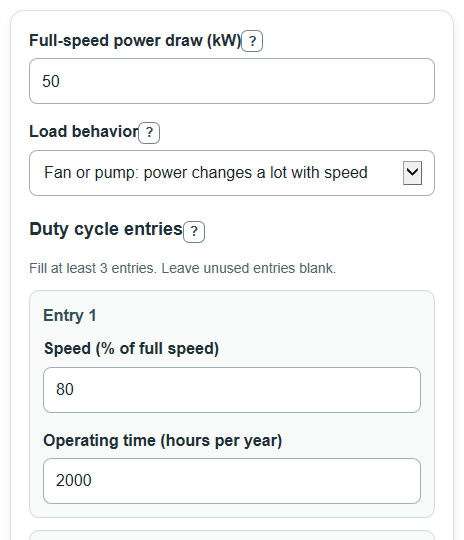
- Enter Full-speed power draw in kW. Use measured input power if you have it, or the motor or fan power at full speed.
- Choose Load behavior. Use fan or pump for variable-torque loads, constant torque for steady-torque loads, or constant power when speed changes do not lower power much.
- Fill Duty cycle entries with 3 to 6 rows. Each row needs a speed percent and hours per year, and the hours should add up to the yearly run time you want to model.
- Enter Electricity price and Installed VFD cost, then use Advanced options only if you want to change Number display or Decimal places.
- Click Calculate and sanity-check the results: compare Hours-weighted average speed with the schedule you intended, and make sure Full-speed baseline electricity equals full-speed kW times total hours.
Definitions
VFD: A variable frequency drive is equipment that controls an AC motor by changing the frequency and voltage supplied to the motor [1].
Duty cycle: The operating pattern over time. In this calculator, Duty cycle entries are the speed percent and hours per year for each operating point [2].
Full-speed power draw: The electrical power, in kW, used when the motor or driven equipment runs at full speed.
Load behavior: The selected rule for how power changes when speed changes. Fan or pump uses a cube relationship, constant torque uses a straight speed relationship, and constant power uses no speed savings from this simplified model.
Installed VFD cost: The project cost used for payback. It can include equipment, materials, engineering, labor, wiring, controls, and startup work [3].
Simple payback time: Installed VFD cost divided by annual energy bill savings. It does not include financing, tax effects, rebates, maintenance changes, or changing electric rates.
Hours-weighted average speed: The average speed after giving more weight to rows with more hours. It is a check on the entered schedule, not the main energy formula.
Common mistakes and quick fixes
Mistake: Using motor nameplate horsepower in Full-speed power draw without converting or measuring input kW.
Fix: Enter full-speed electrical power in kW, or convert carefully before using the calculator.
Mistake: Picking Load behavior as fan or pump for a load that does not follow fan or pump speed laws.
Fix: Choose constant torque or constant power when that better matches the equipment.
Mistake: Putting only one or two rows in Duty cycle entries or leaving row hours blank.
Fix: Enter 3 to 6 complete rows, with speed percent and hours per year in each usable row.
Mistake: Entering a blended utility bill total in Electricity price that includes demand charges, taxes, or fixed fees.
Fix: Use the energy charge in $ per kWh for this input, because Annual bill savings from energy is energy-only.
Mistake: Leaving labor, wiring, controls, or startup out of Installed VFD cost when judging Simple payback time .
Fix: Include the full installed project cost if you want a project payback number.
Mistake: Rounding too much with Decimal places and then comparing small differences between options.
Fix: Show more decimals while checking scenarios, then round only for the final summary.
Limitations & Key Assumptions / Boundary Conditions
- The full-speed baseline assumes the old system draws Full-speed power draw during the same total hours listed in Duty cycle entries.
- The fan or pump option uses a cube speed-power rule. Real systems can differ because of static pressure, pump head, control method, minimum speed limits, and equipment efficiency.
- The model does not subtract VFD losses, motor efficiency changes, bypass operation, harmonics, cooling impacts, or control standby power.
- Annual bill savings from energy uses only Electricity price in $ per kWh. It does not include demand charges, ratchets, time-of-use prices, power factor charges, taxes, or fixed fees.
- Simple payback time is a simple cost divided by savings calculation. It does not include rebates, financing, maintenance savings, downtime, tax treatment, or equipment life.
- Speed percent must be from 0 to 100, and total yearly hours must be above 0. A row with 0 hours is allowed but has no effect on energy use.
- If annual savings are zero or negative, the calculator keeps the signed savings and reports that payback is not reached.
Methodology
Calculation steps
The calculator first adds the hours from all usable Duty cycle entries. It then compares two yearly energy totals: a full-speed baseline and the modeled VFD schedule.
e = 3 for fan or pump; e = 1 for constant torque; e = 0 for constant power
baseline_energy_kwh = full_speed_power_kw * sum(hours_i)
vfd_energy_kwh = sum(full_speed_power_kw * (speed_percent_i / 100)^e * hours_i)
annual_kwh_saved = baseline_energy_kwh - vfd_energy_kwh
annual_cost_savings = annual_kwh_saved * electricity_rate
simple_payback_years = installed_cost / annual_cost_savings
weighted_average_speed_percent = sum(speed_percent_i * hours_i) / sum(hours_i)
If annual cost savings are less than or equal to zero, the payback output is shown as not reached instead of forcing a number.
Mini-example
For a 50 kW fan or pump load running 2,000 hours at 80 percent speed, 1,500 hours at 60 percent speed, and 500 hours at 50 percent speed, total hours are 4,000. The baseline energy is 50 * 4,000 = 200,000 kWh per year. Using the cube rule, modeled VFD energy is 70,525 kWh per year. Annual electricity saved is 129,475 kWh. At $0.12 per kWh, annual bill savings from energy are $15,537. With a $20,000 installed cost, simple payback is about 1.29 years. The hours-weighted average speed is 68.75 percent.
Input handling
Commas, spaces, plain decimals, scientific notation, and common matching unit suffixes are accepted in number fields. The calculator blocks invalid entries, such as full-speed power at or below 0 kW, fewer than 3 usable duty-cycle rows, more than 6 usable rows, speeds outside 0 to 100 percent, negative hours, negative electricity price, or negative installed cost.