
Estimate yearly solar energy and bill value lost from panel shade using shade time, covered area, sunlight, and season.
Advanced options
Table of contents
How to use our Solar Panel Shading Loss Calculator
- Enter Unshaded yearly production (kWh) from a solar quote, monitoring app, or no-shade estimate.
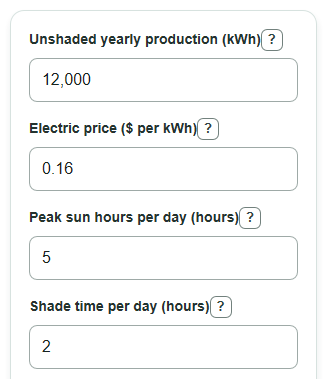
- Enter Electric price ($ per kWh), Peak sun hours per day (hours), Shade time per day (hours), and Array covered by shade (percent).
- Open Advanced options if the shade is seasonal, happens only on some days, or your Panel electronics are not DC optimizers.
- Click Calculate and read Estimated yearly solar energy lost first, then compare the 1-hour less and 1-hour more cards to see how sensitive your estimate is.
- Sanity-check the result: if Estimated yearly production lost seems too high, recheck that Shade time per day counts only useful daylight and that Array covered by shade is for the whole array.
Definitions
Unshaded yearly production: The kWh your solar array is expected to make in a year with no shade.
kWh: A kilowatt-hour is energy equal to 1 kilowatt used or produced for 1 hour [2].
Electric price: The price you pay for each kWh of electricity. Fixed customer charges are not included.
Peak sun hours per day: The daily sunlight energy converted into an equal number of full-strength sun hours.
Shade time per day: The number of useful daylight hours when shade falls on the panels.
Array covered by shade: The percent of the entire solar array covered by shade during the shade window.
Panel electronics: The inverter or panel-level equipment setting used to adjust how much shade may affect nearby unshaded panels.
Common mistakes and quick fixes
Mistake: Entering nighttime or weak evening shade in Shade time per day.
Fix: Count only shade that hits the panels during useful daylight, then recalculate Estimated yearly solar energy lost.
Mistake: Using the shaded percent of one panel for Array covered by shade instead of the whole array.
Fix: Estimate the percent of all panels covered during the shade window.
Mistake: Leaving Months with this shade at 12 when the tree or building shade happens only in one season.
Fix: Enter the number of affected months so Average loss during shaded months and yearly loss stay realistic.
Mistake: Typing the full electric bill total into Electric price.
Fix: Use the energy price in $ per kWh and leave out fixed monthly charges.
Mistake: Choosing the wrong Panel electronics setting.
Fix: Pick String inverter, DC optimizers, or Microinverters based on the system design, because this changes Estimated yearly production lost.
Limitations & Key Assumptions / Boundary Conditions
- This is a planning estimate, not a site survey or a bankable solar production model.
- The calculator assumes the shade pattern is similar during the entered months and days.
- Real losses can differ because sun angle, panel tilt, azimuth, cloud cover, bypass diodes, wiring layout, and inverter behavior are not modeled in detail.
- The Panel electronics factors are simplified planning factors, not manufacturer ratings.
- If Shade time per day is greater than Peak sun hours per day, the time part is capped at 100 percent of the daily usable sunlight.
- The yearly loss is capped at 100 percent of Unshaded yearly production, so Estimated yearly production after shade cannot go below zero.
- Estimated yearly bill value lost uses only Electric price ($ per kWh). It does not model net metering rules, demand charges, time-of-use rates, tax credits, or fixed fees.
Methodology
How the estimate is calculated
The calculator starts with a no-shade annual production estimate, then reduces it by the share of useful sunlight that is shaded, the share of the array covered, the seasonal frequency, and the selected Panel electronics factor.
shade_factor = 1.25 for String inverter, 0.90 for DC optimizers, 0.80 for Microinverters
loss_percent = 100 * min(1, min(shade_hours_per_day / peak_sun_hours_per_day, 1) * array_shaded_percent / 100 * shaded_days_percent / 100 * months_with_shade / 12 * shade_factor)
annual_kwh_lost = unshaded_annual_kwh * loss_percent / 100
annual_dollar_loss = annual_kwh_lost * electric_rate_per_kwh
production_after_shade_kwh = unshaded_annual_kwh - annual_kwh_lost
average_loss_per_shaded_month_kwh = annual_kwh_lost / months_with_shade
One-hour shade-time check
The calculator repeats the same loss formula twice to show how much the answer changes if the observed Shade time per day is off by about 1 hour.
less_hours = max(shade_hours_per_day - 1, 0)
more_hours = min(shade_hours_per_day + 1, peak_sun_hours_per_day)
annual_loss_if_one_hour_less_kwh = loss formula using less_hours
annual_loss_if_one_hour_more_kwh = loss formula using more_hours
Mini example
If Unshaded yearly production is 12000 kWh, Electric price is $0.16 per kWh, Peak sun hours per day is 5, Shade time per day is 2, Array covered by shade is 25 percent, Months with this shade is 12, Days with this shade is 100 percent, and Panel electronics is DC optimizers, the shade factor is 0.90. The loss percent is 9 percent, so Estimated yearly solar energy lost is 1080 kWh. The Estimated yearly bill value lost is $172.80, and Estimated yearly production after shade is 10920 kWh. The 1-hour check gives 540 kWh for 1 hour less shade and 1620 kWh for 1 hour more shade.