
Estimate how solar panel production drops over time and see yearly kWh, lifetime loss, and dollar impact.
| Year | Production (kWh) | Starting production remaining | Energy lost (kWh) | Value lost ($) |
|---|
Table of contents
How to use our Solar Panel Degradation Calculator
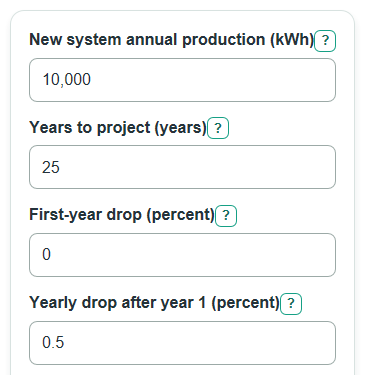
- Enter New system annual production in kWh per year before degradation is applied.
- Enter Years to project, then set First-year drop and Yearly drop after year 1 as percents.
- Enter Electricity price in $ per kWh if you want the lost energy converted to an estimated dollar value.
- Click Calculate and read Annual production in the final year, Total production over the projection, and the year-by-year table.
- Sanity-check the table: yearly production should stay the same or go down, and Estimated dollar value lost to degradation should be $0 only when the price or degradation loss is 0.
Definitions
kWh: A kilowatt-hour is a unit of energy. Solar production and electric bills commonly use kWh.
New system annual production: The expected kWh a new system makes in one year before the first-year drop is applied.
First-year drop: A one-time percent loss applied to the first projected year.
Yearly drop after year 1: The percent loss applied each later year to the previous year's production, not to the original amount.
Degradation: The gradual reduction in solar panel output over time.
80 percent threshold: A comparison point showing the first year when annual production is at or below 80 percent of the new-system annual production.
Common mistakes and quick fixes
Mistake: Entering a monthly kWh number in New system annual production .
Fix: Use annual kWh, or multiply a typical monthly kWh estimate by 12 before entering it.
Mistake: Putting 0.005 in Yearly drop after year 1 for a 0.5 percent yearly drop.
Fix: Enter percent values as percents, so 0.5 percent should be entered as 0.5.
Mistake: Using First-year drop when New system annual production already comes from measured year-1 output.
Fix: Set First-year drop to 0 if the starting production already includes first-year effects.
Mistake: Entering a decimal rate like 0.15 in Electricity price when your bill shows 15 cents per kWh is correct, but entering 15 would mean $15 per kWh.
Fix: Use dollars per kWh, such as 0.15 for 15 cents per kWh.
Mistake: Comparing Total production over the projection to one year of production.
Fix: Compare it to New system annual production multiplied by Years to project if you want the no-degradation baseline.
Limitations & Key Assumptions / Boundary Conditions
- The model uses a fixed yearly degradation rate. Real systems can have uneven losses from weather, equipment issues, dirt, shading, snow, or repairs.
- The electricity price is held flat for every year. Future utility rates, time-of-use billing, credits, and net metering rules can change the dollar impact.
- The calculator compares against the original new-system annual production every year. It does not model battery losses, inverter clipping, panel replacement, or changing household use.
- Years to project must be whole years from 1 to 50 so the year-by-year table stays readable.
- First-year drop and yearly drop after year 1 must be at least 0 percent and less than 100 percent. A 100 percent or higher drop would make the compounding math unusable for this purpose.
- The 80 percent threshold is a planning benchmark in this calculator, not a warranty promise.
Methodology
Calculation steps
The calculator treats the first-year drop as a separate one-time loss. After that, each year is reduced by the yearly drop after year 1. The yearly drop is compounded, which means it is applied to the previous year's output.
production_i = start_kwh * (1 - first_year_drop_percent / 100) * (1 - annual_degradation_percent / 100)^(i - 1)
remaining_percent_i = 100 * production_i / start_kwh
lifetime_production = sum(production_i for i = 1 to projection_years)
energy_lost_to_degradation = start_kwh * projection_years - lifetime_production
lifetime_value_lost = sum((start_kwh - production_i) * electricity_rate_dollars_per_kwh for i = 1 to projection_years)
For the 80 percent check, the calculator first tests whether year 1 is already at or below 80 percent. If not, it uses the compounded yearly drop to find the first whole year that reaches the threshold. If the yearly drop is 0 percent and year 1 is above 80 percent, the threshold is reported as not reached.
if (1 - first_year_drop_percent / 100) <= 0.80, years_until_80_percent = 1
else if annual_degradation_percent = 0, years_until_80_percent = not reached
else years_until_80_percent = 1 + ceil(ln(0.80 / (1 - first_year_drop_percent / 100)) / ln(1 - annual_degradation_percent / 100))
Mini example
Suppose New system annual production is 10,000 kWh per year, Years to project is 5, First-year drop is 2 percent, Yearly drop after year 1 is 0.5 percent, and Electricity price is $0.15 per kWh. Year 1 production is 9,800 kWh. Year 5 production is about 9,605.47 kWh. Total production over the 5 years is about 48,512.44 kWh. Compared with 50,000 kWh with no degradation, total energy lost is about 1,487.56 kWh, and the estimated dollar value lost is about $223.13.