
Estimate sump pump battery backup runtime from pump power, battery size, and how many minutes the pump runs per hour.
Table of contents
How to use our Sump Pump Battery Backup Runtime Calculator
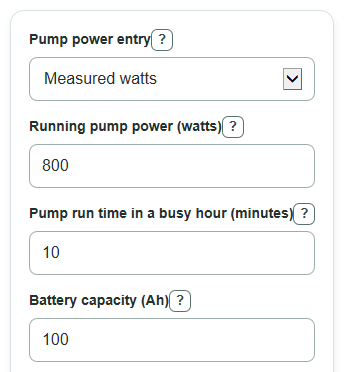
- Choose Pump power entry based on the number you have: Measured watts from a meter, or Measured amps from the pump label.
- Enter Running pump power or Running pump current, then enter Pump run time in a busy hour as the total minutes the pump is on during one heavy-rain hour.
- Enter Battery capacity and Battery bank voltage from the battery or battery bank label.
- Open Advanced options if you want to change Usable battery energy, Inverter efficiency, Start-up surge power, or Inverter size margin.
- Click Calculate, then sanity-check the Estimated backup runtime against Total pump-on time available; a very short pump-on time usually means the pump load, battery capacity, or pump minutes need a second look.
Definitions
Running pump power: The watts the pump uses while it is already running, not the brief start-up spike.
Running pump current: The amps shown on the pump label or meter while the pump is running.
Pump run time in a busy hour: The total minutes the pump is on during one wet, high-use hour.
Battery capacity: The amp-hour, or Ah, rating of the battery or whole battery bank.
Battery bank voltage: The DC voltage of the batteries feeding the backup system.
Usable battery energy: The percent of rated battery energy you plan to use before stopping discharge.
Inverter efficiency: The percent of battery energy that reaches an AC pump after inverter losses.
Start-up surge power: The short extra watt demand when the pump motor starts.
Estimated backup runtime: The clock hours the battery can support the pump at the entered minutes per hour.
Common mistakes and quick fixes
Mistake: Entering start-up watts in Running pump power.
Fix: Put the normal running load in Running pump power and put the short start-up number in Start-up surge power.
Mistake: Using Pump run time in a busy hour as the number of cycles instead of minutes.
Fix: Add the actual on-time minutes, such as ten 30-second cycles = 5 minutes.
Mistake: Entering one battery's Battery capacity when several batteries are wired in parallel.
Fix: Use the amp-hour total for the battery bank when the backup system combines batteries in parallel.
Mistake: Choosing the wrong Battery bank voltage.
Fix: Use the voltage feeding the backup system, such as 12, 24, or 48 volts, not the wall outlet voltage.
Mistake: Leaving Inverter efficiency at 90 percent for a direct DC pump.
Fix: If the pump runs directly from DC batteries with no inverter, set Inverter efficiency to 100 percent.
Mistake: Treating Suggested inverter running rating as the same as Suggested inverter surge rating.
Fix: Use Suggested inverter running rating for continuous load and Suggested inverter surge rating for the pump's short start-up burst.
Limitations & Key Assumptions / Boundary Conditions
- The result is an estimate. Real runtime can change with battery age, temperature, wiring losses, charger condition, water level, and pump wear.
- Running pump power and Running pump current should describe the pump while it is on. Start-up surge power is handled separately.
- Pump run time in a busy hour must be between more than 0 and 60 minutes. A storm that keeps the pump on longer will shorten runtime.
- Battery capacity should match the usable battery bank. Series wiring raises Battery bank voltage; parallel wiring raises amp-hours.
- Inverter sizing outputs are simple watt targets with the selected Inverter size margin. They are not electrical code guidance or a guarantee that a specific inverter will start a specific motor.
- The calculator does not model battery voltage sag, manufacturer-specific discharge curves, or automatic shutdown voltage.
Methodology
How the runtime is calculated
The calculator first finds the pump's running watts. If Pump power entry is Measured watts, it uses Running pump power directly. If Pump power entry is Measured amps, it multiplies Running pump current by Pump supply voltage.
running_watts_used = running_watts
running_watts_used = running_amps * pump_supply_voltage
Next, it changes Pump run time in a busy hour into the part of an hour the pump is on.
duty_fraction = pump_minutes_per_hour / 60
Usable battery energy after losses is based on battery amp-hours, battery voltage, the usable battery percent, and inverter efficiency.
available_battery_energy_wh = battery_capacity_ah * battery_bank_voltage * (usable_battery_percent / 100) * (inverter_efficiency_percent / 100)
The calculator then turns the on-and-off pump into an average load across the hour.
average_pump_load_watts = running_watts_used * duty_fraction
Estimated backup runtime is usable watt-hours divided by that average watt load. Total pump-on time available is the continuous-running equivalent.
estimated_backup_runtime_hours = available_battery_energy_wh / average_pump_load_watts
total_pump_on_time_hours = available_battery_energy_wh / running_watts_used
How inverter sizing is calculated
Suggested inverter running rating uses the pump's running watts plus the selected Inverter size margin. Suggested inverter surge rating is shown only when Start-up surge power is entered.
suggested_inverter_running_rating_watts = running_watts_used * (1 + inverter_margin_percent / 100)
suggested_inverter_surge_rating_watts = surge_watts * (1 + inverter_margin_percent / 100)
Worked mini-example
For an 800 watt pump that runs 10 minutes per hour, the duty fraction is 10 / 60 = 0.1667. A 100 Ah, 12 volt battery bank with 80 percent usable energy and 90 percent inverter efficiency has 864 watt-hours available. The average pump load is 800 * 0.1667 = 133.33 watts, so the estimated backup runtime is 864 / 133.33 = 6.48 hours. The continuous pump-on time is 864 / 800 = 1.08 hours. With a 20 percent margin, the suggested running inverter rating is 960 watts. If Start-up surge power is 1800 watts, the suggested surge rating is 2160 watts.