
Enter your outage appliance plan once to compare portable power station size, generator watt needs, fuel cost, and solar refill time.
Table of contents
How to use our Portable Power Station vs Generator Calculator
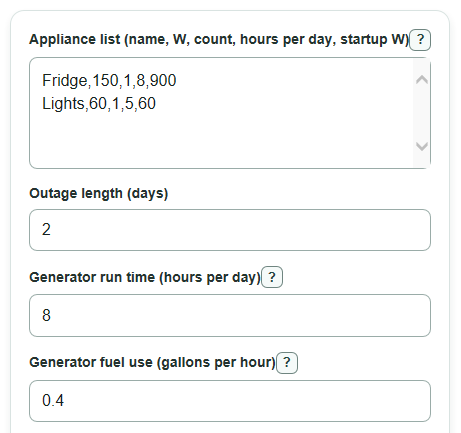
- In Appliance list (name, W, count, hours per day, startup W), enter one item per line using commas, such as
Fridge,150,1,8,900. - Enter Outage length (days), Generator run time (hours per day), Generator fuel use (gallons per hour), and Fuel price ($ per gallon).
- Open Advanced options if you want to adjust battery losses, extra cushion, generator headroom, solar panel size, strong sun time, or solar charging efficiency.
- Click Calculate and compare Portable power station size to shop for with Minimum generator running watts, Starting watts the generator should handle, and fuel cost.
- Sanity-check the result: if a large appliance shows no startup watts, if daily use is over 24 hours, or if solar refill looks faster than expected for your panel size, recheck the appliance row and Advanced options.
Definitions
W: Watts measure how fast a device uses power while it is running.
Wh: Watt-hours measure stored or used energy over time. A 100 W device running for 5 hours uses 500 Wh.
Running watts: The normal watts an appliance uses after it is already on.
Startup W: The short burst of watts some motor-driven appliances need when they start.
Usable battery capacity (percent): The share of a power station's rated Wh that is expected to reach your devices after losses and reserve.
Extra battery cushion (percent): Extra rated battery size added so the plan is not exactly at the edge.
Strong sun time: The number of daily hours that act like full-power sunlight for solar charging estimates.
Solar charging efficiency (percent): The share of panel energy expected to become stored battery energy after real-world charging losses.
Common mistakes and quick fixes
Mistake: Putting total outage hours in Appliance list (name, W, count, hours per day, startup W) instead of daily hours.
Fix: Use hours per day for each appliance row, then put the total outage length in Outage length (days) .
Mistake: Leaving motor appliances with a blank or too-low startup value in Appliance list (name, W, count, hours per day, startup W) .
Fix: Enter the appliance's startup W when you know it; if there is no surge, use running W times count.
Mistake: Treating Generator run time (hours per day) as the same thing as appliance run time.
Fix: Enter only the number of hours you plan to run the generator each day.
Mistake: Guessing Generator fuel use (gallons per hour) from a different size generator or a very different load.
Fix: Use the closest fuel-use value from your generator manual, then test a low and high case.
Mistake: Entering Usable battery capacity (percent) or Solar charging efficiency (percent) as a decimal, such as 0.85 for 85 percent.
Fix: Enter whole percent values like 85 or 75.
Mistake: Comparing Portable power station size to shop for to a battery's marketing watt rating instead of its watt-hour rating.
Fix: Compare the result to rated Wh, and also check that the power station can supply the watts your devices need.
Limitations & Key Assumptions / Boundary Conditions
- The appliance list assumes the listed running loads may run at the same time when sizing generator watts. Real use can be lower if devices cycle on and off.
- The starting-watt calculation assumes only the largest extra startup surge happens at one time. If two motors start together, you may need more generator capacity.
- Fuel cost is fuel only. It does not include oil, maintenance, storage containers, repairs, purchase price, noise limits, or fuel aging.
- Generator fuel use can change with load, fuel type, weather, altitude, and the specific generator model. Use your generator manual when possible.
- Solar refill time assumes steady sunny-day charging from the entered panel watts, strong sun time, and efficiency. Shade, clouds, heat, panel angle, charge limits, and battery temperature can make charging slower.
- If Solar panel size (W) is 0, the calculator can still compare battery and generator needs, but Sunny days to refill that battery is shown as N/A.
- This calculator does not check generator safety, indoor air risk, extension-cord limits, transfer-switch rules, or local code requirements. Follow the generator maker's instructions and local safety guidance.
Methodology
How the appliance rows are used
Each appliance row is read as name, running watts, count, hours per day, and startup watts. Daily energy is the running watts times count times hours per day for each row, then all rows are added.
daily_wh = sum(running_watts_i * count_i * hours_per_day_i)
device_energy_for_outage = daily_wh * outage_days
Battery size
The portable power station result starts with raw device energy, then adjusts for usable battery capacity and the extra battery cushion.
battery_wh_to_shop = device_energy_for_outage / (battery_usable_percent / 100) * (1 + safety_buffer_percent / 100)
For example, a fridge using 150 W for 8 hours per day and lights using 60 W for 5 hours per day use 1,500 Wh per day. For a 2-day outage, raw energy is 3,000 Wh. With 85 percent usable capacity and a 20 percent cushion, the recommended size is 3,000 / 0.85 * 1.20 = 4,235 Wh.
Generator watts and fuel
Generator running watts use the total running watts for all listed devices plus the generator watt cushion. Starting watts add the largest extra startup surge before applying that same cushion.
min_generator_running_w = sum_running_w * (1 + generator_watt_buffer_percent / 100)
starting_watts_to_handle = (sum_running_w + largest_extra_startup_watts) * (1 + generator_watt_buffer_percent / 100)
generator_fuel_needed = generator_fuel_rate_gal_per_hour * generator_hours_per_day * outage_days
generator_fuel_cost = generator_fuel_needed * fuel_price_per_gallon
Using the same fridge and lights example, the simultaneous running load is 210 W. With a 20 percent cushion, the minimum generator running watts are 252 W. If the fridge startup value is 900 W, the largest extra startup surge is 750 W, so starting watts to handle are (210 + 750) * 1.20 = 1,152 W. At 0.4 gallons per hour for 8 hours per day over 2 days, fuel needed is 6.4 gallons, and at $3.50 per gallon the fuel cost is $22.40.
Solar refill estimate
Solar energy per sunny day is panel watts times strong sun time times solar charging efficiency. Sunny days to refill divides the recommended battery size by that daily solar energy. The standard energy conversion is 1 kWh = 1,000 Wh.
solar_energy_per_sunny_day = solar_panel_watts * peak_sun_hours_per_day * (solar_efficiency_percent / 100)
solar_days_to_refill = battery_wh_to_shop / solar_energy_per_sunny_day
With a 400 W panel setup, 4.5 strong sun hours per day, and 75 percent charging efficiency, solar adds 1,350 Wh per sunny day. A 4,235 Wh recommended battery would take about 3.14 sunny days to refill from this estimate.