
Estimate how long a home solar battery may take to pay for itself using your cost, battery use, and electric rates.
Advanced options
Table of contents
How to use our Solar Battery Payback Calculator
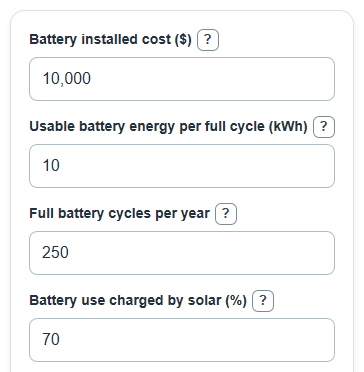
- Enter Battery installed cost, Usable battery energy per full cycle, and Full battery cycles per year from your quote or battery monitoring app.
- Enter Battery use charged by solar, Peak electricity price, Off-peak electricity price, and Export credit from your electric bill or rate plan.
- Open Advanced options if you want to include Round-trip efficiency, Battery energy loss each year, Yearly maintenance cost, Tax credit or rebate, or a different Years to compare.
- Click Calculate and compare Estimated cash payback time with Net value over selected years; a payback longer than your comparison period means the model did not recover the upfront cost in that time.
- Sanity-check the result: if Year 1 peak/off-peak shifting value or Year 1 solar self-consumption value is negative, recheck your rates because exporting or avoiding battery losses may be better for that share.
Definitions
Full battery cycle: One full use of the battery's usable energy. If a 10 kWh usable battery delivers 5 kWh twice, that counts as one full cycle.
Usable battery energy per full cycle: The kWh the battery can deliver to your home in one full cycle, not always the full nameplate size.
Battery use charged by solar: The percent of delivered battery energy that came from solar electricity that otherwise could have been exported.
Export credit: The bill credit or value you get for sending extra solar electricity to the grid.
Round-trip efficiency: The percent of charging energy that comes back out of the battery after losses. At 90%, about 1.11 kWh must go in for 1 kWh to come out.
Peak electricity price: The $ per kWh price during higher-cost hours when the battery powers your home.
Off-peak electricity price: The $ per kWh price during lower-cost hours when grid charging is assumed for the non-solar share.
Net upfront battery cost after credits: Battery installed cost after subtracting the entered Tax credit or rebate percent. Eligibility for tax credits is separate from this math [1].
Common mistakes and quick fixes
Mistake: Entering the post-credit price in Battery installed cost and also entering a Tax credit or rebate.
Fix: Put the before-credit installed price in Battery installed cost, then enter the credit percent only once in Tax credit or rebate.
Mistake: Using nameplate battery size for Usable battery energy per full cycle.
Fix: Use the delivered or usable kWh shown by the installer or battery specs, because some battery capacity is not available for normal use.
Mistake: Treating Full battery cycles per year as charge events instead of full cycles.
Fix: Count two half uses as one full cycle, then enter that yearly total in Full battery cycles per year.
Mistake: Putting the retail solar export value in Peak electricity price instead of Export credit.
Fix: Enter the rate you avoid during battery discharge in Peak electricity price and the credit for exported solar in Export credit.
Mistake: Leaving Battery use charged by solar at 100% when the battery is often charged from the grid.
Fix: Lower Battery use charged by solar so the remaining share is valued with Off-peak electricity price and peak use.
Mistake: Setting Round-trip efficiency to 100% just because the battery is new.
Fix: Use the expected Round-trip efficiency from the battery data sheet or installer estimate; losses matter in both value components.
Limitations & Key Assumptions / Boundary Conditions
- The calculator uses the rates you enter. Real electric bills can include demand charges, fixed fees, tiered pricing, taxes, and utility rules that are not modeled.
- The non-solar share is treated as off-peak grid charging used during peak-price hours. It does not optimize hour-by-hour battery dispatch.
- Battery use charged by solar is a user estimate. A different solar production pattern, home load pattern, or backup-reserve setting can change the split.
- Round-trip efficiency is applied as one average percent. Actual efficiency can vary with power level, temperature, and state of charge.
- Battery energy loss each year is applied evenly at the start of later years. The calculator does not model warranty thresholds, failures, replacements, or repair events.
- Net value over selected years is not discounted for inflation, borrowing cost, or the time value of money.
- Tax credit or rebate is a simple percent reduction. The calculator does not decide eligibility, tax liability, transferability, or timing of any incentive.
- If Year 1 net battery savings is zero or negative, or if cumulative savings do not reach the net upfront cost within Years to compare, a numeric cash payback is not reached.
Methodology
How the battery value is split
The calculator first finds the net upfront cost, then estimates delivered battery energy for each year. The solar-charged share is valued as stored solar that avoids buying peak electricity, but gives up the export credit. The remaining share is valued as off-peak energy shifted to peak hours. Electricity prices and rate structures vary by customer and utility, so the calculator uses your entered rates instead of a utility lookup [2].
net_upfront_cost = battery_cost * (1 - tax_credit_percent / 100)
delivered_y = usable_capacity * cycles_per_year * (1 - annual_capacity_loss_percent / 100)^(y - 1)
solar_delivered_y = delivered_y * solar_charged_percent / 100
grid_delivered_y = delivered_y * (1 - solar_charged_percent / 100)
efficiency_decimal = round_trip_efficiency / 100
self_consumption_value_y = solar_delivered_y * (peak_rate - export_credit / efficiency_decimal)
tou_shifting_value_y = grid_delivered_y * (peak_rate - off_peak_rate / efficiency_decimal)
net_savings_y = self_consumption_value_y + tou_shifting_value_y - annual_maintenance_cost
Payback and selected-year value
Cash payback is the first point where cumulative yearly net savings recover the net upfront cost. If the cost is 0, payback is 0 years. If cumulative savings do not reach the target within Years to compare, the calculator reports that payback is not reached and still shows the selected-year net value.
payback_years = (y - 1) + (net_upfront_cost - cumulative_savings_before_y) / net_savings_y
lifetime_net_value = total_net_savings - net_upfront_cost
cost_per_delivered_kwh = net_upfront_cost / total_delivered_energy
Mini-example
Suppose Battery installed cost is $5,000, Tax credit or rebate is 30%, Usable battery energy per full cycle is 10 kWh, Full battery cycles per year is 250, Battery use charged by solar is 60%, Peak electricity price is $0.30 per kWh, Off-peak electricity price is $0.12 per kWh, Export credit is $0.08 per kWh, Round-trip efficiency is 90%, and Years to compare is 10. Net upfront battery cost after credits is $3,500. Year 1 solar self-consumption value is about $316.67, Year 1 peak/off-peak shifting value is about $166.67, and Year 1 net battery savings is about $483.33. With no battery aging or maintenance in this example, Estimated cash payback time is about 7.24 years, and Net value over selected years is about $1,333.33.