
Estimate radiant barrier cooling-bill savings, DIY and pro payback, and net savings before you ask for quotes.
Table of contents
How to use our Radiant Barrier Savings Calculator
- Choose How do you want to enter cooling cost? based on the information you have: a monthly bill, a cooling-only yearly cost, or cooling kWh and electricity price.
- Enter the matching cost fields, then add Attic or project area and Expected cooling cost drop.
- Open Advanced options if you want to change DIY installed cost, Pro installed cost, Years to compare, or the low and high savings cases.
- Click Calculate and read Simple payback for pro installation first, then compare Estimated yearly cooling savings with the DIY and pro net savings cards.
- Sanity-check the answer: Estimated yearly cooling cost before barrier should be only cooling cost, and a very long payback means the cost assumptions may be too high for the savings assumption.
Definitions
Radiant barrier: A reflective material installed in an attic or roof area to reduce radiant heat moving into the home.
Cooling cost: The part of your electric cost caused by air conditioning or other cooling equipment, not the full electric bill unless cooling is the whole bill.
kWh: Kilowatt-hour, a standard unit for electricity use. The calculator uses Cooling electricity use in kWh per year when you choose the kWh method [1].
Expected cooling cost drop: The percent of cooling cost you expect the radiant barrier to save.
Simple payback: Installed cost divided by yearly cooling savings. It tells about how many years it takes savings to equal the upfront cost.
Net savings: Savings over the selected Years to compare minus installed cost. A negative value means the project has not paid back within that time.
Common mistakes and quick fixes
Mistake: Putting the full yearly electric bill in Annual cooling cost.
Fix: Enter only the cooling part of the bill in Annual cooling cost, or use Average electric bill with Part of the bill used for cooling.
Mistake: Treating Expected cooling cost drop as savings on the whole electric bill.
Fix: Enter the percent drop in cooling cost only for Expected cooling cost drop.
Mistake: Using roof surface area when Attic or project area is meant to match the material area you plan to install.
Fix: Enter the square feet that will actually receive radiant barrier material in Attic or project area.
Mistake: Leaving Electricity price as a base energy rate that excludes per-kWh delivery charges.
Fix: Use the full $ per kWh you pay when using Electricity price.
Mistake: Setting Low-end cooling cost drop higher than High-end cooling cost drop.
Fix: Make Low-end cooling cost drop less than or equal to High-end cooling cost drop.
Mistake: Reading Net savings after chosen years (pro install) as yearly savings.
Fix: Use Estimated yearly cooling savings for one year, and use Net savings after chosen years (pro install) for savings minus install cost over the selected Years to compare.
Limitations & Key Assumptions / Boundary Conditions
- This is a planning estimate for cooling-bill savings only. It does not estimate total electric-bill savings unless cooling is the whole bill.
- Real savings depend on climate, sun exposure, attic ventilation, duct location, existing insulation, roof color, air leaks, thermostat settings, and cooling equipment use.
- The calculator does not use ZIP code, climate zone, roof pitch, humidity, detailed heat-transfer modeling, or utility time-of-use pricing.
- DIY installed cost and Pro installed cost are user-entered assumptions. Replace them with local material prices or contractor quotes when you have them.
- If Expected cooling cost drop is 0 percent, payback is shown as N/A because there are no yearly savings to divide by.
- Negative net savings are valid. They mean the chosen years of savings are less than the estimated installed cost.
Methodology
How the calculator finds the cooling cost base
The calculator first finds Estimated yearly cooling cost before barrier from the entry method you choose. Hidden inputs from other methods are not used.
annual_cooling_cost_before = monthly_electric_bill * 12 * cooling_share_percent / 100
annual_cooling_cost_before = annual_cooling_cost
annual_cooling_cost_before = annual_cooling_kwh * electricity_rate
The kWh method uses kilowatt-hours, a standard electricity-use unit [1].
How savings and costs are calculated
annual_cooling_savings = annual_cooling_cost_before * expected_savings_percent / 100
diy_installed_cost = attic_area_sqft * diy_cost_per_sqft
pro_installed_cost = attic_area_sqft * pro_cost_per_sqft
payback_years = installed_cost / annual_cooling_savings
net_after_years = annual_cooling_savings * compare_years - installed_cost
annual_savings_case = annual_cooling_cost_before * savings_percent_case / 100
If annual_cooling_savings is 0, payback is shown as N/A instead of dividing by zero. Net savings keeps its sign, so a negative value means installed cost is still higher than savings over the chosen years.
Mini example
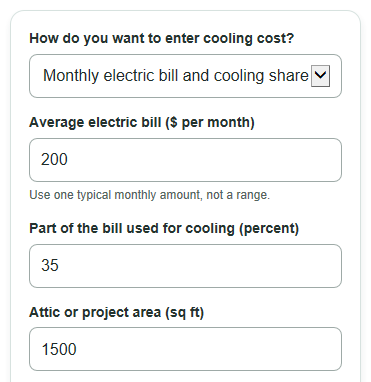
If Average electric bill is $200 per month and Part of the bill used for cooling is 35 percent, the cooling cost base is $200 * 12 * 35 / 100 = $840 per year. With an Expected cooling cost drop of 8 percent, Estimated yearly cooling savings is $840 * 8 / 100 = $67.20 per year. For a 1,500 sq ft project at $1.50 per sq ft pro cost, Estimated pro installed cost is $2,250 and Simple payback for pro installation is $2,250 / $67.20 = 33.48 years. Over 10 years, Net savings after chosen years (pro install) is $67.20 * 10 - $2,250 = -$1,578.